Department of Molecular Biology, University of Texas Southwestern Medical Center, Dallas, TX 75390, USA; Hamon Center for Regenerative Science and Medicine, University of Texas Southwestern Medical Center, Dallas, TX 75390, USA.
Department of Molecular Biology, University of Texas Southwestern Medical Center, Dallas, TX 75390, USA; Hamon Center for Regenerative Science and Medicine, University of Texas Southwestern Medical Center, Dallas, TX 75390, USA.
Curr Opin Genet Dev. 2023 Oct;82:102090. doi: 10.1016/j.gde.2023.102090. Epub 2023 Jul 26.
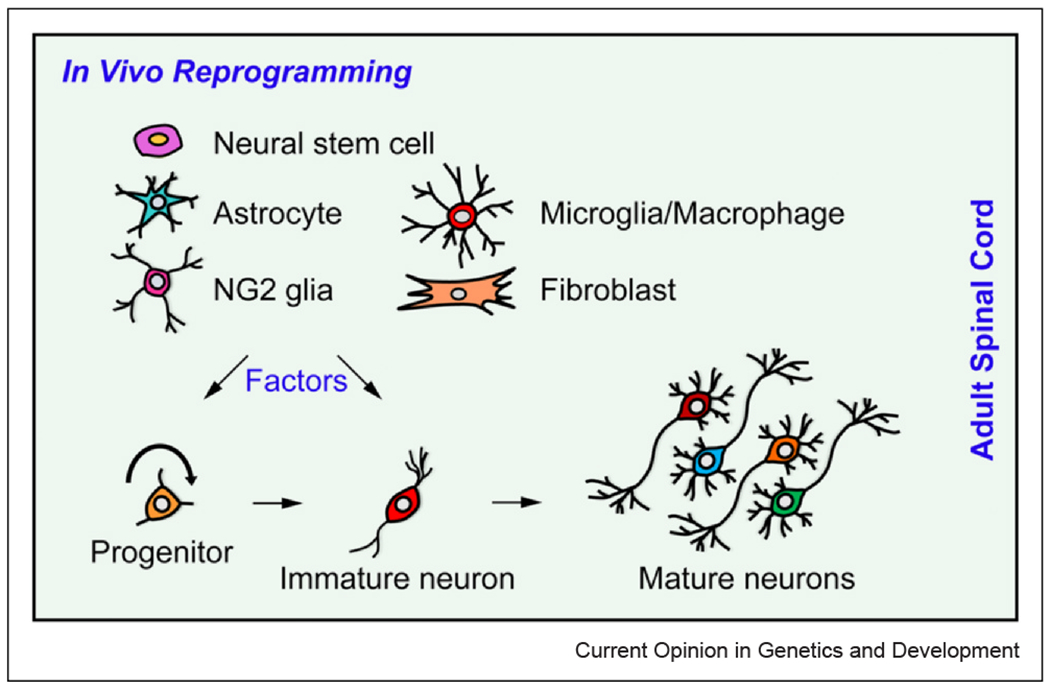
Spinal cord injury (SCI) can lead to the loss of motor, sensory, or autonomic function due to neuronal death. Unfortunately, the adult mammalian spinal cord has limited intrinsic regenerative capacity, making it difficult to rebuild the neural circuits necessary for functional recovery. However, recent evidence suggests that in vivo fate reprogramming of resident cells that are normally non-neurogenic can generate new neurons. This process also improves the pathological microenvironment, and the new neurons can integrate into the local neural network, resulting in better functional outcomes in SCI animal models. In this concise review, we focus on recent advances while also discussing the challenges, pitfalls, and opportunities in the field of in vivo cell fate reprogramming for spinal cord repair.
脊髓损伤 (SCI) 可导致神经元死亡而丧失运动、感觉或自主功能。不幸的是,成年哺乳动物脊髓的内在再生能力有限,难以重建功能恢复所需的神经回路。然而,最近的证据表明,体内对通常非神经生成的常驻细胞进行命运重编程可以产生新的神经元。这一过程还改善了病理性微环境,新的神经元可以整合到局部神经网络中,从而改善 SCI 动物模型的功能结果。在这篇简明的综述中,我们重点介绍了最近的进展,同时也讨论了在体内细胞命运重编程用于脊髓修复领域中的挑战、陷阱和机遇。