Herdea Valeria, Tarciuc Petruta, Ghionaru Raluca, Lupusoru Mircea, Tataranu Elena, Chirila Sergiu, Rosu Oana, Marginean Cristina Oana, Leibovitz Eugene, Diaconescu Smaranda
Doctoral School, "George Emil Palade" University of Medicine, Pharmacy, Science, and Technology of Targu Mures, 540142 Targu Mures, Romania.
Romanian Association for Pediatric Education in Family Medicine, 021507 Bucharest, Romania.
Vaccines (Basel). 2023 Jul 5;11(7):1207. doi: 10.3390/vaccines11071207.
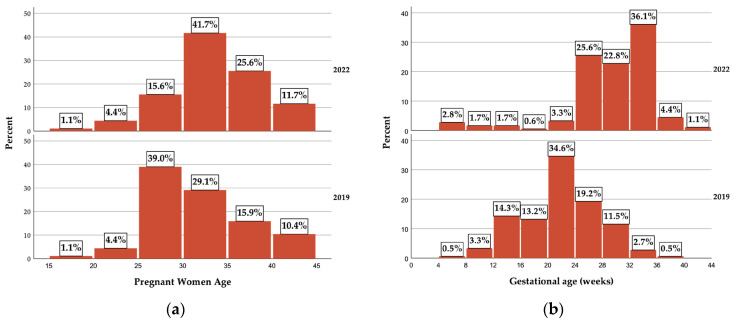
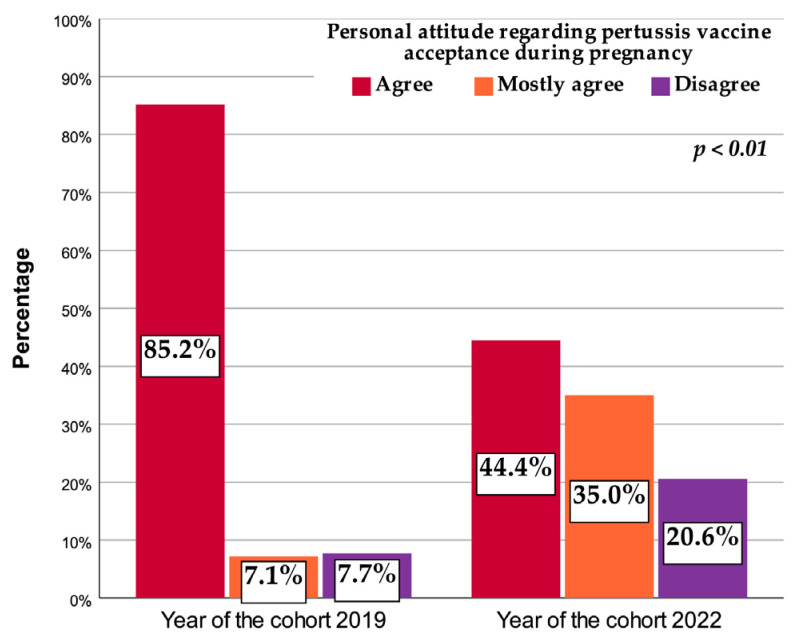
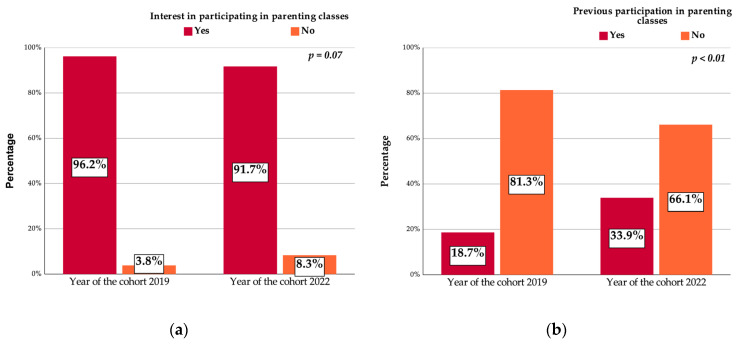
(1) Background: The recent epidemiological events were high-stress level generators for humanity, particularly for pregnant women, influencing their attitude, behavior, and decisions regarding vaccination during pregnancy or regarding their future child. The aim of this study was to analyze the anti-pertussis vaccination decision-shaping factors in pregnant women during two epidemiological periods: the measles epidemic and the COVID-19 pandemic. (2) Methods: Two groups of pregnant women were invited to be part of a medical education program, having as the main theme the infectious disease risks and their prevention through vaccination. Before launching the program, participants received a 12-item questionnaire. From a total number of 362 pregnant women enrolled in the study, 182 participated in 2019, and 180 participated in 2022. (3) Results: The socio-demographic data revealed that the age of pregnant women participating in medical education programs increased in 2022 by 1.7 years ( < 0.01). In vitro fertilization was reported in a significantly higher proportion (20% in 2022 vs 9.8% in 2019, < 0.01). Participation in community-initiated educational programs almost doubled during the pandemic time from 18.7% in 2019 to 33.9% in 2022 ( < 0.01). Pertussis vaccine acceptancy (VA) dropped from 85% in 2019 to 44.4% in 2022 ( < 0.01) (4) Conclusions: In this study, we reported fast-growing vaccine hesitancy and severe declared vaccine reluctance. The results of this complex long-term study, which evaluated pregnant women over several years, showed a five-fold increase in the percentage of pregnant women who disagreed with personal pertussis vaccination. This draws attention to the risks of pertussis epidemic outbreaks in pregnant women and their future infants in the first couple of months of life before the initiation of vaccination.
(1) 背景:近期的流行病学事件对人类来说是高压力源,尤其是对孕妇而言,影响了她们在孕期接种疫苗或关乎未来孩子方面的态度、行为和决策。本研究的目的是分析在两个流行病学时期(麻疹流行期和新冠疫情期)孕妇中影响百日咳疫苗接种决策的因素。(2) 方法:两组孕妇被邀请参加一个以传染病风险及其通过接种疫苗预防为主题的医学教育项目。在项目启动前,参与者收到一份包含12个条目的问卷。在参与研究的362名孕妇中,182人于2019年参与,180人于2022年参与。(3) 结果:社会人口统计学数据显示,参与医学教育项目的孕妇年龄在2022年增加了1.7岁(P<0.01)。报告接受体外受精的比例显著更高(2022年为20%,2019年为9.8%,P<0.01)。在疫情期间,参与社区发起的教育项目的比例几乎翻倍,从2019年的18.7%增至2022年的33.9%(P<0.01)。百日咳疫苗接受率(VA)从2019年的85%降至2022年的44.4%(P<0.01)。(4) 结论:在本研究中,我们报告了疫苗犹豫情绪迅速增长以及严重的明确疫苗抵触情况。这项对孕妇进行数年评估的复杂长期研究结果显示,不同意进行个人百日咳疫苗接种的孕妇比例增加了五倍。这凸显了在孕妇及其出生后头几个月尚未开始接种疫苗的未来婴儿中百日咳疫情爆发的风险。