Agricultural Botany Department, Faculty of Agriculture, Ain Shams University, Hadayek Shubra 11241, P.O. Box 68, Cairo, Egypt.
Agricultural Biochemistry Department, Faculty of Agriculture, Ain Shams University, Hadayek Shubra 11241, P.O. Box 68, Cairo, Egypt.
BMC Plant Biol. 2023 Jul 31;23(1):374. doi: 10.1186/s12870-023-04342-4.
Quinoa (Chenopodium quinoa Willd.) is a facultative halophyte showing various mechanisms of salt resistance among different ecotype cultivars. This study aimed to determine salt resistance limits for a Peruvian sea level ecotype "Hualhuas" and a Bolivian salar ecotype "Real" and elucidate individual mechanisms conferring differences in salt resistance between these cultivars. The plants were grown in sandy soil and irrigated with various saline solutions concentrations (0, 100, 200, 300, 400, and 500 mM NaCl) under controlled conditions.
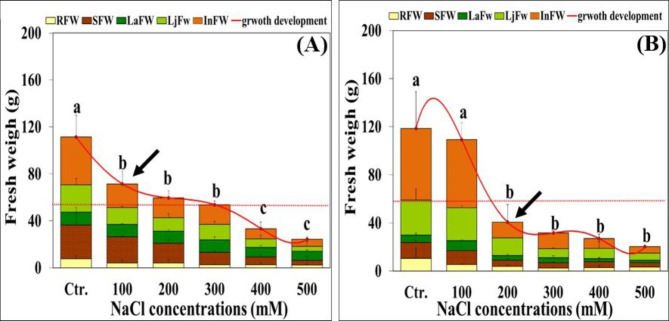
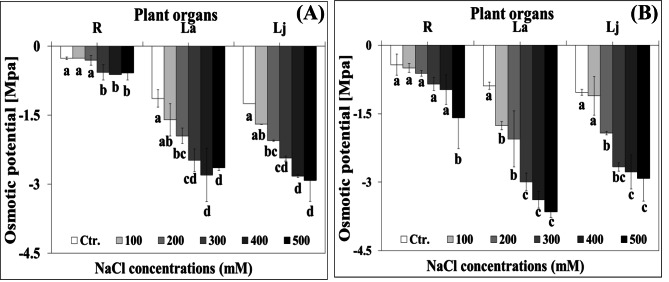
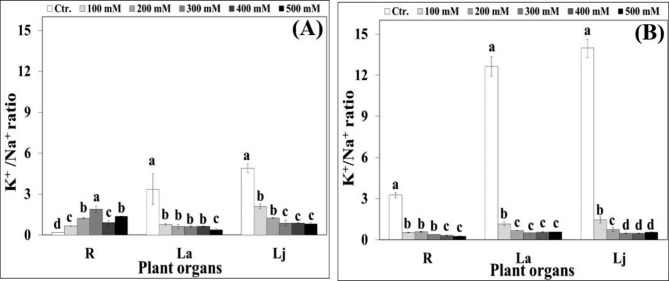
High salinity treatment (500 mM NaCl) reduced the plant growth by 80% and 87% in Hualhuas and Real cultivars, respectively. EC (water salinity which reduces the maximum yield by 50%) was at a salinity of 300 mM NaCl for Hualhuas and between 100 and 200 mM NaCl for Real plants. Both cultivars were able to lower the osmotic potential of all organs due to substantial Na accumulation. However, Hualhuas plants exhibited distinctly lower Na contents and consequently a higher K/Na ratio compared to Real plants, suggesting a more efficient control mechanism for Na loading and better K retention in Hualhuas plants. Net CO assimilation rates (A) were reduced, being only 22.4% and 36.2% of the control values in Hualhuas and Real, respectively, at the highest salt concentration. At this salinity level, Hualhuas plants showed lower stomatal conductance (g) and transpiration rates (E), but higher photosynthetic water use efficiency (PWUE), indicative of an efficient control mechanism over the whole gas-exchange machinery.
These results reveal that Hualhuas is a promising candidate in terms of salt resistance and biomass production compared to Real.
藜麦(Chenopodium quinoa Willd.)是一种兼性盐生植物,在不同生态型品种中表现出各种耐盐机制。本研究旨在确定秘鲁海平面生态型“瓦利亚斯”(Hualhuas)和玻利维亚盐沼生态型“雷亚尔”(Real)的耐盐极限,并阐明导致这些品种间耐盐性差异的个体机制。在受控条件下,将植物种植在沙质土壤中,并以不同的盐水浓度(0、100、200、300、400 和 500 mM NaCl)灌溉。
高盐处理(500 mM NaCl)使 Hualhuas 和 Real 品种的植物生长分别减少了 80%和 87%。Hualhuas 的 EC(降低最大产量 50%的水盐度)在 300 mM NaCl 盐度下,而 Real 植物在 100 至 200 mM NaCl 盐度下。两个品种都能够通过大量的 Na 积累降低所有器官的渗透势。然而,与 Real 植物相比,Hualhuas 植物的 Na 含量明显较低,因此 K/Na 比值较高,表明 Hualhuas 植物对 Na 加载有更有效的控制机制,并且对 K 的保留更好。净 CO 同化率(A)降低,在最高盐浓度下,Hualhuas 和 Real 的 A 值分别仅为对照值的 22.4%和 36.2%。在这个盐度水平下,Hualhuas 植物的气孔导度(g)和蒸腾速率(E)较低,但光合用水效率(PWUE)较高,表明其对整个气体交换机制有有效的控制机制。
与 Real 相比,Hualhuas 在耐盐性和生物量生产方面具有更大的潜力。