Zhao Hairu, Park Bomi, Kim Min-Jung, Hwang Seok-Hyun, Kim Tae-Jong, Kim Seung-Un, Kwon Iksun, Hwang Jae Sung
Department of Genetic & Biotechnology, Graduate School of Biotechnology, College of Life Sciences, Kyung Hee University, Youngin 17104, Republic of Korea.
Research and Development, EVERSPRING Co., Ltd., Seongnam 13207, Republic of Korea.
Biomol Ther (Seoul). 2023 Nov 1;31(6):640-647. doi: 10.4062/biomolther.2023.085. Epub 2023 Aug 1.
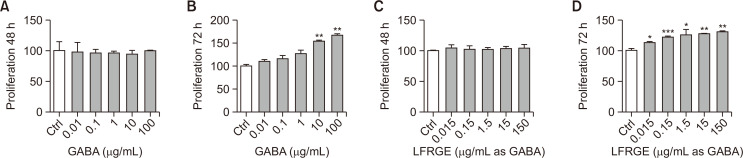
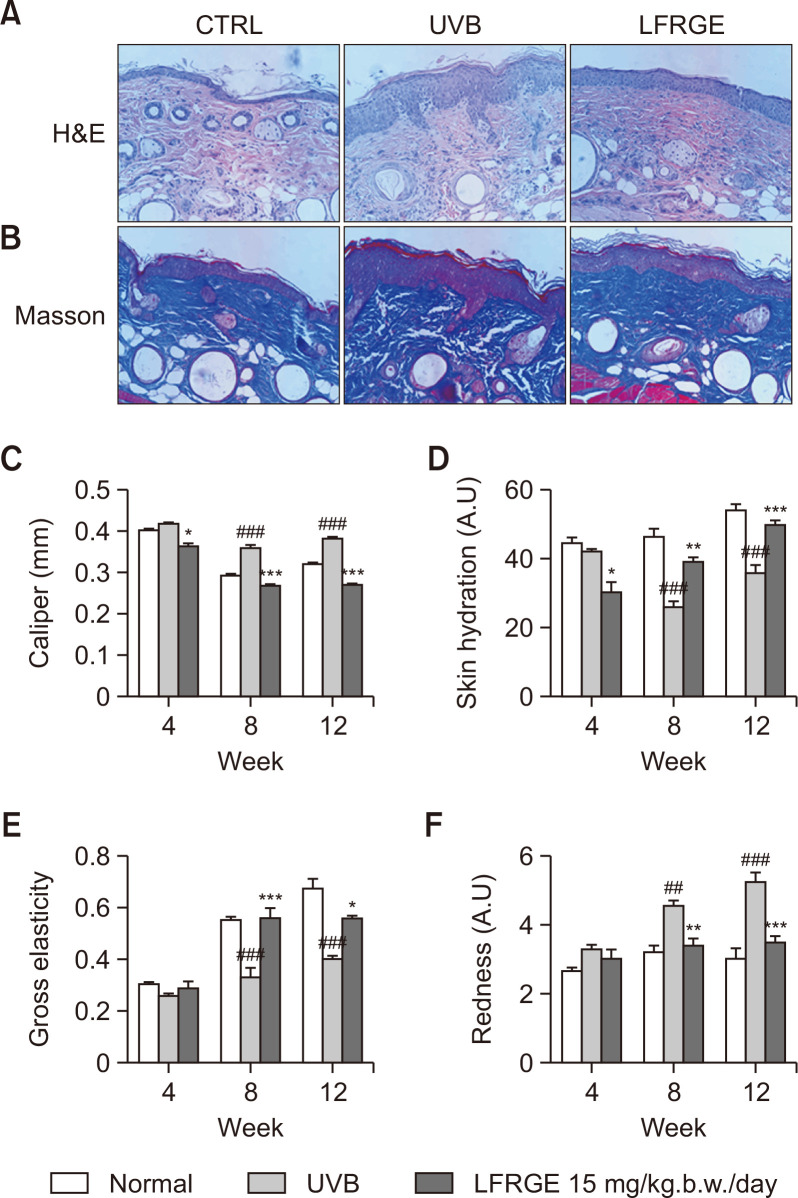
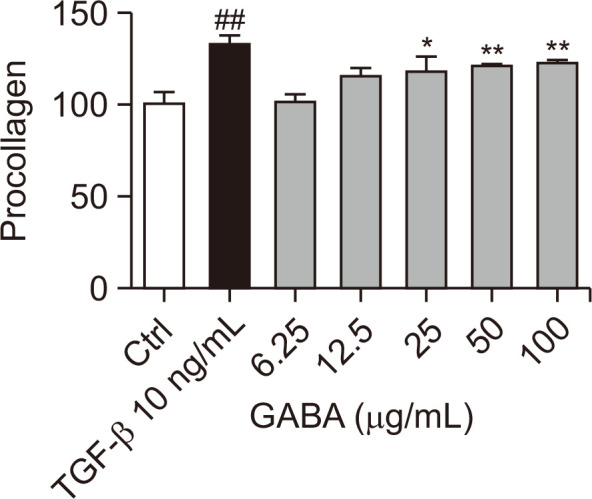
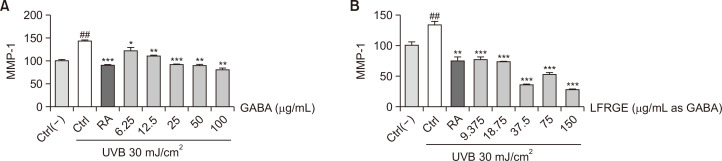
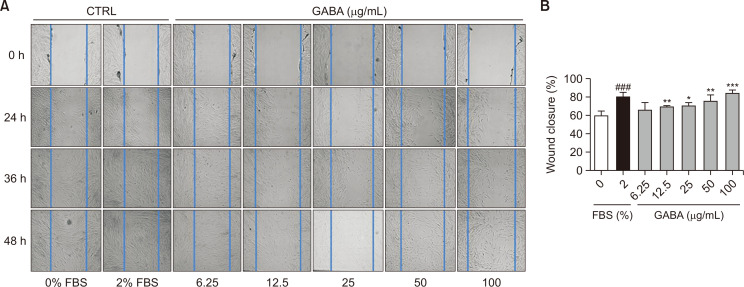
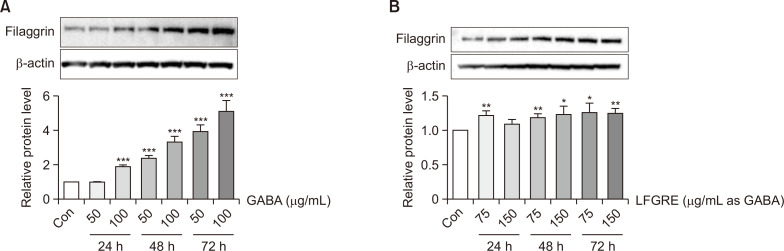
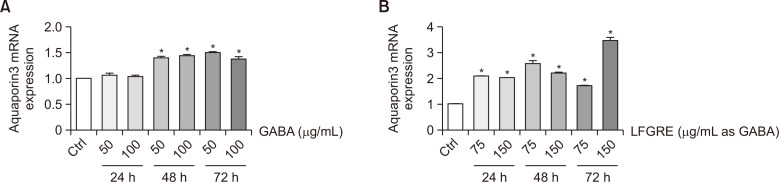
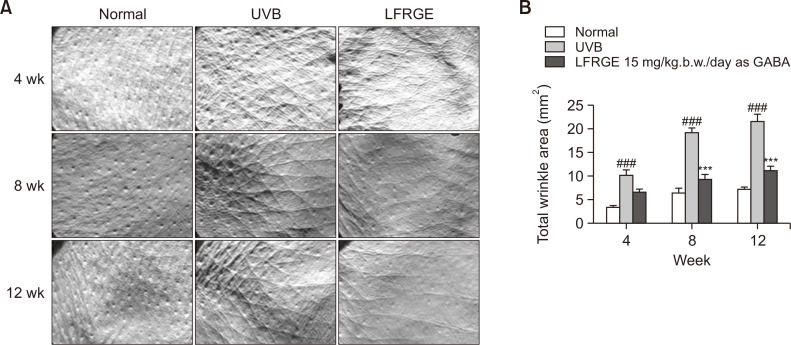
The skin, the largest organ in the body, undergoes age-related changes influenced by both intrinsic and extrinsic factors. The primary external factor is photoaging which causes hyperpigmentation, uneven skin surface, deep wrinkles, and markedly enlarged capillaries. In the human dermis, it decreases fibroblast function, resulting in a lack of collagen structure and also decreases keratinocyte function, which compromises the strength of the protective barrier. In this study, we found that treatment with γ-aminobutyric acid (GABA) had no toxicity to skin fibroblasts and GABA enhanced their migration ability, which can accelerate skin wound healing. UVB radiation was found to significantly induce the production of matrix metalloproteinase 1 (MMP-1), but treatment with GABA resulted in the inhibition of MMP-1 production. We also investigated the enhancement of filaggrin and aquaporin 3 in keratinocytes after treatment with GABA, showing that GABA can effectively improve skin moisturization. experiments showed that oral administration of GABA significantly improved skin wrinkles and epidermal thickness. After the intake of GABA, there was a significant decrease observed in the increase of skin thickness measured by calipers and erythema. Additionally, the decrease in skin moisture and elasticity in hairless mice exposed to UVB radiation was also significantly restored. Overall, this study demonstrates the potential of GABA as functional food material for improving skin aging and moisturizing.
皮肤是人体最大的器官,会受到内在和外在因素的影响而发生与年龄相关的变化。主要的外部因素是光老化,它会导致色素沉着、皮肤表面不平整、深层皱纹以及毛细血管明显扩张。在人类真皮中,光老化会降低成纤维细胞功能,导致胶原蛋白结构缺失,还会降低角质形成细胞功能,从而损害保护屏障的强度。在本研究中,我们发现用γ-氨基丁酸(GABA)处理对皮肤成纤维细胞没有毒性,并且GABA增强了它们的迁移能力,这可以加速皮肤伤口愈合。发现紫外线B辐射能显著诱导基质金属蛋白酶1(MMP-1)的产生,但用GABA处理会导致MMP-1产生受到抑制。我们还研究了用GABA处理后角质形成细胞中聚角蛋白微丝蛋白和水通道蛋白3的增强情况,表明GABA可以有效改善皮肤保湿。实验表明,口服GABA能显著改善皮肤皱纹和表皮厚度。摄入GABA后,用卡尺测量的皮肤厚度增加和红斑现象显著减少。此外,暴露于紫外线B辐射的无毛小鼠皮肤水分和弹性的降低也得到了显著恢复。总体而言,本研究证明了GABA作为改善皮肤老化和保湿的功能性食品原料的潜力。