Department of Critical Care Medicine, Beijing Tiantan Hospital, Capital Medical University, Beijing, China.
Department of Critical Care Medicine, Beijing Shijitan Hospital, Capital Medical University, Beijing, China.
Anesthesiology. 2023 Nov 1;139(5):614-627. doi: 10.1097/ALN.0000000000004721.
There is no widely accepted consensus on the weaning and extubating protocols for neurosurgical patients, leading to heterogeneity in clinical practices and high rates of delayed extubation and extubation failure-related health complications.
In this single-center prospective observational diagnostic study, mechanically ventilated neurosurgical patients with extubation attempts were consecutively enrolled for 1 yr. Responsive physicians were surveyed for the reasons for delayed extubation and developed the Swallowing, Tongue protrusion, Airway protection reflected by spontaneous and suctioning cough, and Glasgow Coma Scale Evaluation (STAGE) score to predict the extubation success for neurosurgical patients already meeting other general extubation criteria.
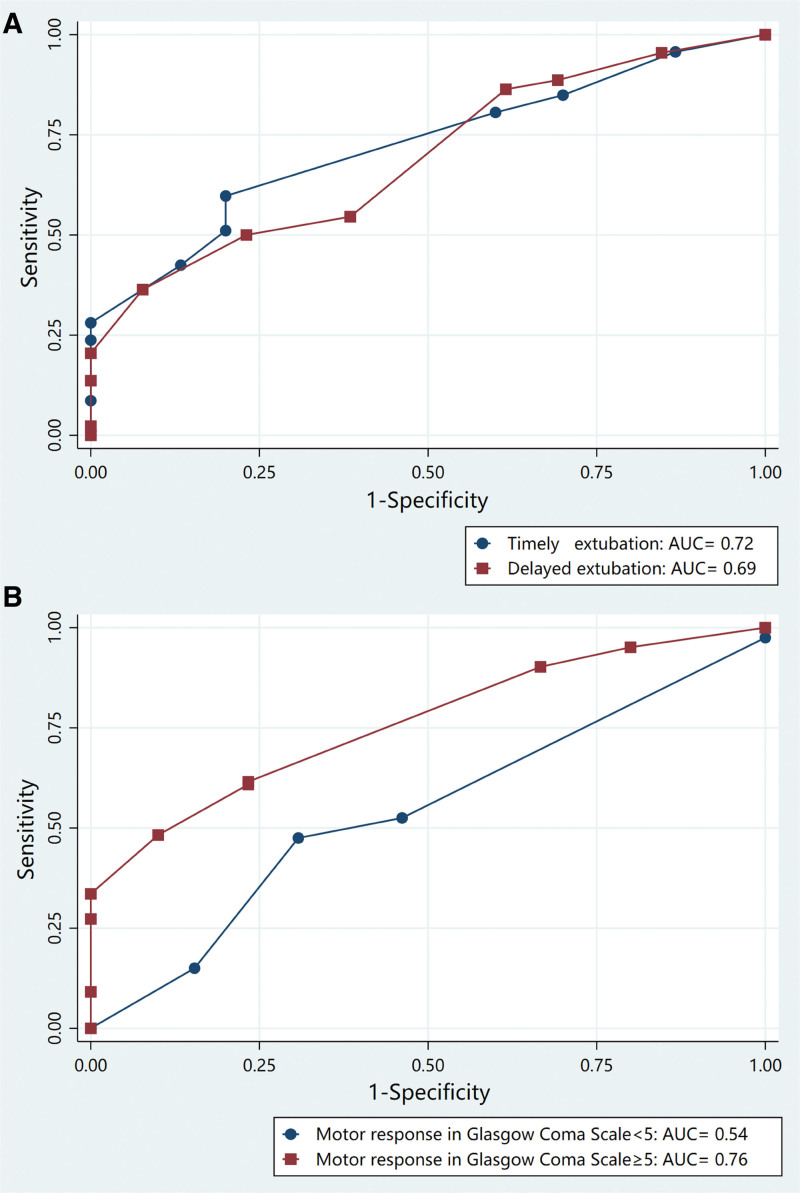
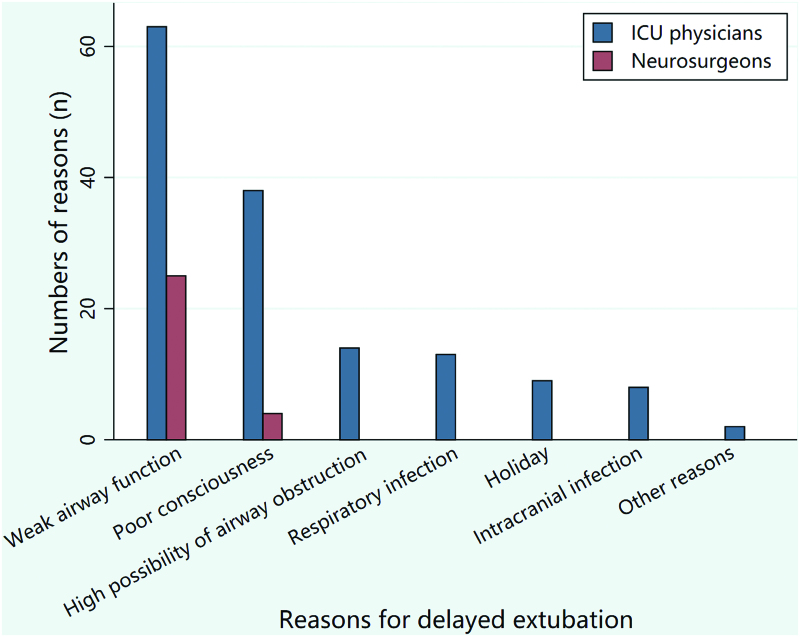
A total of 3,171 patients were screened consecutively, and 226 patients were enrolled in this study. The rates of delayed extubation and extubation failure were 25% (57 of 226) and 19% (43 of 226), respectively. The most common reasons for the extubation delay were weak airway-protecting function and poor consciousness. The area under the receiver operating characteristics curve of the total STAGE score associated with extubation success was 0.72 (95% CI, 0.64 to 0.79). Guided by the highest Youden index, the cutoff point for the STAGE score was set at 6 with 59% (95% CI, 51 to 66%) sensitivity, 74% (95% CI, 59 to 86%) specificity, 90% (95% CI, 84 to 95%) positive predictive value, and 30% (95% CI, 21 to 39%) negative predictive value. At STAGE scores of 9 or higher, the model exhibited a 100% (95% CI, 90 to 100%) specificity and 100% (95% CI, 72 to 100%) positive predictive value for predicting extubation success.
After a survey of the reasons for delayed extubation, the STAGE scoring system was developed to better predict the extubation success rate. This scoring system has promising potential in predicting extubation readiness and may help clinicians avoid delayed extubation and failed extubation-related health complications in neurosurgical patients.
目前对于神经外科患者的撤机和拔管方案尚无广泛认可的共识,导致临床实践存在差异,且拔管延迟和拔管失败相关的健康并发症发生率较高。
在这项单中心前瞻性观察性诊断研究中,连续纳入了 1 年内进行撤机尝试的机械通气神经外科患者。有反应能力的医生对拔管延迟的原因进行了调查,并制定了吞咽、舌伸出、自发性和吸引性咳嗽时气道保护反应,以及格拉斯哥昏迷量表评估(STAGE)评分,以预测已经符合其他一般拔管标准的神经外科患者的拔管成功率。
共连续筛查了 3171 例患者,其中 226 例患者纳入了本研究。拔管延迟和拔管失败的发生率分别为 25%(57/226)和 19%(43/226)。拔管延迟最常见的原因是气道保护功能弱和意识差。与拔管成功相关的总 STAGE 评分的受试者工作特征曲线下面积为 0.72(95%置信区间,0.64 至 0.79)。根据最高 Youden 指数,将 STAGE 评分的截断点设定为 6,此时具有 59%(95%置信区间,51 至 66%)的敏感性、74%(95%置信区间,59 至 86%)的特异性、90%(95%置信区间,84 至 95%)的阳性预测值和 30%(95%置信区间,21 至 39%)的阴性预测值。在 STAGE 评分≥9 分时,该模型对预测拔管成功的特异性为 100%(95%置信区间,90%至 100%),阳性预测值为 100%(95%置信区间,72%至 100%)。
在对拔管延迟的原因进行调查后,制定了 STAGE 评分系统以更好地预测拔管成功率。该评分系统在预测拔管准备情况方面具有很大的潜力,可能有助于临床医生避免神经外科患者的拔管延迟和拔管失败相关的健康并发症。