Zhang Siliang, Chen Long, Gao Jiaxing, Cui Xuewen, Cong Xue, Guo Xudong, Hu Rui, Wang Shuangqing, Chen Jinping, Li Yi, Yang Guoqiang
Beijing National Laboratory for Molecular Sciences, Key Laboratory of Photochemistry, Institute of Chemistry, University of Chinese Academy of Sciences, Chinese Academy of Sciences, Beijing 100190, China.
Key Laboratory of Photochemical Conversion and Optoelectronic Materials, Technical Institute of Physics and Chemistry, University of Chinese Academy of Sciences, Chinese Academy of Sciences, Beijing 100190, China.
ACS Omega. 2023 Jul 23;8(30):26739-26748. doi: 10.1021/acsomega.2c07711. eCollection 2023 Aug 1.
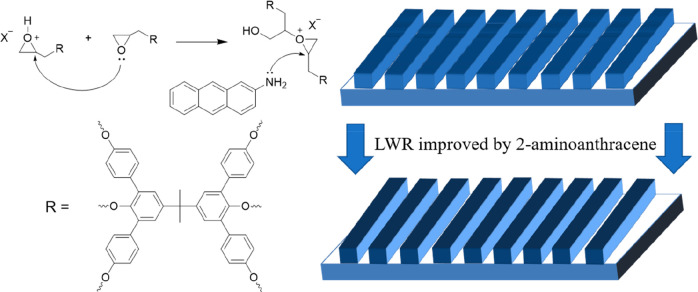
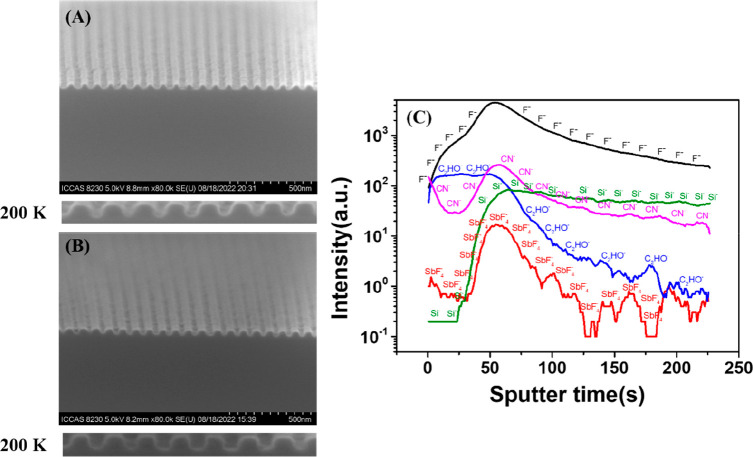
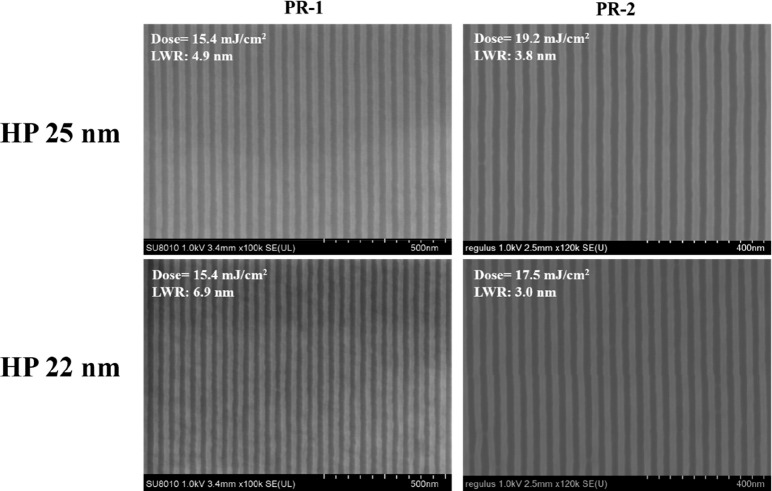
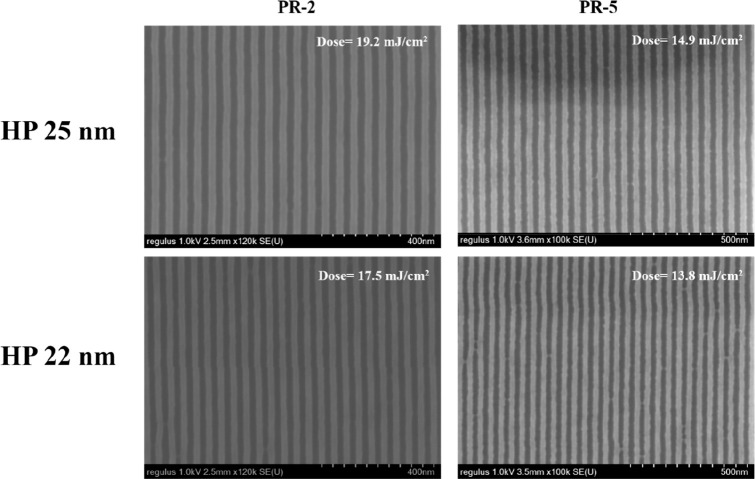
2-Aminoanthracene was used as a nucleophilic additive in a molecular glass photoresist, bisphenol A derivative (BPA-6-epoxy), to improve advanced lithography performance. The effect of 2-aminoanthracene on BPA-6-epoxy was studied by electron beam lithography (EBL) and extreme ultraviolet lithography (EUVL). The result indicates that the additive can optimize the pattern outline by regulating epoxy cross-linking reaction, avoiding photoresist footing effectively in EBL. The EUVL result demonstrates that 2-aminoanthracene can significantly reduce line width roughness (LWR) for HP (Half-Pitch) 25 nm (from 4.9 to 3.8 nm) and HP 22 nm (from 6.9 to 3.0 nm). The power spectrum density (PSD) curve further confirms the reduction of roughness at medium and high frequency for HP 25 nm and the whole range of frequency for HP 22 nm, respectively. The study offers useful guidelines to improve the roughness of a chemically amplified molecular glass photoresist with epoxy groups for electron beam lithography and extreme ultraviolet lithography.
2-氨基蒽被用作分子玻璃光刻胶双酚A衍生物(BPA-6-环氧树脂)中的亲核添加剂,以改善先进光刻性能。通过电子束光刻(EBL)和极紫外光刻(EUVL)研究了2-氨基蒽对BPA-6-环氧树脂的影响。结果表明,该添加剂可通过调节环氧交联反应来优化图案轮廓,在电子束光刻中有效避免光刻胶底部残留。极紫外光刻结果表明,2-氨基蒽可显著降低25纳米半间距(HP)(从4.9纳米降至3.8纳米)和22纳米半间距(从6.9纳米降至3.0纳米)的线宽粗糙度(LWR)。功率谱密度(PSD)曲线进一步分别证实了25纳米半间距在中高频粗糙度的降低以及22纳米半间距在整个频率范围内粗糙度的降低。该研究为改善用于电子束光刻和极紫外光刻的含环氧基团的化学放大分子玻璃光刻胶的粗糙度提供了有用的指导。