Byrd Polar and Climate Research Center, Ohio State University, Columbus, OH, USA.
Department of Microbiology, Ohio State University, Columbus, OH, USA.
Microbiome. 2023 Aug 7;11(1):174. doi: 10.1186/s40168-023-01619-6.
Climate change threatens Earth's ice-based ecosystems which currently offer archives and eco-evolutionary experiments in the extreme. Arctic cryopeg brine (marine-derived, within permafrost) and sea ice brine, similar in subzero temperature and high salinity but different in temporal stability, are inhabited by microbes adapted to these extreme conditions. However, little is known about their viruses (community composition, diversity, interaction with hosts, or evolution) or how they might respond to geologically stable cryopeg versus fluctuating sea ice conditions.
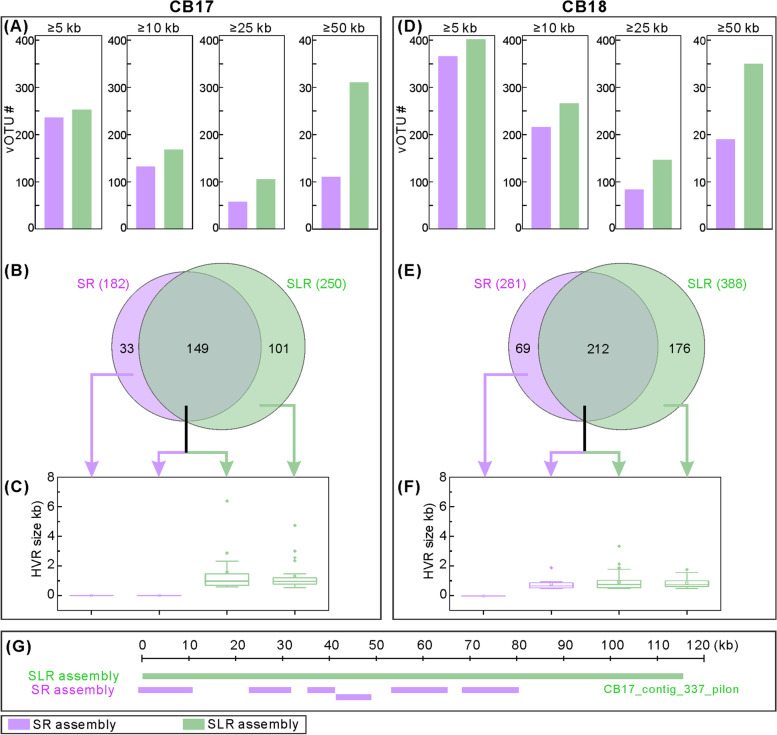
We used long- and short-read viromics and metatranscriptomics to study viruses in Arctic cryopeg brine, sea ice brine, and underlying seawater, recovering 11,088 vOTUs (species-level taxonomic unit), a 4.4-fold increase of known viruses in these brines. More specifically, the long-read-powered viromes doubled the number of longer (≥25 kb) vOTUs generated and recovered more hypervariable regions by >5-fold compared to short-read viromes. Distribution assessment, by comparing to known viruses in public databases, supported that cryopeg brine viruses were of marine origin yet distinct from either sea ice brine or seawater viruses, while 94% of sea ice brine viruses were also present in seawater. A virus-encoded, ecologically important exopolysaccharide biosynthesis gene was identified, and many viruses (half of metatranscriptome-inferred "active" vOTUs) were predicted as actively infecting the dominant microbial genera Marinobacter and Polaribacter in cryopeg and sea ice brines, respectively. Evolutionarily, microdiversity (intra-species genetic variations) analyses suggested that viruses within the stable cryopeg brine were under significantly lower evolutionary pressures than those in the fluctuating sea ice environment, while many sea ice brine virus-tail genes were under positive selection, indicating virus-host co-evolutionary arms races.
Our results confirmed the benefits of long-read-powered viromics in understanding the environmental virosphere through significantly improved genomic recovery, expanding viral discovery and the potential for biological inference. Evidence of viruses actively infecting the dominant microbes in subzero brines and modulating host metabolism underscored the potential impact of viruses on these remote and underexplored extreme ecosystems. Microdiversity results shed light on different strategies viruses use to evolve and adapt when extreme conditions are stable versus fluctuating. Together, these findings verify the value of long-read-powered viromics and provide foundational data on viral evolution and virus-microbe interactions in Earth's destabilized and rapidly disappearing cryosphere. Video Abstract.
气候变化威胁着地球的冰基生态系统,这些生态系统目前为极端环境提供了档案和生态进化实验。北极冷冻盐水(海洋来源,位于永冻层内)和海冰盐水,在亚零温度和高盐度方面相似,但在时间稳定性方面不同,它们都栖息着适应这些极端条件的微生物。然而,人们对它们的病毒(群落组成、多样性、与宿主的相互作用或进化)知之甚少,也不知道它们如何应对地质稳定的冷冻盐水与波动的海冰条件。
我们使用长读长和短读病毒组学和宏转录组学来研究北极冷冻盐水、海冰盐水和底层海水中的病毒,共回收了 11,088 个病毒 OTU(种水平的分类单元),这是这些盐水病毒数量的四倍。具体来说,长读长病毒组学将较长(≥25 kb)病毒 OTU 的数量增加了一倍,并将更多的高变区恢复了超过 5 倍,与短读病毒组学相比。通过与公共数据库中已知病毒的分布评估,支持冷冻盐水病毒来源于海洋,但与海冰盐水或海水病毒不同,而 94%的海冰盐水病毒也存在于海水中。鉴定了一种病毒编码的、生态上重要的胞外多糖生物合成基因,并且许多病毒(宏转录组推断的“活跃”病毒 OTU 的一半)被预测为分别积极感染冷冻盐水和海冰盐水中的优势微生物属 Marinobacter 和 Polaribacter。从进化角度来看,微多样性(种内遗传变异)分析表明,稳定的冷冻盐水内的病毒所受到的进化压力明显低于波动的海冰环境,而许多海冰盐水病毒尾部基因受到正选择,表明病毒-宿主协同进化军备竞赛。
我们的结果通过显著提高基因组回收率,扩大病毒发现范围和潜在的生物学推断,证实了长读长病毒组学在理解环境病毒组方面的优势。证据表明,活跃感染亚零盐水的优势微生物的病毒,以及调节宿主代谢的病毒,强调了病毒对这些偏远和探索不足的极端生态系统的潜在影响。微多样性结果揭示了病毒在极端条件稳定与波动时,用于进化和适应的不同策略。总的来说,这些发现验证了长读长病毒组学的价值,并提供了关于地球不稳定和快速消失的冰冻圈中病毒进化和病毒-微生物相互作用的基础数据。视频摘要。