Human Evolution, Department of Organismal Biology, Uppsala University, 75105, Uppsala, Sweden.
Institute of Human Biology & Evolution, Faculty of Biology, Adam Mickiewicz University in Poznań, 61-614, Poznań, Poland.
Commun Biol. 2023 Aug 9;6(1):793. doi: 10.1038/s42003-023-05131-3.
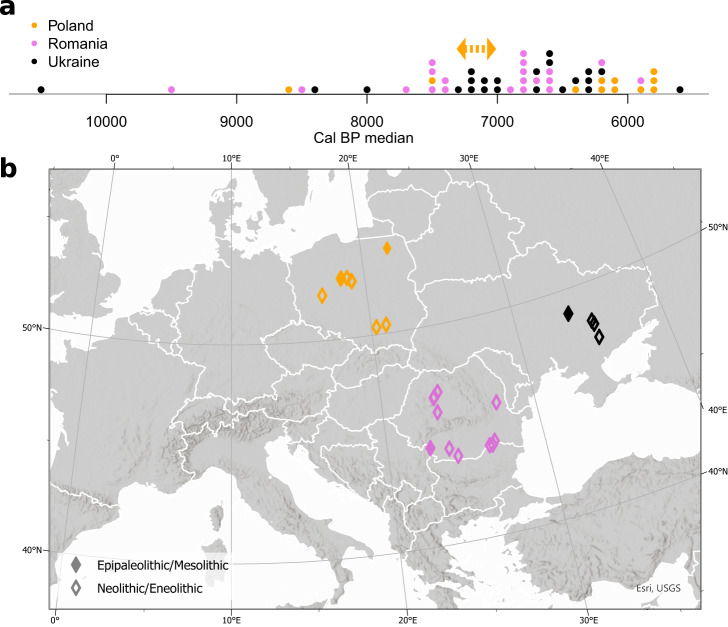
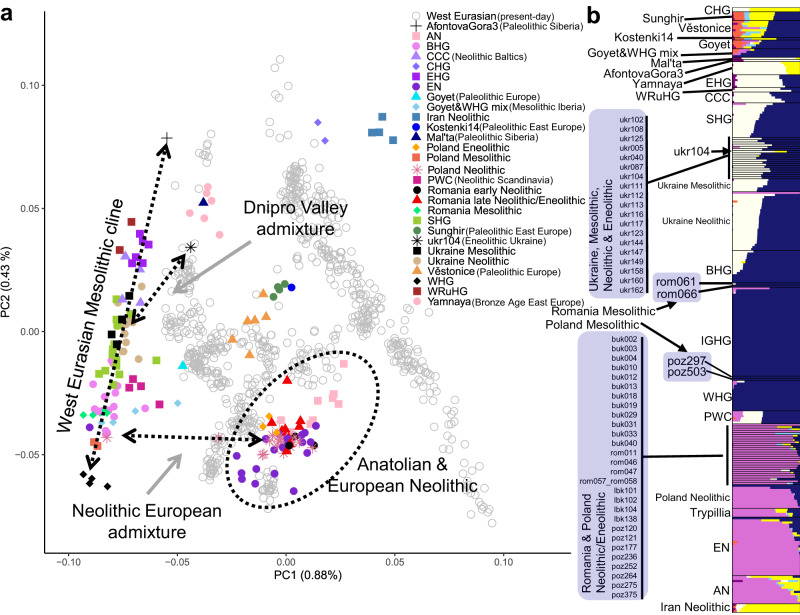
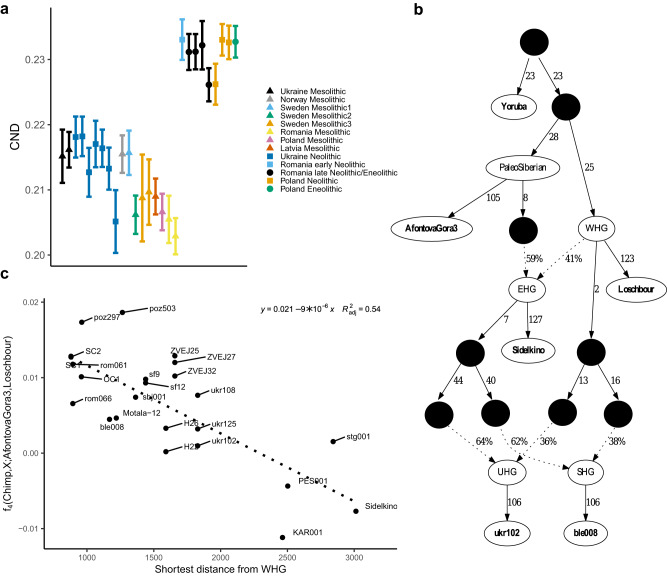
The genomic landscape of Stone Age Europe was shaped by multiple migratory waves and population replacements, but different regions do not all show similar patterns. To refine our understanding of the population dynamics before and after the dawn of the Neolithic, we generated and analyzed genomic sequence data from human remains of 56 individuals from the Mesolithic, Neolithic, and Eneolithic across Central and Eastern Europe. We found that Mesolithic European populations formed a geographically widespread isolation-by-distance zone ranging from Central Europe to Siberia, which was already established 10,000 years ago. We found contrasting patterns of population continuity during the Neolithic transition: people around the lower Dnipro Valley region, Ukraine, showed continuity over 4000 years, from the Mesolithic to the end of the Neolithic, in contrast to almost all other parts of Europe where population turnover drove this cultural change, including vast areas of Central Europe and around the Danube River.
石器时代欧洲的基因组景观是由多次迁徙浪潮和人口更替塑造的,但不同地区并不都呈现出相似的模式。为了更精确地了解新石器时代之前和之后的人口动态,我们从来自中欧和东欧的 56 个人类的中石器时代、新石器时代和铜石并用时代的遗骸中生成并分析了基因组序列数据。我们发现,中石器时代的欧洲人群形成了一个地理上广泛的隔离距离区域,从中欧延伸到西伯利亚,这个区域早在 10000 年前就已经建立了。我们在新石器时代的过渡期间发现了相反的人口连续性模式:乌克兰第聂伯河下游地区的人们在 4000 多年的时间里保持了连续性,从中石器时代一直延续到新石器时代末期,而在欧洲其他几乎所有地区,人口更替推动了这种文化变革,包括中欧的大片地区和多瑙河流域。