Saalfeld Sylvia, Kreher Robert, Hille Georg, Niemann Uli, Hinnerichs Mattes, Öcal Osman, Schütte Kerstin, Zech Christoph J, Loewe Christian, van Delden Otto, Vandecaveye Vincent, Verslype Chris, Gebauer Bernhard, Sengel Christian, Bargellini Irene, Iezzi Roberto, Berg Thomas, Klümpen Heinz J, Benckert Julia, Gasbarrini Antonio, Amthauer Holger, Sangro Bruno, Malfertheiner Peter, Preim Bernhard, Ricke Jens, Seidensticker Max, Pech Maciej, Surov Alexey
Research Campus STIMULATE at the University of Magdeburg, Magdeburg, Germany.
Department of Simulation and Graphics, University of Magdeburg, Magdeburg, Germany.
J Cachexia Sarcopenia Muscle. 2023 Oct;14(5):2301-2309. doi: 10.1002/jcsm.13315. Epub 2023 Aug 17.
Parameters of body composition have prognostic potential in patients with oncologic diseases. The aim of the present study was to analyse the prognostic potential of radiomics-based parameters of the skeletal musculature and adipose tissues in patients with advanced hepatocellular carcinoma (HCC).
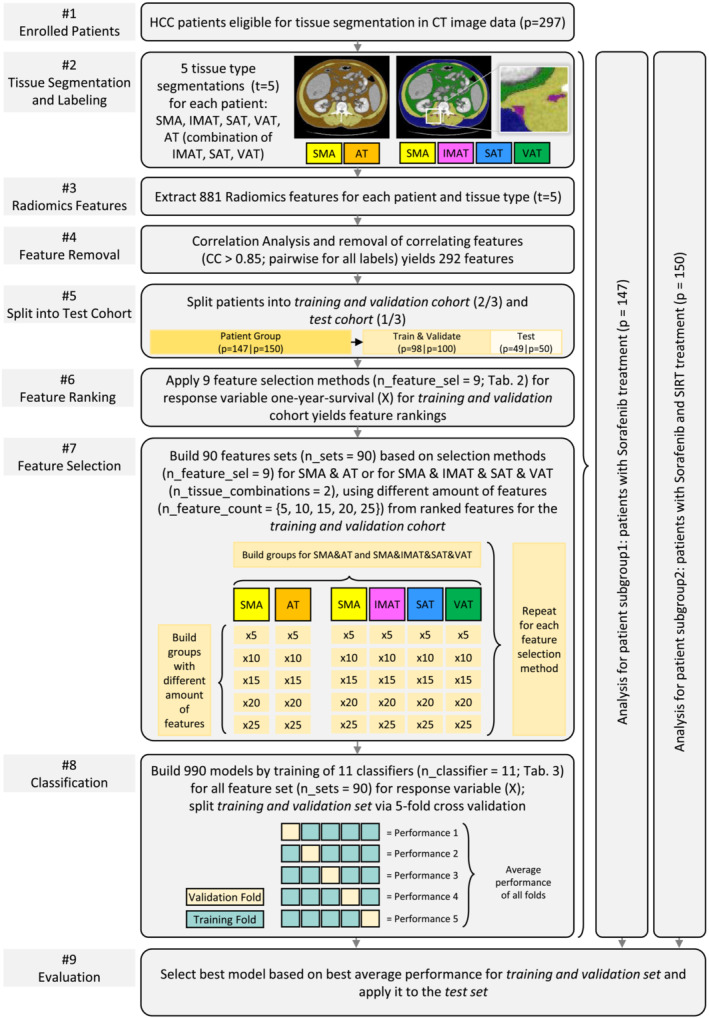
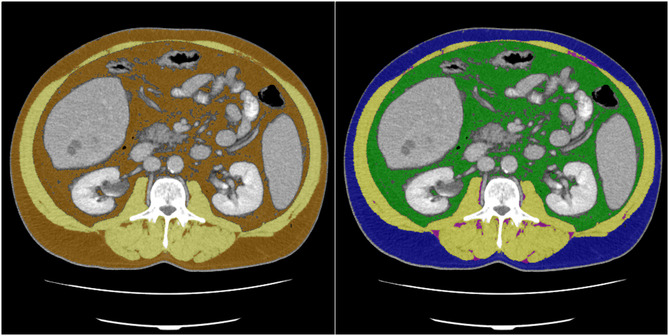
Radiomics features were extracted from a cohort of 297 HCC patients as post hoc sub-study of the SORAMIC randomized controlled trial. Patients were treated with selective internal radiation therapy (SIRT) in combination with sorafenib or with sorafenib alone yielding two groups: (1) sorafenib monotherapy (n = 147) and (2) sorafenib and SIRT (n = 150). The main outcome was 1-year survival. Segmentation of muscle tissue and adipose tissue was used to retrieve 881 features. Correlation analysis and feature cleansing yielded 292 features for each patient group and each tissue type. We combined 9 feature selection methods with 10 feature set compositions to build 90 feature sets. We used 11 classifiers to build 990 models. We subdivided the patient groups into a train and validation cohort and a test cohort, that is, one third of the patient groups.
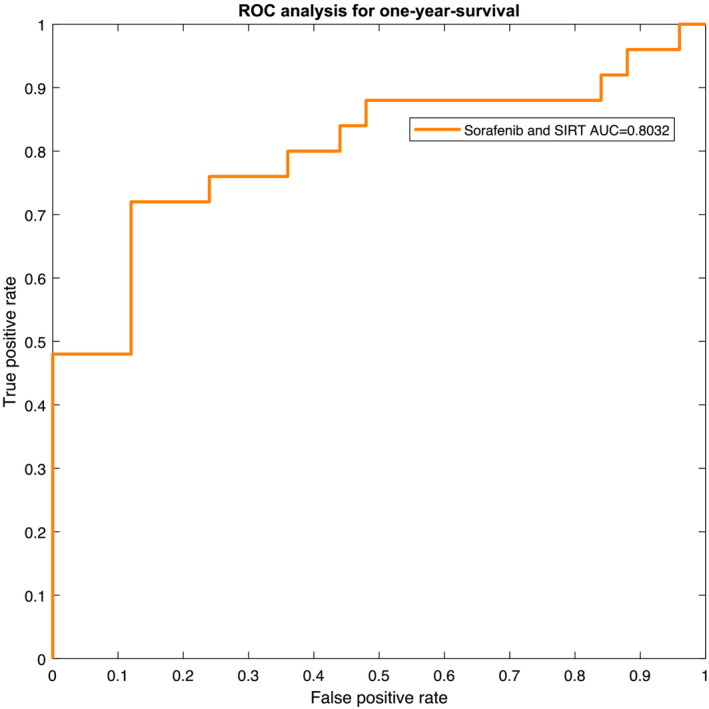
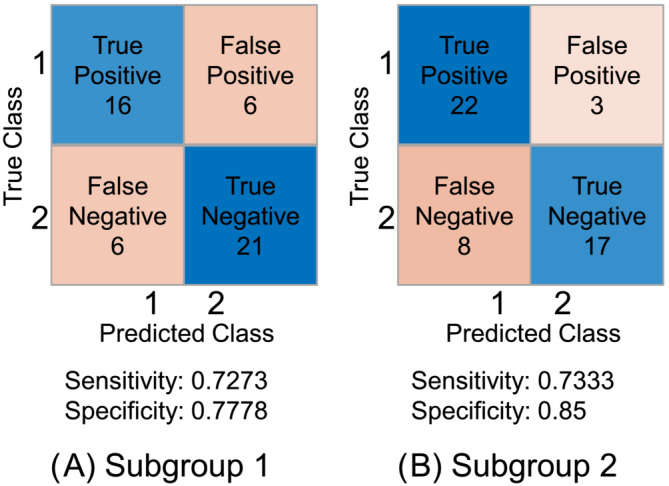
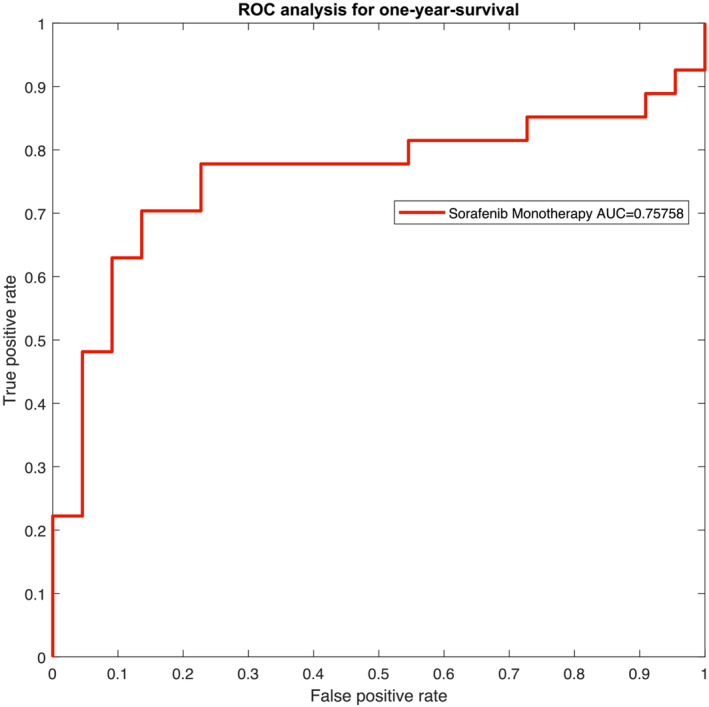
We used the train and validation set to identify the best feature selection and classification model and applied it to the test set for each patient group. Classification yields for patients who underwent sorafenib monotherapy an accuracy of 75.51% and area under the curve (AUC) of 0.7576 (95% confidence interval [CI]: 0.6376-0.8776). For patients who underwent treatment with SIRT and sorafenib, results are accuracy = 78.00% and AUC = 0.8032 (95% CI: 0.6930-0.9134).
Parameters of radiomics-based analysis of the skeletal musculature and adipose tissue predict 1-year survival in patients with advanced HCC. The prognostic value of radiomics-based parameters was higher in patients who were treated with SIRT and sorafenib.
身体成分参数对肿瘤疾病患者具有预后预测潜力。本研究旨在分析基于影像组学的骨骼肌和脂肪组织参数对晚期肝细胞癌(HCC)患者的预后预测潜力。
作为SORAMIC随机对照试验的事后子研究,从297例HCC患者队列中提取影像组学特征。患者接受选择性内放射治疗(SIRT)联合索拉非尼或仅接受索拉非尼治疗,分为两组:(1)索拉非尼单药治疗组(n = 147)和(2)索拉非尼联合SIRT治疗组(n = 150)。主要结局为1年生存率。通过肌肉组织和脂肪组织分割获取881个特征。相关性分析和特征清理后,每个患者组和每种组织类型各得到292个特征。我们将9种特征选择方法与10种特征集组合相结合,构建了90个特征集。使用11种分类器构建了990个模型。我们将患者组细分为训练和验证队列以及测试队列,即患者组的三分之一。
我们使用训练和验证集确定最佳特征选择和分类模型,并将其应用于每个患者组的测试集。索拉非尼单药治疗患者的分类准确率为75.51%,曲线下面积(AUC)为0.7576(95%置信区间[CI]:0.6376 - 0.8776)。接受SIRT和索拉非尼治疗的患者,结果为准确率 = 78.00%,AUC = 0.8032(95% CI:0.6930 - 0.9134)。
基于影像组学的骨骼肌和脂肪组织分析参数可预测晚期HCC患者的1年生存率。在接受SIRT和索拉非尼治疗的患者中,基于影像组学的参数的预后价值更高。