Glavina Ana, Lugović-Mihić Liborija, Martinović Dinko, Cigić Livia, Tandara Leida, Lukenda Marino, Biočina-Lukenda Dolores, Šupe-Domić Daniela
Dental Clinic Split, 21000 Split, Croatia.
Department of Oral Medicine and Periodontology, Study of Dental Medicine, School of Medicine, University of Split, 21000 Split, Croatia.
Biomedicines. 2023 Aug 3;11(8):2182. doi: 10.3390/biomedicines11082182.
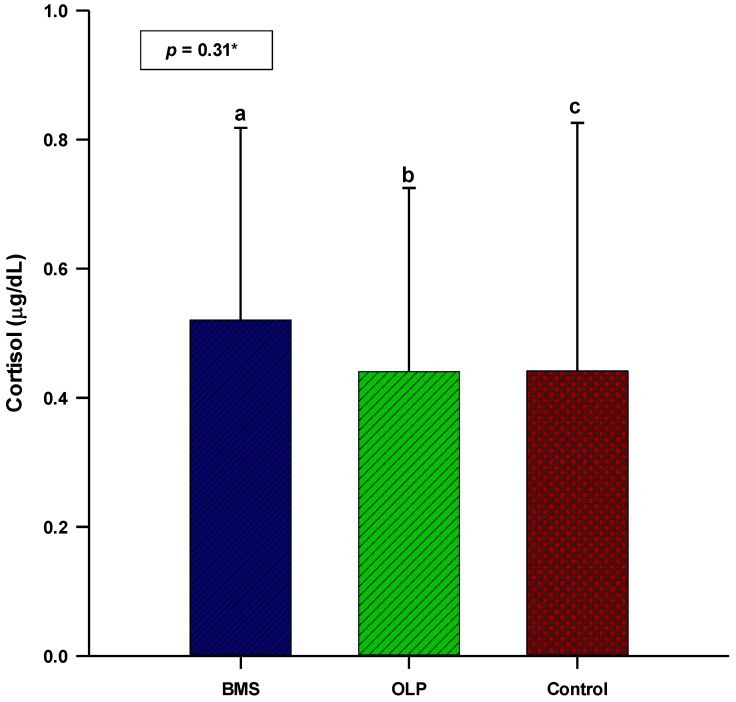
The aim of our study was to assess the relationship between the concentration/activity of salivary stress biomarkers (cortisol, α-amylase) and the psychological profile of patients with oral lichen planus (OLP) and primary burning mouth syndrome (BMS). A total of 160 subjects participated in this case-control study: 60 patients with OLP; 60 patients with primary BMS; and 40 control subjects. Unstimulated whole saliva (UWS) was collected between 9 and 10 a.m. Salivary biomarkers were analyzed by enzyme-linked immunosorbent assays (ELISAs). Psychological assessment was evaluated with the Depression, Anxiety, and Stress Scale (DASS-21). The patients with primary BMS had higher salivary cortisol concentrations and α-amylase activity (0.52 vs. 0.44 µg/dL; 160,531 vs. 145,804 U/L; one-way analysis of variance (ANOVA) with Scheffe test) compared with patients with OLP. The patients with primary BMS had statistically significant higher scores for depression, anxiety, and stress compared with patients with OLP and control subjects ( < 0.001, Kruskal-Wallis test). There was a strong positive correlation between anxiety and depression, stress and depression, and stress and anxiety in patients with OLP and BMS ( < 0.001 and < 0.001, respectively; Spearman's correlation). There was a good positive correlation between symptom intensity (pain/burning) and psychological profile (depression, anxiety, stress) in patients with primary BMS (r = 0.373, = 0.003; r = 0.515, < 0.001; r = 0.365, = 0.004, respectively; Spearman's correlation). This case-control study is the first to compare the psychoendocrinological profile of patients with two different oral diseases. The patients with BMS showed a higher concentration/activity of salivary stress biomarkers (cortisol, α-amylase) and a stronger association with mental disorders compared with patients with OLP. However, an interdisciplinary psychoneuroimmunological approach is equally important in both patient groups (OLP and BMS), regardless of whether mental disorders are the cause or the consequence.
我们研究的目的是评估唾液应激生物标志物(皮质醇、α-淀粉酶)的浓度/活性与口腔扁平苔藓(OLP)患者和原发性灼口综合征(BMS)患者心理状况之间的关系。共有160名受试者参与了这项病例对照研究:60名OLP患者;60名原发性BMS患者;以及40名对照受试者。上午9点至10点之间收集非刺激性全唾液(UWS)。通过酶联免疫吸附测定(ELISA)分析唾液生物标志物。使用抑郁、焦虑和压力量表(DASS-21)进行心理评估。与OLP患者相比,原发性BMS患者的唾液皮质醇浓度和α-淀粉酶活性更高(分别为0.52 vs. 0.44 µg/dL;160,531 vs. 145,804 U/L;采用Scheffe检验的单因素方差分析(ANOVA))。与OLP患者和对照受试者相比,原发性BMS患者在抑郁、焦虑和压力方面的得分在统计学上显著更高(Kruskal-Wallis检验,P < 0.001)。OLP和BMS患者的焦虑与抑郁、压力与抑郁以及压力与焦虑之间存在强正相关(分别为P < 0.001和P < 0.001;Spearman相关性)。原发性BMS患者的症状强度(疼痛/灼痛)与心理状况(抑郁、焦虑、压力)之间存在良好的正相关(分别为r = 0.373,P = 0.003;r = 0.515,P < 0.001;r = 0.365,P = 0.004;Spearman相关性)。这项病例对照研究首次比较了两种不同口腔疾病患者的心理内分泌状况。与OLP患者相比,BMS患者的唾液应激生物标志物(皮质醇、α-淀粉酶)浓度/活性更高,且与精神障碍的关联更强。然而,跨学科的心理神经免疫学方法在这两个患者群体(OLP和BMS)中同样重要,无论精神障碍是病因还是结果。