Department of Cardiology, Shunde Hospital of Guangzhou University of Chinese Medicine, Foshan, Guangdong, 528311, People's Republic of China.
Department of Cardiovascularology, The Second Clinical Medical College of Guangzhou, University of Traditional Chinese Medicine, No. 12, Jinshada Road, Daliang Town, Shunde District, Guangzhou, Guangdong, 510006, People's Republic of China.
BMC Endocr Disord. 2023 Aug 29;23(1):185. doi: 10.1186/s12902-023-01412-4.
This study was to explore the association between dietary polyunsaturated fatty acids (PUFAs) consumption and cardiovascular diseases (CVDs), all-cause mortality, and CVD-specific mortality.
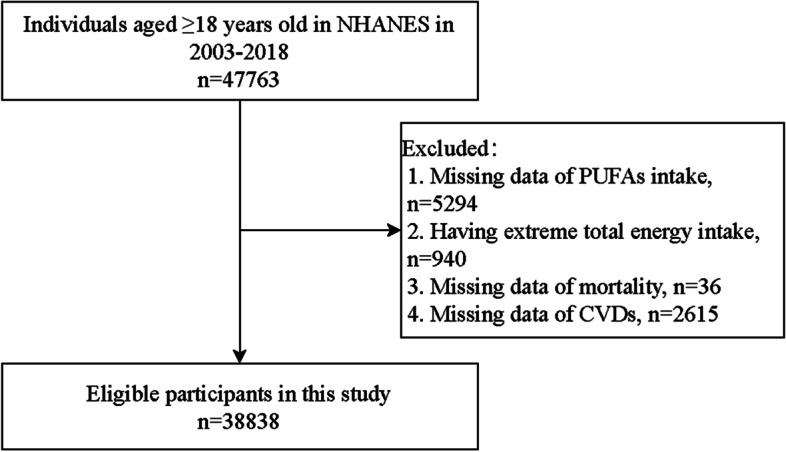
This retrospective cohort study extracted demographic and clinical data of 38,838 adult participants from the National Health and Nutrition Examination Survey (NHANES) database in 2003-2018. We explored the association between octadecadienoic acid (ODA), octadecatrienoic acid (ALA), octadecatetraenoic acid (ODTA), eicosatetraenoic acid (AA), eicosapentaenoic acid (EPA), docosapentaenoic acid (DPA), and docosahexaenoic acid (DHA) and different CVDs using weighted univariate and multivariate logistic regression analyses with odds ratio (OR) and 95% confidence interval (CI). The PUFAs were divided into four levels according to the quartiles (≤ Q1, Q1 to Q2, Q1 to Q2, > Q3). Weighted univariate and multivariate COX regression analyses with hazard ratio (HR) and 95% CI were used for exploring the association between PUFAs and all-cause mortality, CVD-specific mortality and other cause-specific mortality.
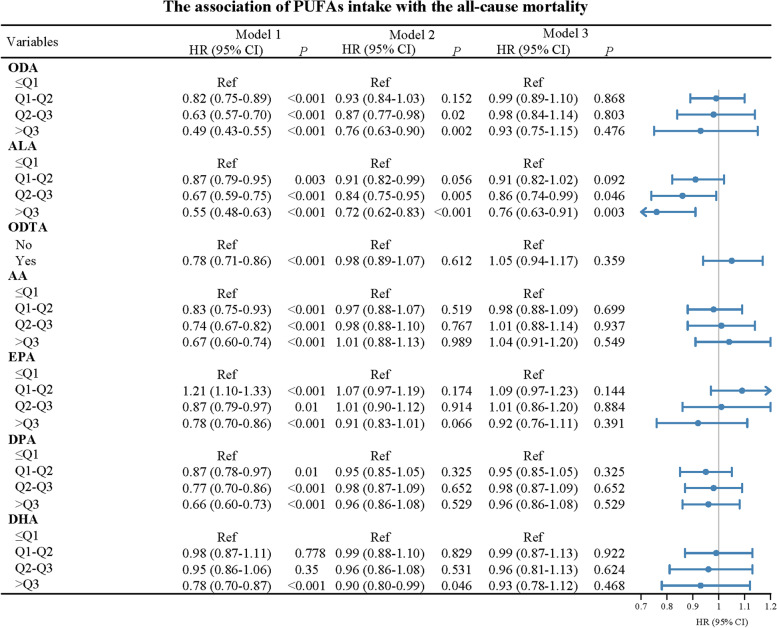
During the follow-up, a total of 4,908 (9.12%) eligible participants died. The results showed that after adjusting for covariates, ODTA intake was related to low odds of coronary heart disease (CHD) [OR = 0.75, 95%CI: (0.64-0.88)]. Q1-Q2 quartile of ALA [OR = 0.81, 95%CI: (0.66-0.99)] and Q2-Q3 quartile of DPA [OR = 0.78, 95%CI: (0.62-0.99)] intakes were linked to low odds of heart attack, and > Q3 quartile of ODA intake was associated with low odds of congestive heart failure (CHF) [OR = 0.66, 95%CI: (0.49-0.90)] and stroke [OR = 0.65, 95%CI: (0.47-0.90)]. Q2-Q3 quartile of DPA intake was linked to low odds of angina [OR = 0.76, 95%CI: (0.58-0.99)]. Higher ALA intake was associated with a lower risk of all-cause mortality [Q2-Q3: HR = 0.86, 95%CI: (0.74-0.99); > Q3: HR = 0.76, 95%CI: (0.63-0.91)]. Additionally, Q2-Q3 quartile of ALA, Q1-Q2 quartile of AA and DPA intakes were respectively related to a low risk of CVD-specific mortality, while that > Q3 quartile of ALA related to that of mortality by other causes.
Our study found that PUFAs were associated with different CVDs, and higher ALA intake was related to lower risk of all-cause mortality. Ensuring adequate intake of PUFAs was beneficial to the health and may decrease the risk of mortality.
本研究旨在探讨膳食多不饱和脂肪酸(PUFAs)的摄入与心血管疾病(CVDs)、全因死亡率和 CVD 特异性死亡率之间的关系。
本回顾性队列研究从 2003 年至 2018 年的国家健康与营养调查(NHANES)数据库中提取了 38838 名成年参与者的人口统计学和临床数据。我们使用加权单变量和多变量逻辑回归分析(比值比(OR)和 95%置信区间(CI))来探讨十八碳二烯酸(ODA)、十八碳三烯酸(ALA)、十八碳四烯酸(ODTA)、二十碳四烯酸(AA)、二十碳五烯酸(EPA)、二十二碳五烯酸(DPA)和二十二碳六烯酸(DHA)与不同 CVD 之间的关系。根据四分位数(Q1 到 Q4)将 PUFAs 分为四组(≤Q1、Q1 到 Q2、Q1 到 Q2、>Q3)。使用加权单变量和多变量 COX 回归分析(风险比(HR)和 95%CI)来探讨 PUFAs 与全因死亡率、CVD 特异性死亡率和其他原因特异性死亡率之间的关系。
在随访期间,共有 4908 名(9.12%)符合条件的参与者死亡。结果表明,在调整了协变量后,ODTA 的摄入与冠心病(CHD)的低发病风险相关[OR=0.75,95%CI:(0.64-0.88)]。ALA 的 Q1-Q2 四分位数[OR=0.81,95%CI:(0.66-0.99)]和 DPA 的 Q2-Q3 四分位数[OR=0.78,95%CI:(0.62-0.99)]与心脏病发作的低发病风险相关,而 ODA 的>Q3 四分位数与充血性心力衰竭(CHF)[OR=0.66,95%CI:(0.49-0.90)]和中风[OR=0.65,95%CI:(0.47-0.90)]的低发病风险相关。DPA 的 Q2-Q3 四分位数与心绞痛的低发病风险相关[OR=0.76,95%CI:(0.58-0.99)]。较高的 ALA 摄入量与全因死亡率降低相关[Q2-Q3:HR=0.86,95%CI:(0.74-0.99);>Q3:HR=0.76,95%CI:(0.63-0.91)]。此外,ALA 的 Q2-Q3 四分位数、AA 和 DPA 的 Q1-Q2 四分位数分别与 CVD 特异性死亡率降低相关,而 ALA 的>Q3 四分位数与其他原因死亡率降低相关。
本研究发现 PUFAs 与不同的 CVD 相关,较高的 ALA 摄入量与全因死亡率降低相关。确保 PUFAs 的充足摄入有益于健康,并可能降低死亡率。