Department of Healthcare Management, School of Economics and Management, Technical University Berlin, Berlin, Germany.
Department of Orthopedics, VAMED Ostseeklinik Damp, Damp, Germany.
JAMA Netw Open. 2023 Sep 5;6(9):e2331301. doi: 10.1001/jamanetworkopen.2023.31301.
Although remote patient-reported outcome measure (PROM) monitoring has shown promising results in cancer care, there is a lack of research on PROM monitoring in orthopedics.
To determine whether PROM monitoring can improve health outcomes for patients with joint replacement compared with the standard of care.
DESIGN, SETTING, AND PARTICIPANTS: A 2-group, patient-level randomized clinical trial (PROMoting Quality) across 9 German hospitals recruited patients aged 18 years or older with primary hip or knee replacement from October 1, 2019, to December 31, 2020, with follow-up until March 31, 2022.
Intervention and control groups received the standard of care and PROMs at hospital admission, discharge, and 12 months after surgery. In addition, the intervention group received PROMs at 1, 3, and 6 months after surgery. Based on prespecified PROM score thresholds, at these times, an automated alert signaled critical recovery paths to hospital study nurses. On notification, study nurses contacted patients and referred them to their physicians if necessary.
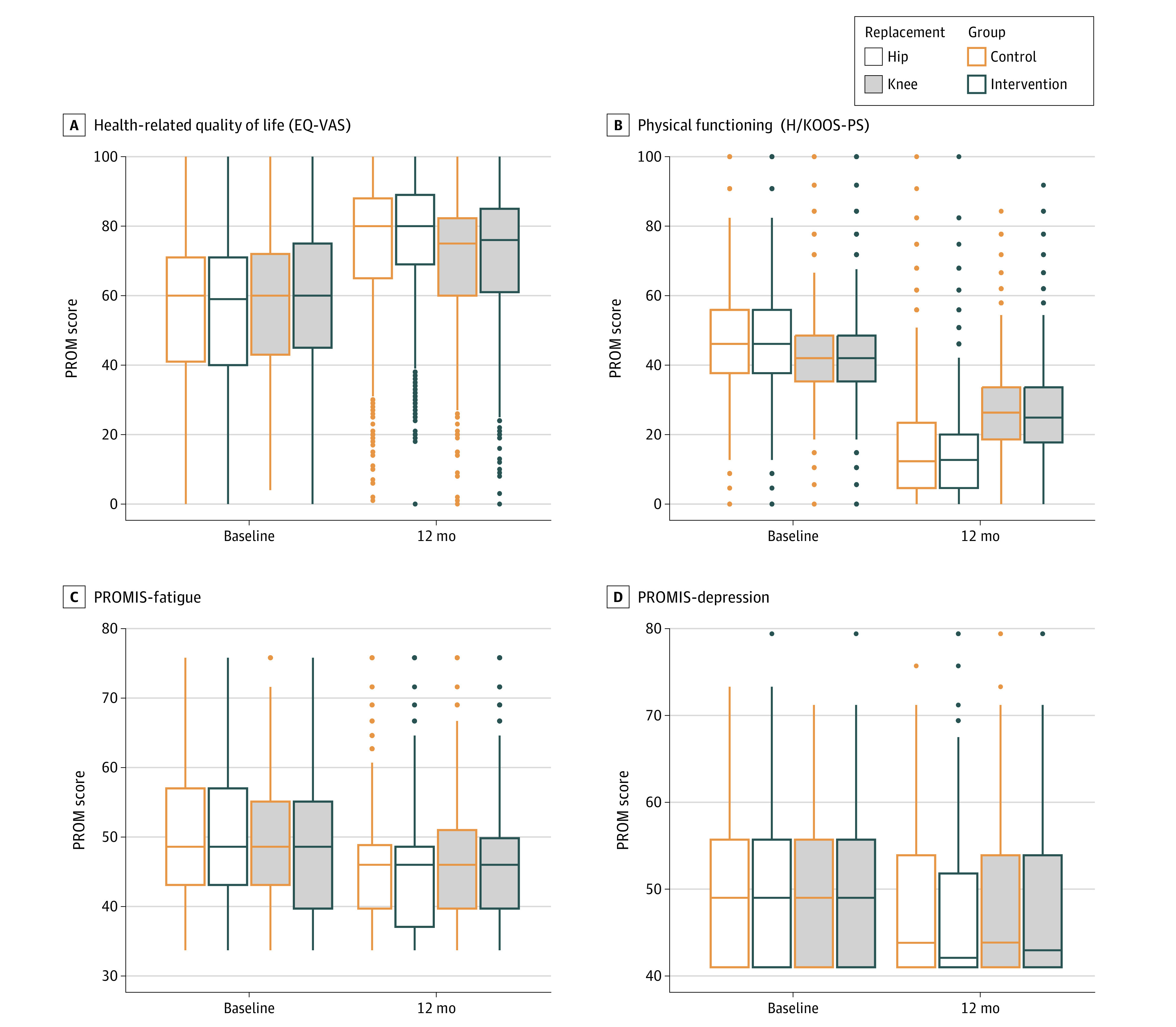
The prespecified outcomes were the mean change in PROM scores (European Quality of Life 5-Dimension 5-Level version [EQ-5D-5L; range, -0.661 to 1.0, with higher values indicating higher levels of health-related quality of life (HRQOL)], European Quality of Life Visual Analogue Scale [EQ-VAS; range, 0-100, with higher values indicating higher levels of HRQOL], Hip Disability and Osteoarthritis Outcome Score-Physical Function Shortform [HOOS-PS; range, 0-100, with lower values indicating lower physical impairment] or Knee Injury and Osteoarthritis Outcome Score-Physical Function Shortform [KOOS-PS; range, 0-100, with lower values indicating lower physical impairment], Patient-Reported Outcomes Measurement Information System [PROMIS]-fatigue [range, 33.7-75.8, with lower values indicating lower levels of fatigue], and PROMIS-depression [range, 41-79.4, with lower values indicating lower levels of depression]) from baseline to 12 months after surgery. Analysis was on an intention-to-treat basis.
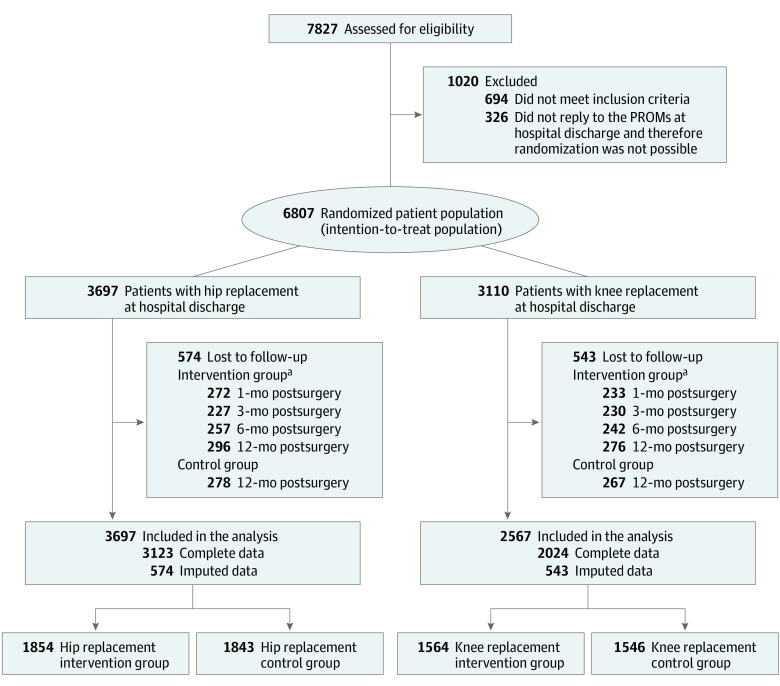
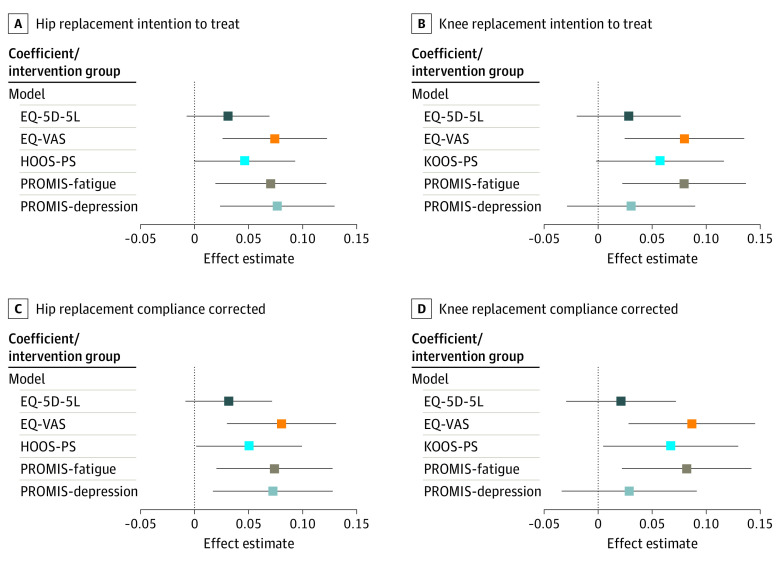
The study included 3697 patients with hip replacement (mean [SD] age, 65.8 [10.6] years; 2065 women [55.9%]) and 3110 patients with knee replacement (mean [SD] age, 66.0 [9.2] years; 1669 women [53.7%]). Exploratory analyses showed significantly better health outcomes in the intervention group on all PROMs except the EQ-5D-5L among patients with hip replacement, with a 2.10-point increase on the EQ-VAS in the intervention group compared with the control group (HOOS-PS, -1.86 points; PROMIS-fatigue, -0.69 points; PROMIS-depression, -0.57 points). Patients in the intervention group with knee replacement had a 1.24-point increase on the EQ-VAS, as well as significantly better scores on the KOOS-PS (-0.99 points) and PROMIS-fatigue (-0.84 points) compared with the control group. Mixed-effect models showed a significant difference in improvement on the EQ-VAS (hip replacement: effect estimate [EE], 1.66 [95% CI, 0.58-2.74]; knee replacement: EE, 1.71 [95% CI, 0.53-2.90]) and PROMIS-fatigue (hip replacement: EE, -0.65 [95% CI, -1.12 to -0.18]; knee replacement: EE, -0.71 [95% CI, -1.23 to -0.20]). The PROMIS-depression score was significantly reduced in the hip replacement group (EE, -0.60 [95% CI, -1.01 to -0.18]).
In this randomized clinical trial, the PROM-based monitoring intervention led to a small improvement in HRQOL and fatigue among patients with hip or knee replacement, as well as in depression among patients with hip replacement.
Deutsches Register Klinischer Studien ID: DRKS00019916.
重要性:尽管远程患者报告结局测量(PROM)监测在癌症护理中显示出了有前景的结果,但在矫形外科中,PROM 监测的研究还很缺乏。
目的:确定与标准护理相比,PROM 监测是否可以改善关节置换患者的健康结局。
设计、地点和参与者:一项在德国 9 家医院进行的 2 组、患者水平的随机临床试验(PROMoting Quality),于 2019 年 10 月 1 日至 12 月 31 日期间招募了原发性髋关节或膝关节置换术的年龄在 18 岁及以上的患者,随访至 2022 年 3 月 31 日。
干预措施:干预组和对照组在入院、出院时以及手术后 12 个月接受标准护理和 PROM。此外,干预组在手术后 1、3 和 6 个月时接受 PROM。根据预先规定的 PROM 评分阈值,在这些时间点,自动警报信号向医院研究护士发出关键康复路径。接到通知后,研究护士会联系患者,并在必要时将其转介给医生。
主要结果和测量:预设的结果是 PROM 评分的平均变化(欧洲生活质量 5 维度 5 水平版 [EQ-5D-5L;范围为-0.661 至 1.0,分数越高表示健康相关生活质量越高 (HRQOL)]、欧洲生活质量视觉模拟量表 [EQ-VAS;范围为 0 至 100,分数越高表示 HRQOL 越高]、髋关节功能障碍和骨关节炎结局评分-物理功能简明量表 [HOOS-PS;范围为 0 至 100,分数越低表示身体损伤越低] 或膝关节损伤和骨关节炎结局评分-物理功能简明量表 [KOOS-PS;范围为 0 至 100,分数越低表示身体损伤越低]、患者报告的结果测量信息系统 [PROMIS]-疲劳 [范围为 33.7 至 75.8,分数越低表示疲劳程度越低] 和 PROMIS-抑郁 [范围为 41 至 79.4,分数越低表示抑郁程度越低])从基线到手术后 12 个月。分析基于意向治疗原则。
结果:该研究纳入了 3697 例髋关节置换患者(平均[标准差]年龄为 65.8[10.6]岁;2065 名女性[55.9%])和 3110 例膝关节置换患者(平均[标准差]年龄为 66.0[9.2]岁;1669 名女性[53.7%])。探索性分析显示,在髋关节置换患者中,干预组在所有 PROM 上的健康结局均显著改善,除了 EQ-5D-5L 外,与对照组相比,干预组的 EQ-VAS 增加了 2.10 分(HOOS-PS,-1.86 分;PROMIS-疲劳,-0.69 分;PROMIS-抑郁,-0.57 分)。接受膝关节置换的患者,EQ-VAS 增加了 1.24 分,KOOS-PS(-0.99 分)和 PROMIS-疲劳(-0.84 分)的评分也显著改善,与对照组相比。混合效应模型显示,EQ-VAS(髋关节置换:效应估计 [EE],1.66 [95%置信区间,0.58-2.74];膝关节置换:EE,1.71 [95%置信区间,0.53-2.90])和 PROMIS-疲劳(髋关节置换:EE,-0.65 [95%置信区间,-1.12 至 -0.18];膝关节置换:EE,-0.71 [95%置信区间,-1.23 至 -0.20])的改善有显著差异。髋关节置换患者的 PROMIS-抑郁评分显著降低(EE,-0.60 [95%置信区间,-1.01 至 -0.18])。
结论和相关性:在这项随机临床试验中,基于 PROM 的监测干预措施导致髋关节或膝关节置换患者的 HRQOL 和疲劳略有改善,髋关节置换患者的抑郁也有所改善。
试验注册:德国临床试验注册中心 ID:DRKS00019916。