Department of Rheumatology, The First Hospital of Jilin University, Changchun, People's Republic of China.
Department of Laboratory Medicine, Suzhou Municipal Hospital, The Affiliated Suzhou Hospital of Nanjing Medical University, Suzhou, People's Republic of China.
Biol Direct. 2023 Sep 7;18(1):56. doi: 10.1186/s13062-023-00401-w.
Tumor-associated macrophages (TAMs) are an important subset of innate immune cells in the tumor microenvironment, and they are pivotal regulators of tumor-promoting inflammation and tumor progression. Evidence has proven that TAM numbers are substantially increased in cancers, and most of these TAMs are polarized toward the alternatively activated M2 phenotype; Thus, these TAMs strongly promote the progression of cancer diseases. Type 1 innate lymphocytes (ILC1s) are present in high numbers in intestinal tissues and are characterized by the expression of the transcription factor T-bet and the secretion of interferon (IFN)-γ, which can promote macrophages to polarize toward the classically activated antitumor M1 phenotype. However, the relationship between these two cell subsets in colon cancer remains unclear.
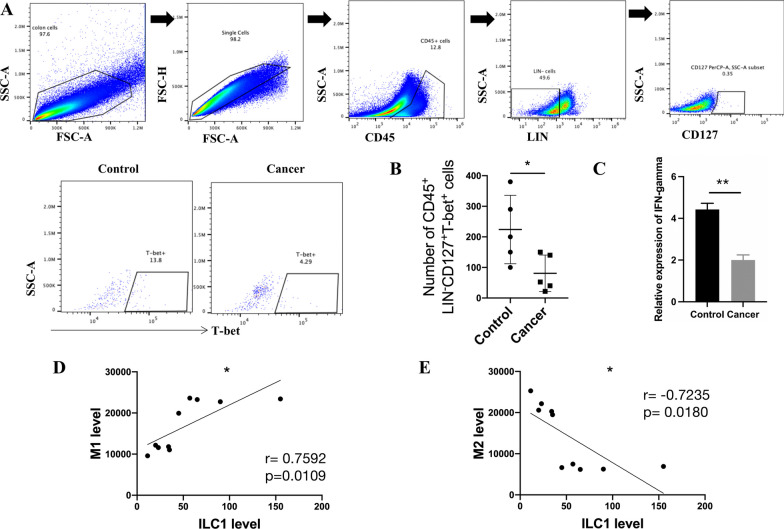
Flow cytometry was used to determine the percentages of M1-like macrophages, M2-like macrophages and ILC1s in colon cancer tissues and paracancerous healthy colon tissues in the AOM/DSS-induced mouse model of colon cancer. Furthermore, ILC1s were isolated and bone marrow-derived macrophages were generated to analyze the crosstalk that occurred between these cells when cocultured in vitro. Moreover, ILC1s were adoptively transferred or inhibited in vivo to explore the effects of ILC1s on tumor-infiltrating macrophages and tumor growth.
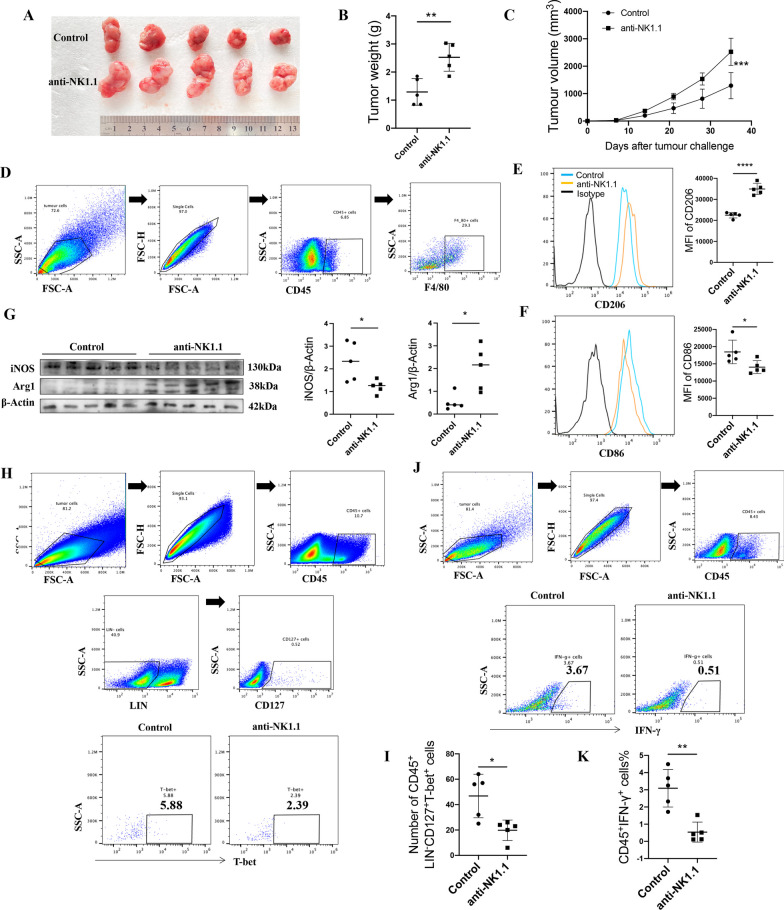
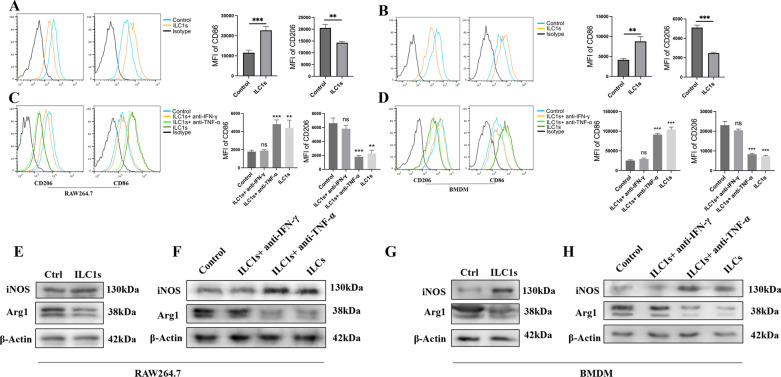
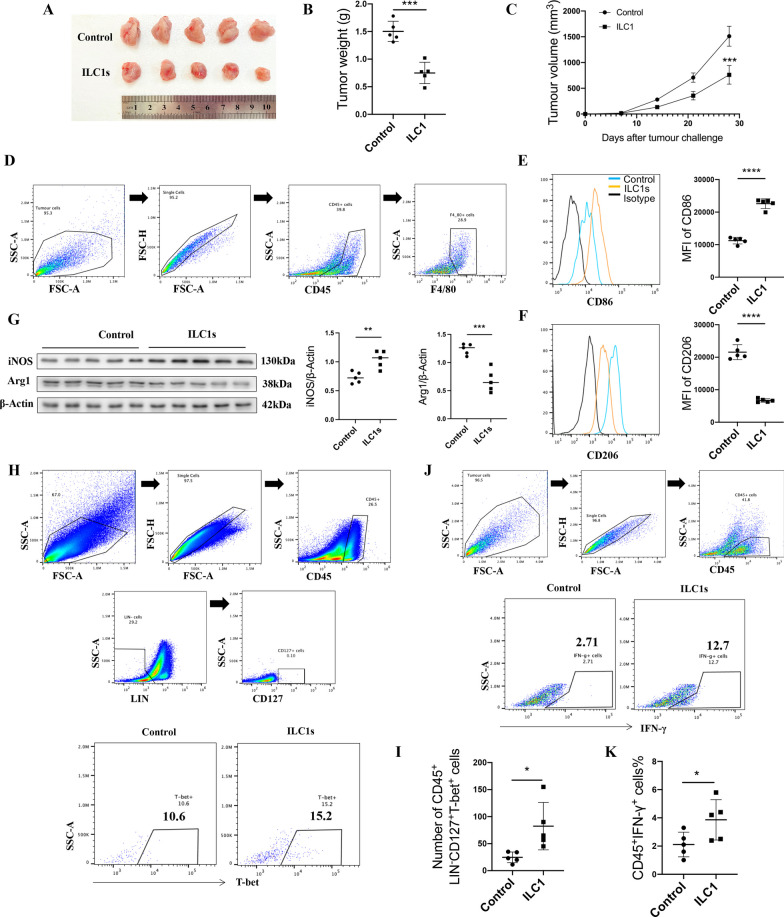
We found that the percentages of M1-like macrophages and ILC1s were decreased in colon cancer tissues, and these populations were positively correlated. ILC1s promoted the polarization of macrophages toward the classically activated M1-like phenotype in vitro, and this effect could be blocked by an anti-IFN-γ antibody. The in vivo results showed that the administration of the Group 1 innate lymphocyte-blocking anti-NK1.1 antibody decreased the number of M1-like macrophages in the tumor tissues of MC38 tumor-bearing mice and promoted tumor growth, and adoptive transfer of ILC1s inhibited tumors and increased the percentage of M1-like macrophages in MC38 tumor-bearing mice.
Our studies preliminarily prove for the first time that ILC1s promote the activation of M1-like macrophages by secreting IFN-γ and inhibit the progression of colon cancer, which may provide insight into immunotherapeutic approaches for colon cancer.
肿瘤相关巨噬细胞(TAMs)是肿瘤微环境中固有免疫细胞的一个重要亚群,它们是促进肿瘤炎症和肿瘤进展的关键调节因子。有证据表明,癌症中 TAM 的数量显著增加,而且大多数这些 TAMs 向替代性激活的 M2 表型极化;因此,这些 TAMs 强烈促进癌症疾病的进展。1 型固有淋巴细胞(ILC1)在肠道组织中大量存在,其特征在于转录因子 T-bet 的表达和干扰素(IFN)-γ的分泌,这可以促进巨噬细胞向经典激活的抗肿瘤 M1 表型极化。然而,这两种细胞亚群在结肠癌中的关系尚不清楚。
采用流式细胞术检测 AOM/DSS 诱导的结肠癌小鼠模型中结肠癌组织和癌旁健康结肠组织中 M1 样巨噬细胞、M2 样巨噬细胞和 ILC1 的百分比。此外,分离 ILC1 并生成骨髓来源的巨噬细胞,以分析体外共培养时这些细胞之间发生的相互作用。此外,体内过继转移或抑制 ILC1 以探讨 ILC1 对肿瘤浸润巨噬细胞和肿瘤生长的影响。
我们发现结肠癌组织中 M1 样巨噬细胞和 ILC1 的比例降低,并且这些群体呈正相关。ILC1 在体外促进巨噬细胞向经典激活的 M1 样表型极化,这种作用可以被抗 IFN-γ 抗体阻断。体内结果表明,给予组 1 固有淋巴细胞阻断性抗 NK1.1 抗体可减少 MC38 荷瘤小鼠肿瘤组织中 M1 样巨噬细胞的数量并促进肿瘤生长,而 ILC1 的过继转移则抑制肿瘤并增加 MC38 荷瘤小鼠中 M1 样巨噬细胞的比例。
我们的研究首次初步证明 ILC1 通过分泌 IFN-γ促进 M1 样巨噬细胞的激活,并抑制结肠癌的进展,这可能为结肠癌的免疫治疗方法提供思路。