Terzis Robert, Reimer Robert Peter, Nelles Christian, Celik Erkan, Caldeira Liliana, Heidenreich Axel, Storz Enno, Maintz David, Zopfs David, Große Hokamp Nils
Institute for Diagnostic and Interventional Radiology, University Hospital Cologne, 50937 Cologne, Germany.
Department of Urology, Uro-Oncology, Robot-Assisted and Specialized Urologic Surger, University Hospital Cologne, 50937 Cologne, Germany.
Diagnostics (Basel). 2023 Aug 31;13(17):2821. doi: 10.3390/diagnostics13172821.
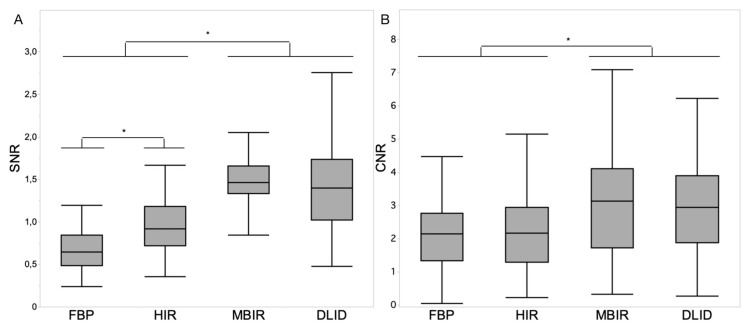
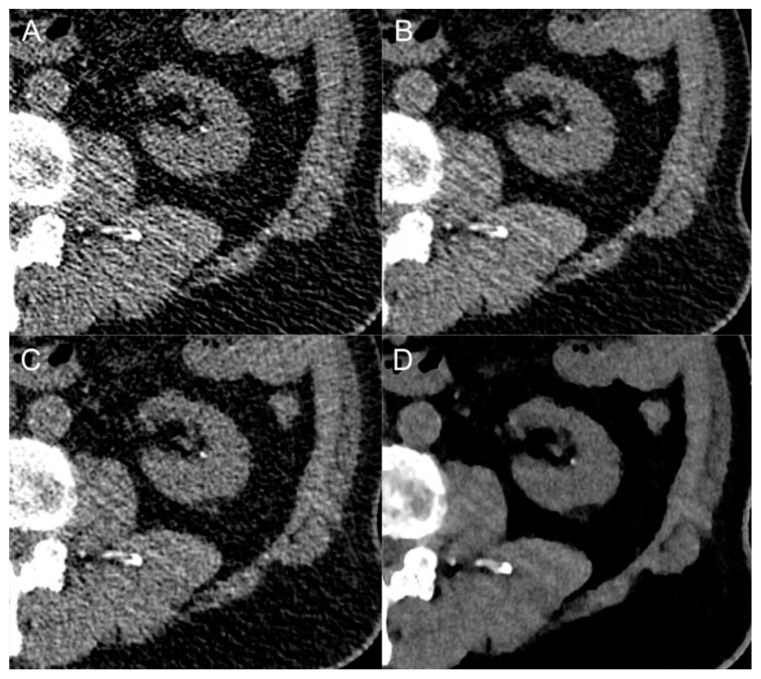
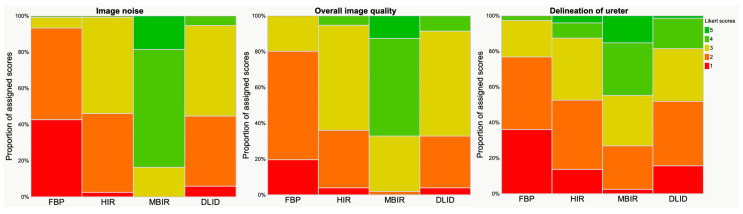
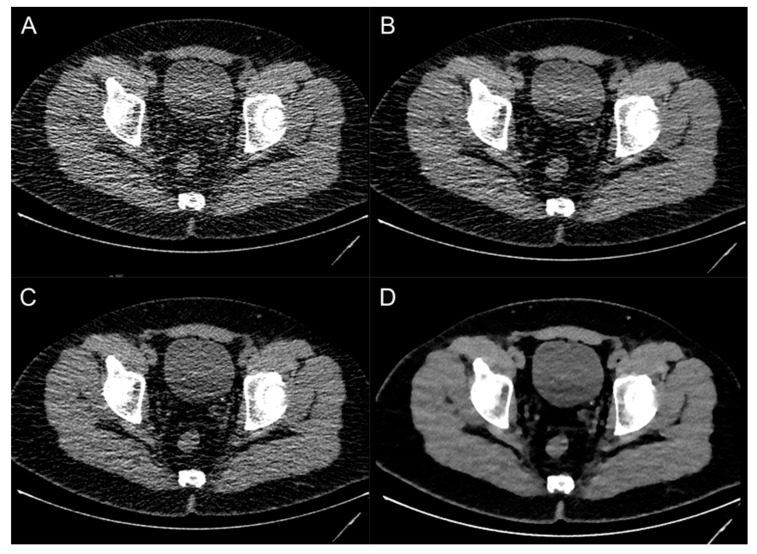
This study aimed to compare the image quality and diagnostic accuracy of deep-learning-based image denoising reconstructions (DLIDs) to established iterative reconstructed algorithms in low-dose computed tomography (LDCT) of patients with suspected urolithiasis. LDCTs (CTDIvol, 2 mGy) of 76 patients (age: 40.3 ± 5.2 years, M/W: 51/25) with suspected urolithiasis were retrospectively included. Filtered-back projection (FBP), hybrid iterative and model-based iterative reconstruction (HIR/MBIR, respectively) were reconstructed. FBP images were processed using a Food and Drug Administration (FDA)-approved DLID. ROIs were placed in renal parenchyma, fat, muscle and urinary bladder. Signal- and contrast-to-noise ratios (SNR/CNR, respectively) were calculated. Two radiologists evaluated image quality on five-point Likert scales and urinary stones. The results showed a progressive decrease in image noise from FBP, HIR and DLID to MBIR with significant differences between each method ( < 0.05). SNR and CNR were comparable between MBIR and DLID, while it was significantly lower in HIR followed by FBP (e.g., SNR: 1.5 ± 0.3; 1.4 ± 0.4; 1.0 ± 0.3; 0.7 ± 0.2, < 0.05). Subjective analysis confirmed best image quality in MBIR, followed by DLID and HIR, both being superior to FBP ( < 0.05). Diagnostic accuracy for urinary stone detection was best using MBIR (0.94), lowest using FBP (0.84) and comparable between DLID (0.90) and HIR (0.90). Stone size measurements were consistent between all reconstructions and showed excellent correlation (r = 0.958-0.975). In conclusion, MBIR yielded the highest image quality and diagnostic accuracy, with DLID producing better results than HIR and FBP in image quality and matching HIR in diagnostic precision.
本研究旨在比较基于深度学习的图像去噪重建(DLIDs)与既定的迭代重建算法在疑似尿路结石患者低剂量计算机断层扫描(LDCT)中的图像质量和诊断准确性。回顾性纳入了76例疑似尿路结石患者(年龄:40.3±5.2岁,男/女:51/25)的LDCT(容积CT剂量指数,2 mGy)。分别进行了滤波反投影(FBP)、混合迭代重建和基于模型的迭代重建(分别为HIR/MBIR)。FBP图像使用美国食品药品监督管理局(FDA)批准的DLID进行处理。在肾实质、脂肪、肌肉和膀胱中放置感兴趣区(ROI)。计算信号噪声比和对比噪声比(分别为SNR/CNR)。两名放射科医生用五点李克特量表评估图像质量和尿路结石情况。结果显示,从FBP、HIR、DLID到MBIR,图像噪声逐渐降低,各方法之间存在显著差异(<0.05)。MBIR和DLID之间的SNR和CNR相当,而HIR中的显著较低,其次是FBP(例如,SNR:1.5±0.3;1.4±0.4;1.0±0.3;0.7±0.2,<0.05)。主观分析证实MBIR的图像质量最佳,其次是DLID和HIR,两者均优于FBP(<0.05)。使用MBIR检测尿路结石的诊断准确性最高(0.94),使用FBP最低(0.84),DLID(0.90)和HIR(0.90)之间相当。所有重建方法对结石大小的测量结果一致,且相关性极佳(r = 0.958 - 0.975)。总之,MBIR产生的图像质量和诊断准确性最高,DLID在图像质量方面比HIR和FBP产生更好的结果,并且在诊断精度上与HIR相当。