Department of Urology, Tianjin Medical University General Hospital, Tianjin, China.
Front Endocrinol (Lausanne). 2023 Sep 8;14:1215666. doi: 10.3389/fendo.2023.1215666. eCollection 2023.
The correlation between serum 25-hydroxyvitamin D (25(OH)D) and different sub-types of urinary incontinence in elderly men continues to be uncertain. Hence, we performed this research to evaluate whether serum 25(OH)D levels are correlated with urinary incontinence among elderly men.
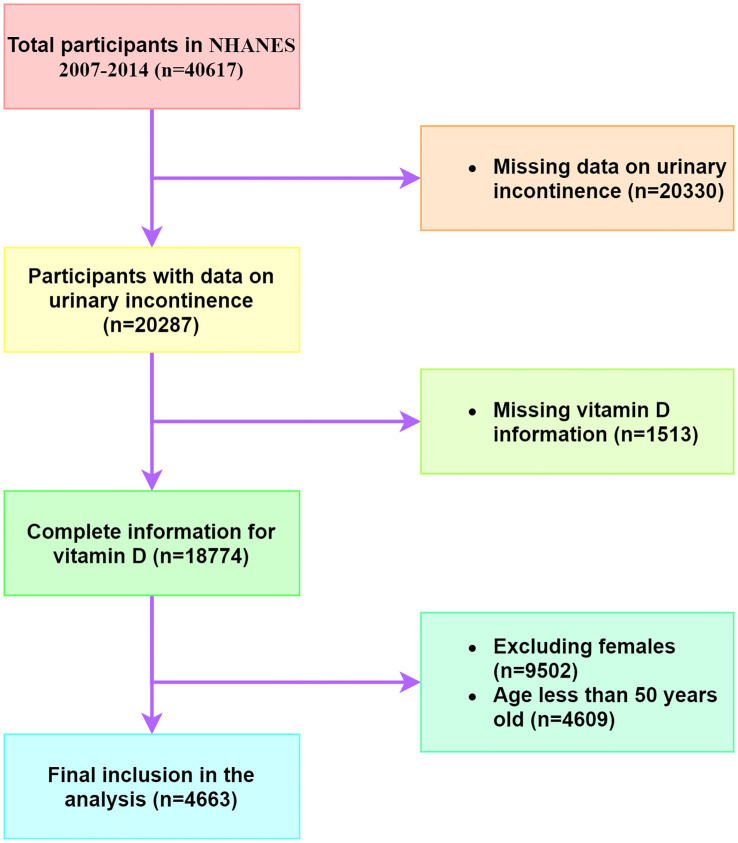
The present study incorporated the male population aged 50 years and above from four cycles of the NHANES database spanning from 2007 to 2014, for the purpose of analysis. The assessment of urinary incontinence was carried out through a correlation questionnaire, while standardized liquid chromatography-tandem mass spectrometry (LC-MS/MS) was adopted to quantify serum 25(OH)D. A weighted multi-factorial logistic regression analysis was carried out to ascertain and investigate any potential correlation that may exist between serum 25(OH)D and urinary incontinence in senior males.
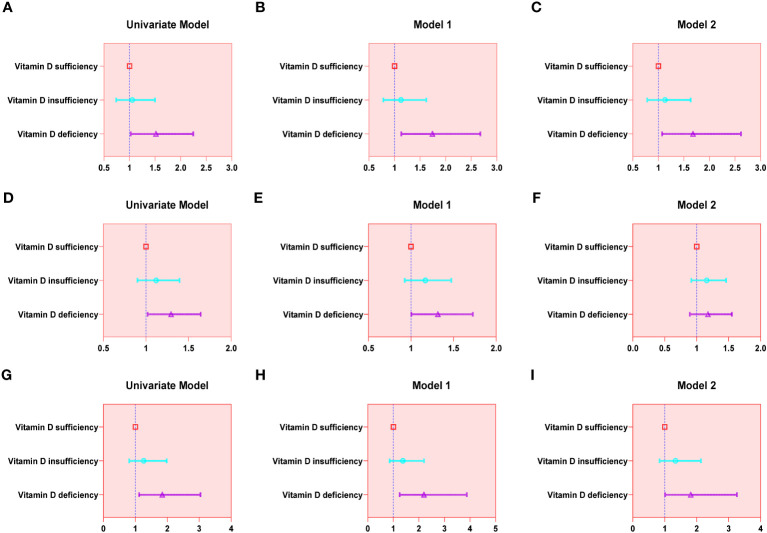
Ultimately, a sum of 4663 elderly men were involved in our analysis. The outcomes of the univariable analysis illustrated that the group with vitamin D deficiency exhibited augmented odds of all three urinary incontinence types in comparison to the vitamin D-sufficient group. After accounting for age, race, and BMI, no appreciable variations in the outcomes were noticed. However, after accounting for all covariates, only SUI (OR = 1.677; 95% confidence interval (CI) = 1.074-2.618) and MUI (OR = 1.815; 95% confidence interval (CI) = 1.010-3.260) demonstrated statistical significance.
Decreased serum 25(OH)D levels were connected with stress urinary incontinence and mixed urinary incontinence in elderly men.
血清 25-羟维生素 D(25(OH)D)与老年男性不同类型尿失禁之间的相关性仍不确定。因此,我们进行了这项研究,以评估血清 25(OH)D 水平是否与老年男性的尿失禁有关。
本研究纳入了 2007 年至 2014 年 NHANES 数据库四个周期中年龄在 50 岁及以上的男性人群进行分析。通过相关问卷评估尿失禁,采用标准化液相色谱-串联质谱法(LC-MS/MS)定量血清 25(OH)D。采用加权多因素逻辑回归分析确定并探讨老年男性血清 25(OH)D 与尿失禁之间可能存在的相关性。
最终,共有 4663 名老年男性参与了我们的分析。单变量分析的结果表明,与维生素 D 充足组相比,维生素 D 缺乏组三种类型尿失禁的可能性均增加。在考虑年龄、种族和 BMI 后,结果没有明显变化。然而,在考虑所有协变量后,只有压力性尿失禁(OR=1.677;95%置信区间(CI)=1.074-2.618)和混合性尿失禁(OR=1.815;95%置信区间(CI)=1.010-3.260)具有统计学意义。
血清 25(OH)D 水平降低与老年男性的压力性尿失禁和混合性尿失禁有关。