• 文献检索
  • 文档翻译
  • 深度研究
  • 学术资讯
  • Suppr Zotero 插件Zotero 插件
  • 邀请有礼
  • 套餐&价格
  • 历史记录
应用&插件
Suppr Zotero 插件Zotero 插件浏览器插件Mac 客户端Windows 客户端微信小程序
定价
高级版会员购买积分包购买API积分包
服务
文献检索文档翻译深度研究API 文档MCP 服务
关于我们
关于 Suppr公司介绍联系我们用户协议隐私条款
关注我们

Suppr 超能文献

核心技术专利:CN118964589B侵权必究
粤ICP备2023148730 号-1Suppr @ 2026

文献检索

告别复杂PubMed语法,用中文像聊天一样搜索,搜遍4000万医学文献。AI智能推荐,让科研检索更轻松。

立即免费搜索

文件翻译

保留排版,准确专业,支持PDF/Word/PPT等文件格式,支持 12+语言互译。

免费翻译文档

深度研究

AI帮你快速写综述,25分钟生成高质量综述,智能提取关键信息,辅助科研写作。

立即免费体验

小儿食物蛋白诱导的小肠结肠炎综合征中肠道微生物群发生改变。

Intestinal microbiota is modified in pediatric food protein-induced enterocolitis syndrome.

作者信息

Caparrós Esther, Cenit María Carmen, Muriel Javier, Benítez-Páez Alfonso, Moreno María Victoria, González-Delgado Purificación, Rubio Gonzalo, Sanz Yolanda, Fernández Javier

机构信息

Clinical Medicine Department, University Miguel Hernández, San Juan de Alicante, Alicante, Spain.

Microbial Ecology, Nutrition, and Health Research Unit, Institute of Agrochemistry and Food Technology, Paterna, Valencia, Spain.

出版信息

J Allergy Clin Immunol Glob. 2022 Sep 6;1(4):217-224. doi: 10.1016/j.jacig.2022.07.005. eCollection 2022 Nov.

DOI:10.1016/j.jacig.2022.07.005
PMID:37779539
原文链接:https://pmc.ncbi.nlm.nih.gov/articles/PMC10510020/
Abstract

BACKGROUND

Food protein-induced enterocolitis syndrome (FPIES) is a non-IgE-mediated food hypersensitivity that affects the gastrointestinal system, especially in children, who often present with more severe clinical manifestations than adults do. Although its pathogenesis is poorly understood and biomarkers are still lacking, scientific evidence suggests that gut microbiota may play an important role in the development of FPIES.

OBJECTIVE

We aimed to compare the composition of gut microbiota in children with FPIES with that in age- and sex-matched healthy controls.

METHODS

We analyzed the gut microbiota profiles in fecal samples of 17 patients with FPIES (case patients) and 12 age-matched healthy children (controls) by tag sequencing of the 16S ribosomal RNA gene hypervariable V4-V5 regions. Subjects' sociodemographic, clinical, and food diary variables were described and compared between groups by using inferential statistical tests. Nonparametric linear discriminant analysis was performed for intestinal microbiota data.

RESULTS

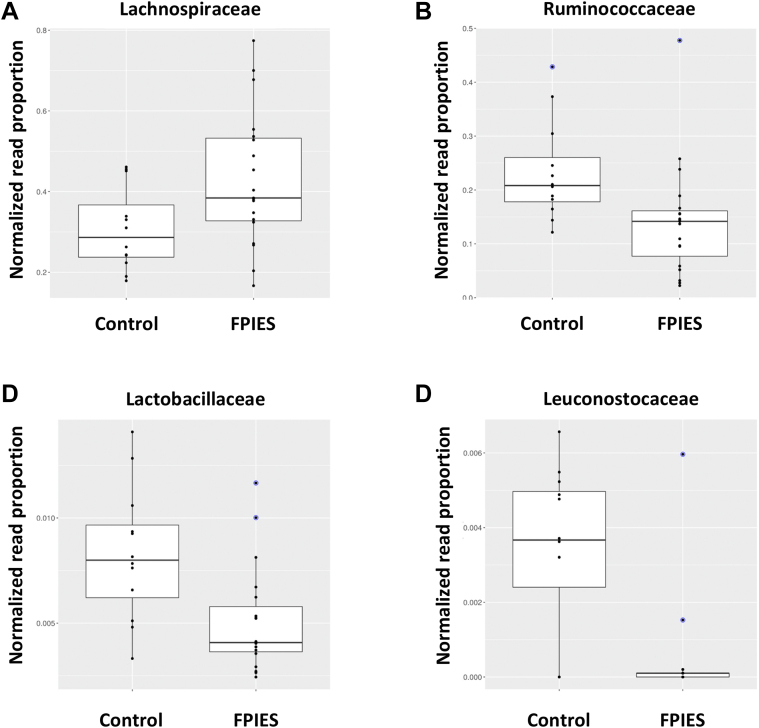
Patients with confirmed cases FPIES (n = 17; average patient age, 7.5 ± 3.2 years) and controls without FPIES or any atopy (n = 12, average patient age, 6.9 ± 2.7 years) were included. Fish was the main FPIES-inducing allergen in 65% of the cases. The patients with FPIES showed higher proportions of Lachnospiraceae spp ( < .0286) and a lower proportion of Ruminococcaceae spp ( < .0066), Lactobacillaceae spp ( < .0075), and Leuconostocaceae spp ( < .0173) than the controls.

CONCLUSIONS

Our data clearly show a different gut microbial signature in patients with FPIES, suggesting a new potential avenue for aiding the diagnosis and clinical management of FPIES. Larger studies are needed to confirm these results.

摘要

背景

食物蛋白诱导的小肠结肠炎综合征(FPIES)是一种非IgE介导的食物过敏反应,影响胃肠道系统,尤其是儿童,他们通常比成人表现出更严重的临床表现。尽管其发病机制尚不清楚且仍缺乏生物标志物,但科学证据表明肠道微生物群可能在FPIES的发展中起重要作用。

目的

我们旨在比较FPIES患儿与年龄和性别匹配的健康对照者的肠道微生物群组成。

方法

我们通过对16S核糖体RNA基因高变V4-V5区域进行标签测序,分析了17例FPIES患者(病例组)和12例年龄匹配的健康儿童(对照组)粪便样本中的肠道微生物群谱。使用推断性统计检验描述并比较了两组受试者的社会人口统计学、临床和食物日记变量。对肠道微生物群数据进行非参数线性判别分析。

结果

纳入确诊为FPIES的患者(n = 17;平均患者年龄,7.5 ± 3.2岁)和无FPIES或任何特应性疾病的对照组(n = 12,平均患者年龄,6.9 ± 2.7岁)。65%的病例中,鱼类是主要的FPIES诱导性过敏原。与对照组相比,FPIES患者的毛螺菌科菌属比例更高(P < .0286),而瘤胃球菌科菌属、乳杆菌科菌属和明串珠菌科菌属的比例更低(P < .0066、P < .0075、P < .0173)。

结论

我们的数据清楚地显示了FPIES患者不同的肠道微生物特征,这为辅助FPIES的诊断和临床管理提供了一条新的潜在途径。需要更大规模的研究来证实这些结果。
https://cdn.ncbi.nlm.nih.gov/pmc/blobs/53f9/10510020/5afddd9a3cdc/gr3.jpg
https://cdn.ncbi.nlm.nih.gov/pmc/blobs/53f9/10510020/c44b4a9f83ac/gr1.jpg
https://cdn.ncbi.nlm.nih.gov/pmc/blobs/53f9/10510020/e07e336abda1/gr2.jpg
https://cdn.ncbi.nlm.nih.gov/pmc/blobs/53f9/10510020/5afddd9a3cdc/gr3.jpg
https://cdn.ncbi.nlm.nih.gov/pmc/blobs/53f9/10510020/c44b4a9f83ac/gr1.jpg
https://cdn.ncbi.nlm.nih.gov/pmc/blobs/53f9/10510020/e07e336abda1/gr2.jpg
https://cdn.ncbi.nlm.nih.gov/pmc/blobs/53f9/10510020/5afddd9a3cdc/gr3.jpg

相似文献

1
Intestinal microbiota is modified in pediatric food protein-induced enterocolitis syndrome.小儿食物蛋白诱导的小肠结肠炎综合征中肠道微生物群发生改变。
J Allergy Clin Immunol Glob. 2022 Sep 6;1(4):217-224. doi: 10.1016/j.jacig.2022.07.005. eCollection 2022 Nov.
2
The intestinal microbiome of infants with cow's milk-induced FPIES is enriched in taxa and genes of enterobacteria.牛奶蛋白诱导的 FPIES 婴儿的肠道微生物组中,肠杆菌科的分类群和基因丰富。
J Pediatr Gastroenterol Nutr. 2024 Oct;79(4):841-849. doi: 10.1002/jpn3.12356. Epub 2024 Aug 22.
3
Deep analysis of immune response and metabolic signature in children with food protein induced enterocolitis to cow's milk.对食物蛋白诱导的小肠结肠炎患儿针对牛奶的免疫反应和代谢特征的深入分析。
Clin Transl Allergy. 2018 Sep 28;8:38. doi: 10.1186/s13601-018-0224-9. eCollection 2018.
4
Elevated Atopic Comorbidity in Patients with Food Protein-Induced Enterocolitis.食物蛋白诱导的小肠结肠炎患者中特应性共病增加。
J Allergy Clin Immunol Pract. 2020 Mar;8(3):1039-1046. doi: 10.1016/j.jaip.2019.10.047. Epub 2019 Nov 20.
5
Clinical features and resolution of food protein-induced enterocolitis syndrome: 10-year experience.食物蛋白诱导性肠炎综合征的临床特征和转归:10 年经验。
J Allergy Clin Immunol. 2014 Aug;134(2):382-9. doi: 10.1016/j.jaci.2014.04.008. Epub 2014 May 28.
6
Gut microbiota in infants with food protein enterocolitis.患有食物蛋白性小肠结肠炎的婴儿的肠道微生物群
Pediatr Res. 2025 Feb;97(2):763-773. doi: 10.1038/s41390-024-03424-9. Epub 2024 Jul 20.
7
Comparison of 16S rRNA gene sequencing microbiota among children with serological IgE-mediated food hypersensitivity.血清 IgE 介导的食物过敏儿童的 16S rRNA 基因测序微生物组比较。
Pediatr Res. 2024 Jan;95(1):241-250. doi: 10.1038/s41390-023-02735-7. Epub 2023 Aug 30.
8
[Food protein-induced enterocolitis syndrome (FPIES) in 14 children].[14例儿童食物蛋白诱导的小肠结肠炎综合征(FPIES)]
Arch Pediatr. 2017 Apr;24(4):310-316. doi: 10.1016/j.arcped.2017.01.011. Epub 2017 Feb 21.
9
A Slice of Food Protein-Induced Enterocolitis Syndrome (FPIES): Insights from 441 Children with FPIES as Provided by Caregivers in the International FPIES Association.食物蛋白诱导的肠炎综合征(FPIES):国际 FPIES 协会中照顾者提供的 441 名 FPIES 患儿的见解。
J Allergy Clin Immunol Pract. 2020 May;8(5):1702-1709. doi: 10.1016/j.jaip.2020.01.030. Epub 2020 Jan 28.
10
The role of casein-specific IgA and TGF-β in children with food protein-induced enterocolitis syndrome to milk.酪蛋白特异性IgA和转化生长因子-β在牛奶蛋白诱导的小肠结肠炎综合征患儿中的作用。
Pediatr Allergy Immunol. 2014 Nov;25(7):651-6. doi: 10.1111/pai.12288. Epub 2014 Nov 21.

引用本文的文献

1
Food Protein-Induced Enterocolitis Syndrome Across Lifespan: Focus on Adolescence.全生命周期食物蛋白诱导的小肠结肠炎综合征:聚焦于青少年期。
J Clin Med. 2025 Aug 16;14(16):5799. doi: 10.3390/jcm14165799.
2
Neonatal Food Protein-Induced Enterocolitis: Current Insights and Knowledge Gaps.新生儿食物蛋白诱导的小肠结肠炎:当前见解与知识空白
J Clin Med. 2025 Apr 3;14(7):2461. doi: 10.3390/jcm14072461.
3
Immunoglobulin-coating patterns reveal altered humoral responses to gut bacteria in pediatric cow milk allergies.免疫球蛋白包被模式揭示了小儿牛奶过敏中对肠道细菌的体液免疫反应的改变。

本文引用的文献

1
Association of Antibiotic Usage with Food Protein-Induced Enterocolitis Syndrome Development from a Caregiver's Survey.基于一项护理人员调查的抗生素使用与食物蛋白诱导的小肠结肠炎综合征发生的关联
JPGN Rep. 2021 Nov;2(4):e132. doi: 10.1097/pg9.0000000000000132.
2
Geographic differences in gut microbiota composition impact susceptibility to enteric infection.肠道微生物组成的地理差异影响对肠道感染的易感性。
Cell Rep. 2021 Jul 27;36(4):109457. doi: 10.1016/j.celrep.2021.109457.
3
Gastrointestinal immunopathology of food protein-induced enterocolitis syndrome and other non-immunoglobulin E-mediated food allergic diseases.
J Transl Med. 2024 Nov 12;22(1):1021. doi: 10.1186/s12967-024-05850-z.
4
Gut microbiome features in pediatric food allergy: a scoping review.儿童食物过敏中的肠道微生物群特征:一项范围综述
Front Allergy. 2024 Sep 25;5:1438252. doi: 10.3389/falgy.2024.1438252. eCollection 2024.
5
Early infancy dysbiosis in food protein-induced enterocolitis syndrome: A prospective cohort study.食物蛋白诱导的肠易激综合征婴儿期肠道菌群失调:一项前瞻性队列研究。
Allergy. 2023 Jun;78(6):1595-1604. doi: 10.1111/all.15644. Epub 2023 Jan 24.
食物蛋白诱导的肠绞痛综合征和其他非免疫球蛋白 E 介导的食物过敏疾病的胃肠道免疫病理学。
Ann Allergy Asthma Immunol. 2021 May;126(5):516-523. doi: 10.1016/j.anai.2021.02.024. Epub 2021 Mar 3.
4
Advances in understanding immune mechanisms of food protein-induced enterocolitis syndrome.食物蛋白诱导的结肠炎综合征免疫机制研究进展。
Ann Allergy Asthma Immunol. 2021 May;126(5):478-481. doi: 10.1016/j.anai.2021.01.033. Epub 2021 Feb 3.
5
Functional and Genomic Variation between Human-Derived Isolates of Lachnospiraceae Reveals Inter- and Intra-Species Diversity.人类衍生的lachnospiraceae 种间和种内多样性的功能和基因组变异。
Cell Host Microbe. 2020 Jul 8;28(1):134-146.e4. doi: 10.1016/j.chom.2020.05.005. Epub 2020 Jun 2.
6
Interaction between microbiota and immunity in health and disease.肠道菌群与免疫在健康与疾病中的相互作用。
Cell Res. 2020 Jun;30(6):492-506. doi: 10.1038/s41422-020-0332-7. Epub 2020 May 20.
7
The Controversial Role of Human Gut Lachnospiraceae.人类肠道毛螺菌科的争议性作用
Microorganisms. 2020 Apr 15;8(4):573. doi: 10.3390/microorganisms8040573.
8
Microbiota in non-IgE-mediated food allergy.非 IgE 介导的食物过敏中的微生物组。
Curr Opin Allergy Clin Immunol. 2020 Jun;20(3):323-328. doi: 10.1097/ACI.0000000000000644.
9
Regulation of oral immune tolerance by the microbiome in food allergy.肠道菌群调控食物过敏的口腔免疫耐受。
Curr Opin Immunol. 2019 Oct;60:141-147. doi: 10.1016/j.coi.2019.06.001. Epub 2019 Jul 11.
10
Differentiating Acute Food Protein-Induced Enterocolitis Syndrome From Its Mimics: A Comparison of Clinical Features and Routine Laboratory Biomarkers.急性食物蛋白诱导性肠炎综合征与类似疾病的鉴别:临床特征和常规实验室生物标志物的比较。
J Allergy Clin Immunol Pract. 2019 Feb;7(2):471-478.e3. doi: 10.1016/j.jaip.2018.10.020. Epub 2018 Oct 25.