Li Junxian, Song Fengju
Department of Blood Transfusion, Key Laboratory of Cancer Prevention and Therapy in Tianjin, National Clinical Research Center for Cancer, Tianjin's Clinical Research Center for Cancer, Tianjin Medical University Cancer Institute & Hospital, Tianjin, China.
Department of Epidemiology and Biostatistics, Key Laboratory of Molecular Cancer Epidemiology in Tianjin, National Clinical Research Center for Cancer, Tianjin's Clinical Research Center for Cancer, Tianjin Medical University Cancer Institute & Hospital, Tianjin Medical University, Tianjin, China.
Diabetol Metab Syndr. 2023 Oct 10;15(1):194. doi: 10.1186/s13098-023-01174-y.
The available evidence regarding the association of antioxidants, minerals, and vitamins with the risk of metabolic syndrome (MetS) traits is currently limited and inconsistent. Therefore, the purpose of this Mendelian randomization (MR) study was to investigate the potential causal relationship between genetically predicted antioxidants, minerals, and vitamins, and MetS.
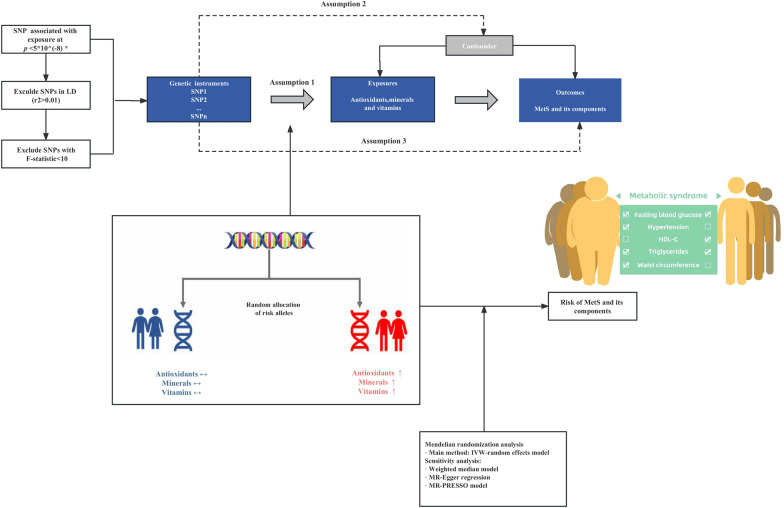
In this study, we utilized genetic variation as instrumental variable (IV) to capture exposure data related to commonly consumed dietary nutrients, including antioxidants (β-carotene, lycopene, and uric acid), minerals (copper, calcium, iron, magnesium, phosphorus, zinc, and selenium), and vitamins (folate, vitamin A, B6, B12, C, D, E, and K1). The outcomes of interest, namely MetS (n = 291,107), waist circumference (n = 462,166), hypertension (n = 463,010), fasting blood glucose (FBG) (n = 281,416), triglycerides (n = 441,016), and high-density lipoprotein cholesterol (HDL-C) (n = 403,943), were assessed using pooled data obtained from the most comprehensive genome-wide association study (GWAS) available. Finally, we applied the inverse variance weighting method as the result and conducted a sensitivity analysis for further validation.
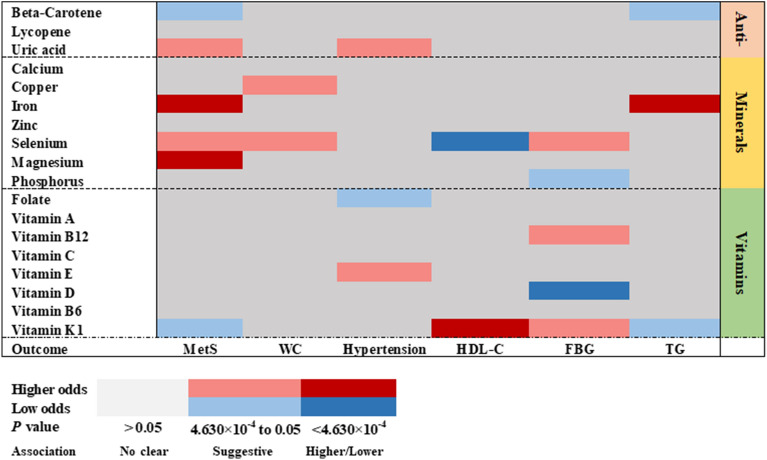
Genetically predicted higher iron (OR = 1.070, 95% CI 1.037-1.105, P = 2.91E-05) and magnesium levels (OR = 1.130, 95% CI 1.058-1.208, P = 2.80E-04) were positively associated with increased risk of MetS. For each component of MetS, higher level of genetically predicted selenium (OR = 0.971, 95% CI 0.957-0.986, P = 1.09E-04) was negatively correlated with HDL-C levels, while vitamin K1 (OR = 1.023, 95% CI 1.012-1.033, P = 2.90E-05) was positively correlated with HDL-C levels. Moreover, genetically predicted vitamin D (OR = 0.985, 95% CI 0.978-0.992, P = 5.51E-5) had a protective effect on FBG levels. Genetically predicted iron level (OR = 1.043, 95% CI 1.022-1.064, P = 4.33E-05) had a risk effect on TG level.
Our study provides evidence that genetically predicted some specific, but not all, antioxidants, minerals, and vitamins may be causally related to the development of MetS traits.
目前,关于抗氧化剂、矿物质和维生素与代谢综合征(MetS)特征风险之间关联的现有证据有限且不一致。因此,本孟德尔随机化(MR)研究的目的是调查基因预测的抗氧化剂、矿物质和维生素与MetS之间的潜在因果关系。
在本研究中,我们利用基因变异作为工具变量(IV)来获取与常见膳食营养素相关的暴露数据,包括抗氧化剂(β-胡萝卜素、番茄红素和尿酸)、矿物质(铜、钙、铁、镁、磷、锌和硒)和维生素(叶酸、维生素A、B6、B12、C、D、E和K1)。感兴趣的结局,即MetS(n = 291,107)、腰围(n = 462,166)、高血压(n = 463,010)、空腹血糖(FBG)(n = 281,416)、甘油三酯(n = 441,016)和高密度脂蛋白胆固醇(HDL-C)(n = 403,943),使用从现有最全面的全基因组关联研究(GWAS)中获得的汇总数据进行评估。最后,我们应用逆方差加权法作为结果,并进行敏感性分析以进一步验证。
基因预测的较高铁水平(OR = 1.070,95%CI 1.037 - 1.105,P = 2.91E - 05)和镁水平(OR = 1.130,95%CI 1.058 - 1.208,P = 2.80E - 04)与MetS风险增加呈正相关。对于MetS的每个组成部分,基因预测的较高硒水平(OR = 0.971,95%CI 0.957 - 0.986,P = 1.09E - 04)与HDL - C水平呈负相关,而维生素K1(OR = 1.023,95%CI 1.012 - 1.033,P = 2.90E - 05)与HDL - C水平呈正相关。此外,基因预测的维生素D(OR = 0.985,95%CI 0.978 - 0.992,P = 5.51E - 5)对FBG水平有保护作用。基因预测的铁水平(OR = 1.043,95%CI 1.022 - 1.064,P = 4.33E - 05)对TG水平有风险作用。
我们的研究提供了证据,表明基因预测的某些特定但并非所有抗氧化剂、矿物质和维生素可能与MetS特征的发展存在因果关系。