Mion Thomas, D'Agati Michael J, Sofronici Sydney, Bussmann Konrad, Staruch Margo, Kost Jason L, Co Kevin, Olsson Roy H, Finkel Peter
US Naval Research Laboratory, American Society for Engineering Education Postdoc, Washington, DC 02375, USA.
Electrical and Systems Engineering Department, University of Pennsylvania, Philadelphia, PA 19104, USA.
Sensors (Basel). 2023 Oct 21;23(20):8626. doi: 10.3390/s23208626.
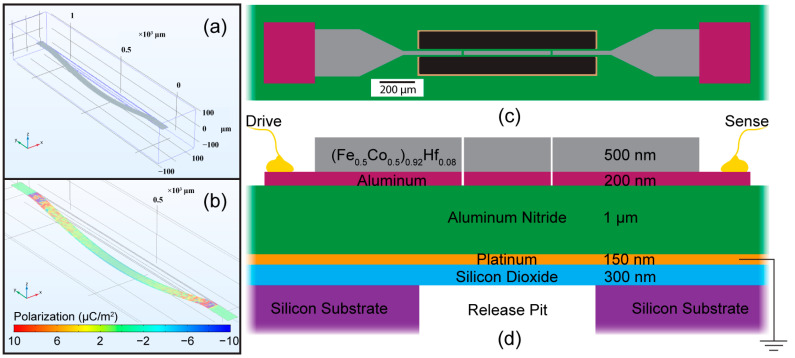
Magnetoelectric (ME)-based magnetometers have garnered much attention as they boast ultra-low-power systems with a small form factor and limit of detection in the tens of picotesla. The highly sensitive and low-power electric readout from the ME sensor makes them attractive for near DC and low-frequency AC magnetic fields as platforms for continuous magnetic signature monitoring. Among multiple configurations of the current ME magnetic sensors, most rely on exploiting the mechanically resonant characteristics of a released ME microelectromechanical system (MEMS) in a heterostructure device. Through optimizing the resonant device configuration, we design and fabricate a fixed-fixed resonant beam structure with high isolation compared to previous designs operating at ~800 nW of power comprised of piezoelectric aluminum nitride (AlN) and magnetostrictive (CoFe)-based thin films that are less susceptible to vibration while providing similar characteristics to ME-MEMS cantilever devices. In this new design of double-clamped magnetoelectric MEMS resonators, we have also utilized thin films of a new iron-cobalt-hafnium alloy (FeCo)Hf that provides a low-stress, high magnetostrictive material with an amorphous crystalline structure and ultra-low magnetocrystalline anisotropy. Together, the improvements of this sensor design yield a magnetic field sensitivity of 125 Hz/mT when released in a compressive state. The overall detection limit of these sensors using an electric field drive and readout are presented, and noise sources are discussed. Based on these results, design parameters for future ME MEMS field sensors are discussed.
基于磁电(ME)的磁力计备受关注,因为它们拥有超小型超低功耗系统,检测极限可达数十皮特斯拉。ME传感器的高灵敏度和低功耗电读出特性,使其作为连续磁特征监测平台,对近直流和低频交流磁场具有吸引力。在当前多种配置的ME磁传感器中,大多数依赖于利用异质结构器件中释放的ME微机电系统(MEMS)的机械共振特性。通过优化共振器件配置,我们设计并制造了一种固定-固定共振梁结构,与之前工作在约800 nW功率下的设计相比,具有更高的隔离度,该结构由压电氮化铝(AlN)和基于磁致伸缩(CoFe)的薄膜组成,不易受振动影响,同时具备与ME-MEMS悬臂器件相似的特性。在这种新型双夹磁电MEMS谐振器设计中,我们还采用了一种新型铁钴铪合金(FeCo)Hf薄膜,它提供了一种具有非晶晶体结构和超低磁晶各向异性的低应力、高磁致伸缩材料。综合起来,这种传感器设计的改进使得在压缩状态下释放时,磁场灵敏度达到125 Hz/mT。文中给出了这些传感器使用电场驱动和读出时的整体检测极限,并讨论了噪声源。基于这些结果,还讨论了未来ME MEMS场传感器的设计参数。