Department of Biostatistics, Epidemiology, and Informatics, Perelman School of Medicine, University of Pennsylvania, Philadelphia.
Penn Statistics in Imaging and Visualization Endeavor, Department of Biostatistics, Epidemiology, and Informatics, Perelman School of Medicine, University of Pennsylvania, Philadelphia.
JAMA Netw Open. 2023 Nov 1;6(11):e2342203. doi: 10.1001/jamanetworkopen.2023.42203.
Predictive models using machine learning techniques have potential to improve early detection and management of Alzheimer disease (AD). However, these models potentially have biases and may perpetuate or exacerbate existing disparities.
To characterize the algorithmic fairness of longitudinal prediction models for AD progression.
DESIGN, SETTING, AND PARTICIPANTS: This prognostic study investigated the algorithmic fairness of logistic regression, support vector machines, and recurrent neural networks for predicting progression to mild cognitive impairment (MCI) and AD using data from participants in the Alzheimer Disease Neuroimaging Initiative evaluated at 57 sites in the US and Canada. Participants aged 54 to 91 years who contributed data on at least 2 visits between September 2005 and May 2017 were included. Data were analyzed in October 2022.
Fairness was quantified across sex, ethnicity, and race groups. Neuropsychological test scores, anatomical features from T1 magnetic resonance imaging, measures extracted from positron emission tomography, and cerebrospinal fluid biomarkers were included as predictors.
Outcome measures quantified fairness of prediction models (logistic regression [LR], support vector machine [SVM], and recurrent neural network [RNN] models), including equal opportunity, equalized odds, and demographic parity. Specifically, if the model exhibited equal sensitivity for all groups, it aligned with the principle of equal opportunity, indicating fairness in predictive performance.
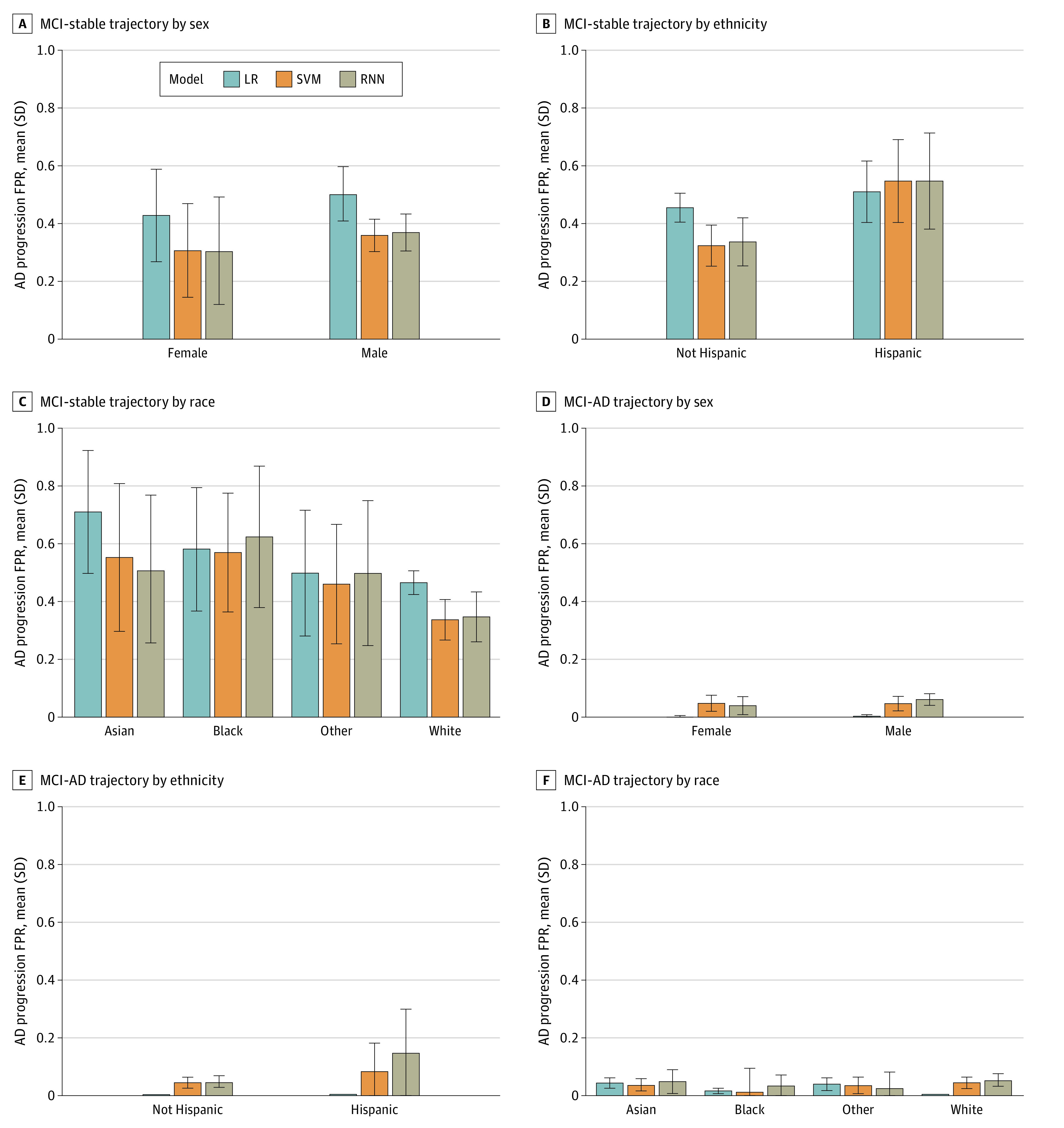
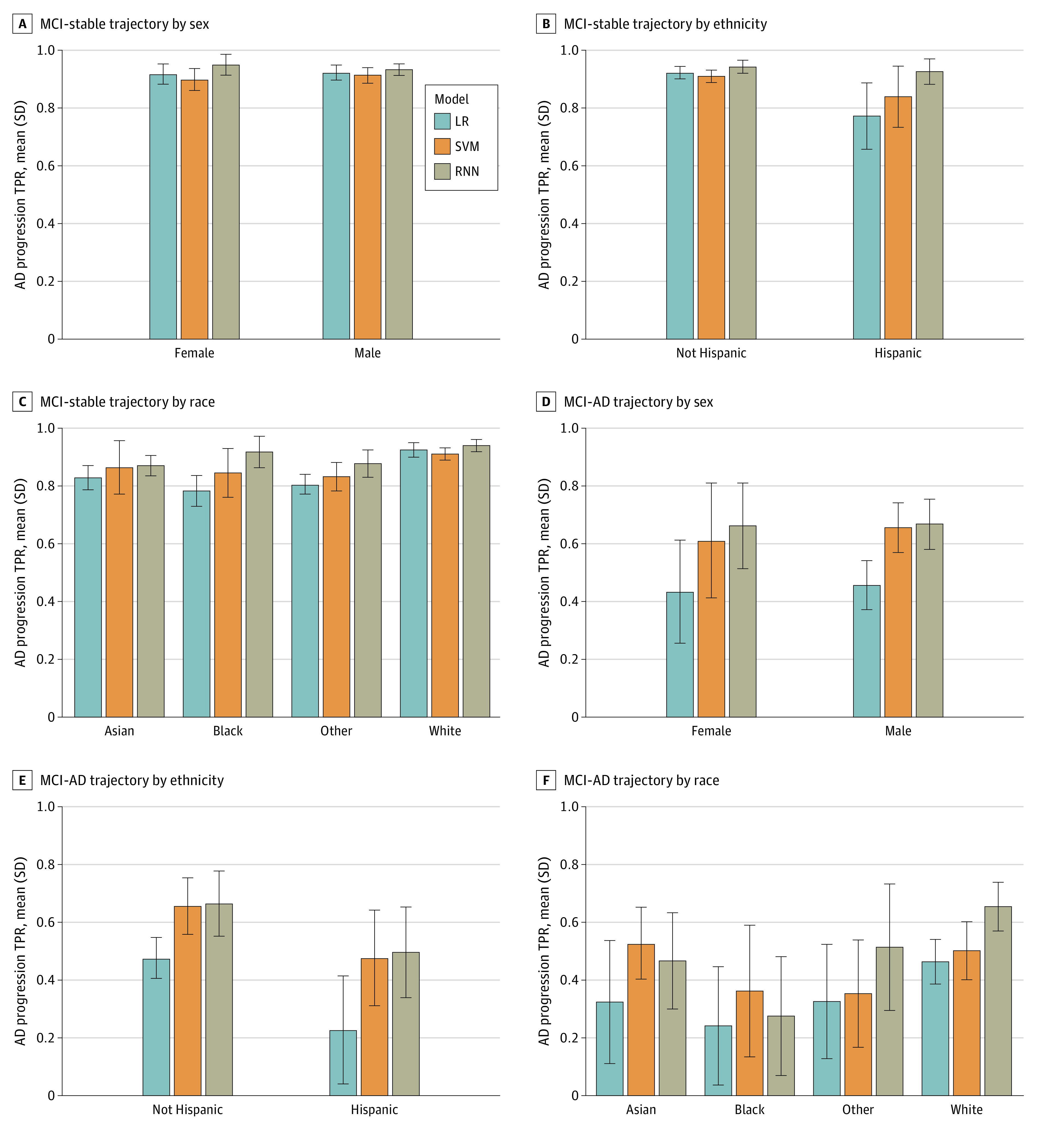
A total of 1730 participants in the cohort (mean [SD] age, 73.81 [6.92] years; 776 females [44.9%]; 69 Hispanic [4.0%] and 1661 non-Hispanic [96.0%]; 29 Asian [1.7%], 77 Black [4.5%], 1599 White [92.4%], and 25 other race [1.4%]) were included. Sensitivity for predicting progression to MCI and AD was lower for Hispanic participants compared with non-Hispanic participants; the difference (SD) in true positive rate ranged from 20.9% (5.5%) for the RNN model to 27.8% (9.8%) for the SVM model in MCI and 24.1% (5.4%) for the RNN model to 48.2% (17.3%) for the LR model in AD. Sensitivity was similarly lower for Black and Asian participants compared with non-Hispanic White participants; for example, the difference (SD) in AD true positive rate was 14.5% (51.6%) in the LR model, 12.3% (35.1%) in the SVM model, and 28.4% (16.8%) in the RNN model for Black vs White participants, and the difference (SD) in MCI true positive rate was 25.6% (13.1%) in the LR model, 24.3% (13.1%) in the SVM model, and 6.8% (18.7%) in the RNN model for Asian vs White participants. Models generally satisfied metrics of fairness with respect to sex, with no significant differences by group, except for cognitively normal (CN)-MCI and MCI-AD transitions (eg, an absolute increase [SD] in the true positive rate of CN-MCI transitions of 10.3% [27.8%] for the LR model).
In this study, models were accurate in aggregate but failed to satisfy fairness metrics. These findings suggest that fairness should be considered in the development and use of machine learning models for AD progression.
使用机器学习技术的预测模型有可能改善阿尔茨海默病(AD)的早期检测和管理。然而,这些模型可能存在偏差,并可能加剧或加剧现有的差异。
描述 AD 进展纵向预测模型的算法公平性。
设计、地点和参与者:本预后研究使用来自美国和加拿大 57 个地点的阿尔茨海默病神经影像学倡议参与者的数据,调查了逻辑回归、支持向量机和递归神经网络预测向轻度认知障碍(MCI)和 AD 进展的算法公平性。参与者年龄在 54 至 91 岁之间,在 2005 年 9 月至 2017 年 5 月期间至少参加了 2 次访问。数据分析于 2022 年 10 月进行。
在性别、族裔和种族群体之间量化公平性。神经心理学测试分数、T1 磁共振成像的解剖特征、正电子发射断层扫描提取的测量值以及脑脊液生物标志物被纳入预测因素。
结局衡量了预测模型(逻辑回归[LR]、支持向量机[SVM]和递归神经网络[RNN]模型)的公平性,包括均等机会、均等赔率和人口均等。具体来说,如果模型对所有群体都表现出相同的敏感性,则符合均等机会原则,表明预测性能公平。
队列中共有 1730 名参与者(平均[标准差]年龄,73.81[6.92]岁;776 名女性[44.9%];69 名西班牙裔[4.0%]和 1661 名非西班牙裔[96.0%];29 名亚洲人[1.7%],77 名黑人[4.5%],1599 名白人[92.4%]和 25 名其他种族[1.4%])被纳入研究。与非西班牙裔参与者相比,西班牙裔参与者预测向 MCI 和 AD 进展的敏感性较低;在 MCI 中,RNN 模型的真阳性率差异(标准差)范围为 20.9%(5.5%)至 27.8%(9.8%),SVM 模型为 24.1%(5.4%)至 48.2%(17.3%),LR 模型为 AD;在 AD 中,敏感性相似地低于黑人和亚洲参与者与非西班牙裔白人参与者相比;例如,LR 模型中 AD 真阳性率差异(标准差)为 14.5%(51.6%),SVM 模型为 12.3%(35.1%),RNN 模型为 28.4%(16.8%),LR 模型为黑人与白人参与者,SVM 模型为 24.3%(13.1%),RNN 模型为 6.8%(18.7%),亚洲人与白人参与者。除了认知正常(CN)-MCI 和 MCI-AD 过渡外(例如,LR 模型中 CN-MCI 过渡的真阳性率增加[标准差]为 10.3%[27.8%]),这些模型通常符合公平性指标,在组间没有显著差异。
在这项研究中,模型总体上是准确的,但未能满足公平性指标。这些发现表明,在开发和使用 AD 进展的机器学习模型时,应考虑公平性。