Department of Computer Science and Engineering, Bangladesh University of Professionals, Dhaka, Bangladesh.
Department of Information and Communication Technology, Bangladesh University of Professionals, Dhaka, Bangladesh.
PLoS One. 2023 Nov 16;18(11):e0294253. doi: 10.1371/journal.pone.0294253. eCollection 2023.
According to the World Health Organization (WHO), dementia is the seventh leading reason of death among all illnesses and one of the leading causes of disability among the world's elderly people. Day by day the number of Alzheimer's patients is rising. Considering the increasing rate and the dangers, Alzheimer's disease should be diagnosed carefully. Machine learning is a potential technique for Alzheimer's diagnosis but general users do not trust machine learning models due to the black-box nature. Even, some of those models do not provide the best performance because of using only neuroimaging data.
To solve these issues, this paper proposes a novel explainable Alzheimer's disease prediction model using a multimodal dataset. This approach performs a data-level fusion using clinical data, MRI segmentation data, and psychological data. However, currently, there is very little understanding of multimodal five-class classification of Alzheimer's disease.
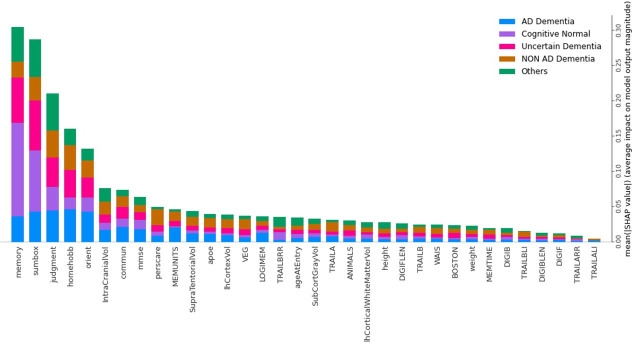
For predicting five class classifications, 9 most popular Machine Learning models are used. These models are Random Forest (RF), Logistic Regression (LR), Decision Tree (DT), Multi-Layer Perceptron (MLP), K-Nearest Neighbor (KNN), Gradient Boosting (GB), Adaptive Boosting (AdaB), Support Vector Machine (SVM), and Naive Bayes (NB). Among these models RF has scored the highest value. Besides for explainability, SHapley Additive exPlanation (SHAP) is used in this research work.
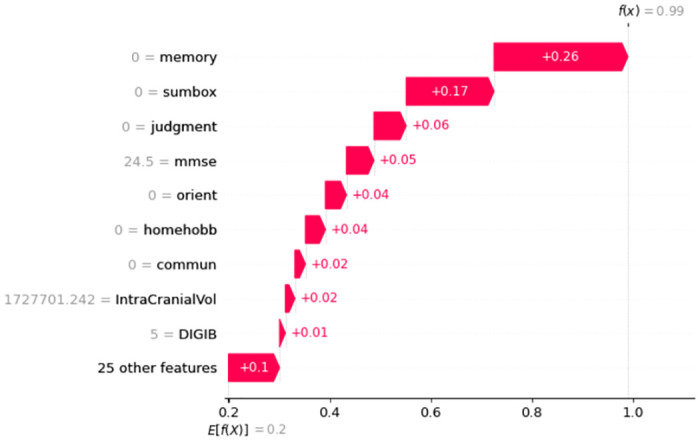
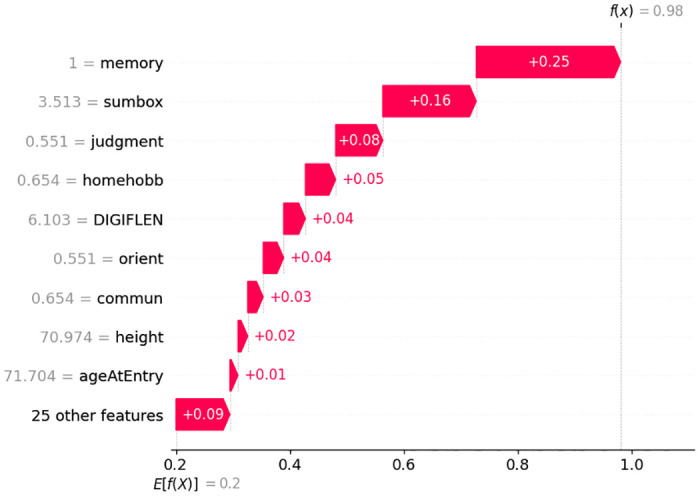
The performance evaluation demonstrates that the RF classifier has a 10-fold cross-validation accuracy of 98.81% for predicting Alzheimer's disease, cognitively normal, non-Alzheimer's dementia, uncertain dementia, and others. In addition, the study utilized Explainable Artificial Intelligence based on the SHAP model and analyzed the causes of prediction. To the best of our knowledge, we are the first to present this multimodal (Clinical, Psychological, and MRI segmentation data) five-class classification of Alzheimer's disease using Open Access Series of Imaging Studies (OASIS-3) dataset. Besides, a novel Alzheimer's patient management architecture is also proposed in this work.
根据世界卫生组织(WHO)的说法,痴呆症是所有疾病中第七大致死原因,也是世界上老年人残疾的主要原因之一。阿尔茨海默病患者的数量每天都在增加。鉴于发病率的上升和危害,阿尔茨海默病的诊断应该仔细进行。机器学习是一种用于阿尔茨海默病诊断的潜在技术,但由于黑盒性质,普通用户不信任机器学习模型。甚至,由于仅使用神经影像学数据,一些模型没有提供最佳性能。
为了解决这些问题,本文提出了一种使用多模态数据集的新型可解释阿尔茨海默病预测模型。该方法使用临床数据、MRI 分割数据和心理数据进行数据级融合。然而,目前对于阿尔茨海默病的五分类多模态数据的理解还很少。
为了预测五类分类,使用了 9 种最流行的机器学习模型。这些模型包括随机森林(RF)、逻辑回归(LR)、决策树(DT)、多层感知机(MLP)、K 最近邻(KNN)、梯度提升(GB)、自适应提升(AdaB)、支持向量机(SVM)和朴素贝叶斯(NB)。在这些模型中,RF 模型的得分最高。除了解释性之外,本研究还使用了 SHapley Additive exPlanation(SHAP)模型。
性能评估表明,RF 分类器在预测阿尔茨海默病、认知正常、非阿尔茨海默痴呆、不确定痴呆和其他疾病方面具有 10 倍交叉验证准确率为 98.81%。此外,该研究利用基于 SHAP 模型的可解释人工智能分析了预测的原因。据我们所知,我们是第一个使用开放获取成像研究系列(OASIS-3)数据集对多模态(临床、心理和 MRI 分割数据)阿尔茨海默病进行五类分类的。此外,本工作还提出了一种新的阿尔茨海默病患者管理架构。