Stomatology Department, Sichuan Provincial People's Hospital, University of Electronic Science and Technology of China, Chengdu, 610072, China.
School of Stomatology, Southwest Medical University, Luzhou, 646699, China.
BMC Oral Health. 2024 Jan 5;24(1):27. doi: 10.1186/s12903-023-03809-y.
Numerous studies have demonstrated the impact of beverage consumption on overall health and oral health. Specifically, high consumption of sugar-sweetened beverages and coffee has been associated with an increased risk of metabolic disorders and periodontitis. Conversely, high intake of plain water has been linked to various health benefits, including weight management and reduced energy intake. However, no previous studies have explored the potential association between plain water intake and the risk of periodontitis.
Our objective was to investigate the relationship between plain water consumption and periodontitis in a middle-aged and elderly population.
The present cross-sectional study was conducted among participants aged ≥ 45 in the 2009-2014 National Health and Nutrition Examination Surveys. Multivariable regression analysis, subgroup analysis and smooth fitting tests were conducted to explore the independent relationship between plain water intake and periodontitis.
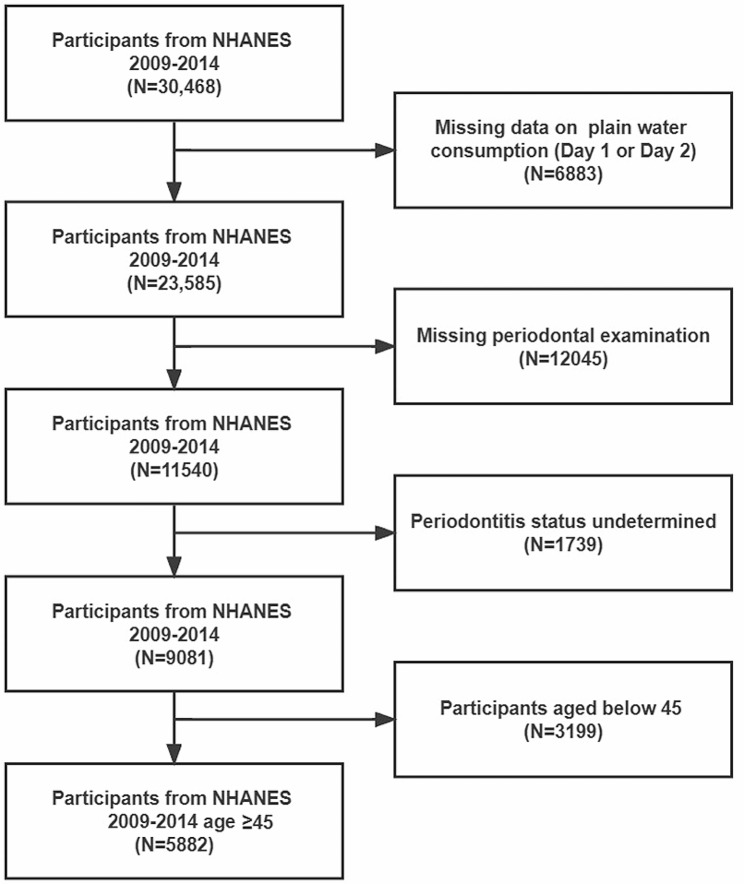
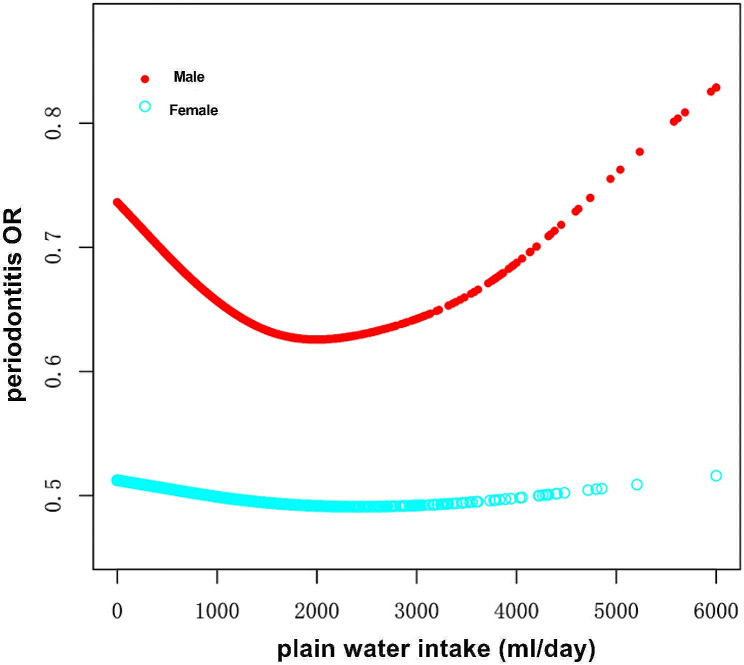
A total of 5,882 participants were enrolled,62.02% have periodontitis. Periodontitis patients have lower plain water intake. The multivariable regression tests showed that the risk of periodontitis decreased with increased plain water intake quartiles (Q4 OR = 0.78; 95%CI 0.62-0.96) after fully adjustment. Subgroup analysis and interaction tests showed that gender, age, smoking, diabetes, hypertension or BMI does not significantly interact with the association. However, the relation was significant in males (Q4 OR = 0.64; 95%CI 0.47-0.86) but not in females (Q4 OR = 0.97;95% CI 0.71-1.31). In the smoothed curve fits stratified by gender, the curve for male participants displayed as a U-shape, with an optimal plain water intake at 1200 ml/day. For males drinking plain water less than 1200 ml/day, the risk of periodontitis decreased by 24% with each increase of 500 ml plain water intake (OR = 0.76, 95%CI 0.66-0.87, p < 0.001).
Together, the results showed that plain water intake is negatively associated with periodontitis risk in US middle aged and elderly population. Further studies are needed to investigate the mechanism unites this association. Attention should be given to adequate plain water intake when considering dietary suggestions to the population at high risk of developing periodontitis, especially for men.
许多研究已经证明了饮料消费对整体健康和口腔健康的影响。具体来说,大量饮用含糖饮料和咖啡与代谢紊乱和牙周炎的风险增加有关。相反,大量摄入白开水与各种健康益处有关,包括体重管理和减少能量摄入。然而,以前没有研究探讨白开水摄入量与牙周炎风险之间的潜在关联。
我们的目的是调查中年和老年人中白开水摄入与牙周炎之间的关系。
本横断面研究纳入了 2009-2014 年全国健康与营养调查中年龄≥45 岁的参与者。采用多变量回归分析、亚组分析和平滑拟合检验来探讨白开水摄入量与牙周炎之间的独立关系。
共纳入 5882 名参与者,62.02%患有牙周炎。牙周炎患者白开水摄入量较低。多变量回归检验显示,在充分调整后,白开水摄入量 quartiles 越高,牙周炎的风险越低(Q4 OR=0.78;95%CI 0.62-0.96)。亚组分析和交互检验表明,性别、年龄、吸烟、糖尿病、高血压或 BMI 与该关联无显著交互作用。然而,该关联在男性中具有统计学意义(Q4 OR=0.64;95%CI 0.47-0.86),但在女性中无统计学意义(Q4 OR=0.97;95%CI 0.71-1.31)。在按性别分层的平滑曲线拟合中,男性参与者的曲线呈 U 形,最佳白开水摄入量为 1200 ml/天。对于每天饮用白开水少于 1200 ml 的男性,白开水摄入量每增加 500 ml,牙周炎风险降低 24%(OR=0.76,95%CI 0.66-0.87,p<0.001)。
总的来说,结果表明白开水摄入与美国中年和老年人的牙周炎风险呈负相关。需要进一步的研究来探讨这种关联的机制。在考虑针对牙周炎高危人群的饮食建议时,应注意足够的白开水摄入,尤其是男性。