JCI Insight. 2024 Jan 23;9(2):e173863. doi: 10.1172/jci.insight.173863.
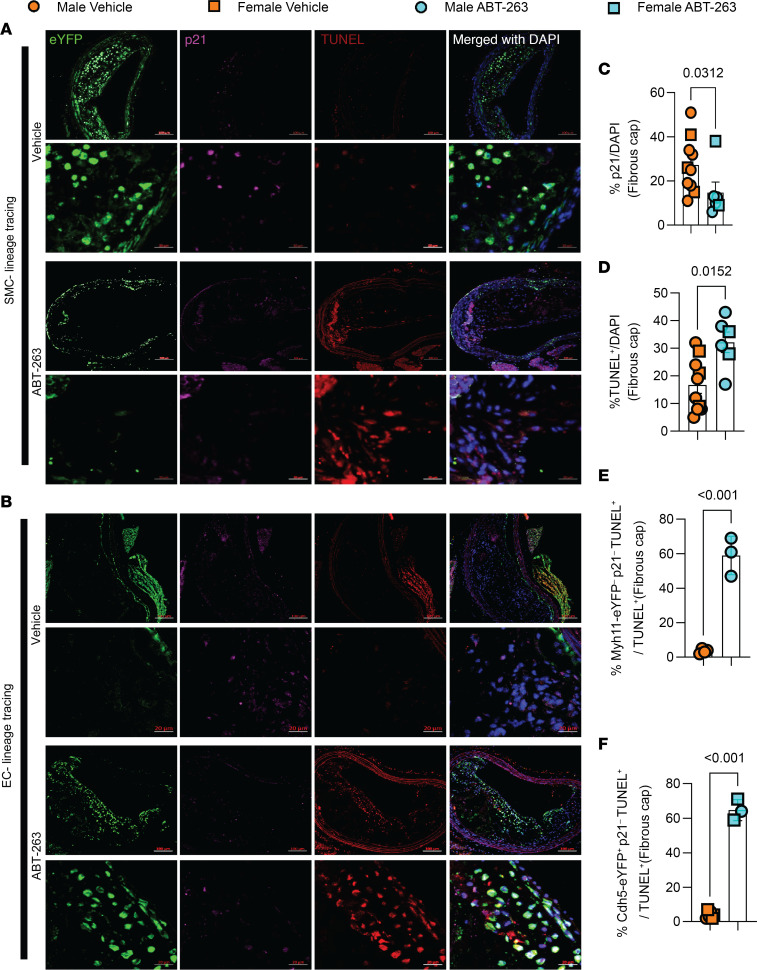
The use of senolytic agents to remove senescent cells from atherosclerotic lesions is controversial. A common limitation of previous studies is the failure to rigorously define the effects of senolytic agent ABT-263 (Navitoclax) on smooth muscle cells (SMC) despite studies claiming that these cells are the major source of senescent cells. Moreover, there are no studies on the effect of ABT-263 on endothelial cells (EC), which - along with SMC - comprise 90% of α-smooth muscle actin+ (α-SMA+) myofibroblast-like cells in the protective fibrous cap. Here we tested the hypothesis that treatment of advanced atherosclerotic mice with ABT-263 will reduce lesion size and increase plaque stability. SMC (Myh11-CreERT2-eYFP) and EC (Cdh5-CreERT2-eYFP) lineage tracing Apoe-/- mice were fed a western diet (WD) for 18 weeks, followed by ABT-263 at 100 mg/kg/bw for 6 weeks or 50 mg/kg/bw for 9 weeks. ABT-263 treatment did not change lesion size or lumen area of the brachiocephalic artery (BCA). However, ABT-263 treatment reduced SMC by 90% and increased EC contributions to lesions via EC-to-mesenchymal transition (EndoMT) by 60%. ABT-263 treatment also reduced α-SMA+ fibrous cap thickness by 60% and was associated with a > 50% mortality rate. Taken together, ABT-263 treatment of WD-fed Apoe-/- mice with advanced lesions resulted in multiple detrimental changes, including reduced indices of stability and increased mortality.
使用衰老细胞清除剂从动脉粥样硬化病变中清除衰老细胞的作用存在争议。以前的研究普遍存在一个局限性,即未能严格定义衰老细胞清除剂 ABT-263(Navitoclax)对平滑肌细胞 (SMC) 的影响,尽管有研究声称这些细胞是衰老细胞的主要来源。此外,尚无关于 ABT-263 对内皮细胞 (EC) 影响的研究,而 EC 与 SMC 一起构成了保护纤维帽中 90%的α-平滑肌肌动蛋白+ (α-SMA+)肌成纤维细胞样细胞。在这里,我们检验了这样一个假设,即用 ABT-263 治疗晚期动脉粥样硬化小鼠将减少病变大小并增加斑块稳定性。SMC (Myh11-CreERT2-eYFP) 和 EC (Cdh5-CreERT2-eYFP) 谱系追踪 Apoe-/- 小鼠喂食西方饮食 (WD) 18 周,随后用 100mg/kg/bw 的 ABT-263 治疗 6 周或用 50mg/kg/bw 的 ABT-263 治疗 9 周。ABT-263 治疗并未改变肱动脉 (BCA) 的病变大小或管腔面积。然而,ABT-263 治疗使 SMC 减少了 90%,并通过内皮细胞向间充质转化 (EndoMT) 使 EC 对病变的贡献增加了 60%。ABT-263 治疗还使 α-SMA+纤维帽厚度减少了 60%,并伴有 >50%的死亡率。综上所述,用 ABT-263 治疗晚期病变的 WD 喂养的 Apoe-/- 小鼠导致了多种不利变化,包括稳定性指数降低和死亡率增加。