
利用臭牡丹合成氧化铝纳米颗粒及其抗菌、抗炎和抗氧化活性
Green Synthesis of Aluminum Oxide Nanoparticles Using Clerodendrum phlomidis and Their Antibacterial, Anti-inflammatory, and Antioxidant Activities.
作者信息
Thanaraj Srigopika, Mitthun A N K, Geetha Sravanthy P, Carmelin Durai Singh, Surya Muthuvel, Saravanan Muthupandian
机构信息
Department of Pharmacology, Saveetha Dental College and Hospitals, Saveetha Institute of Medical and Technical Sciences, Chennai, IND.
出版信息
Cureus. 2024 Jan 14;16(1):e52279. doi: 10.7759/cureus.52279. eCollection 2024 Jan.
INTRODUCTION
plays a significant role in many indigenous medical systems, and it can be mostly found in Southeast Asia. The objective of the study was to synthesize and characterize the biosynthesized aluminum oxide nanoparticles (AlO-NPs) using and analyze their antibacterial (bactericidal), antioxidant, and anti-inflammatory activities.
METHODS
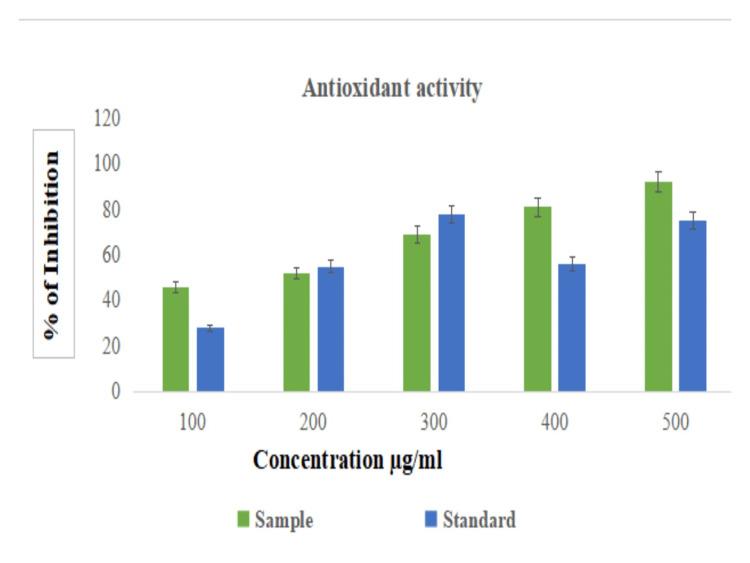
The extract was prepared by the autoclave-assisted method, and the AlO-NPs were synthesized by the green synthesis method. The biosynthesized AlO-NPs were characterized by ultraviolet-visible (UV-Vis) spectroscopy, Fourier transform infrared (FT-IR), field emission scanning electron microscopy (FE-SEM), and energy dispersive X-ray (EDX) analysis. The antibacterial property was assessed by the Kirby-Bauer well diffusion method, and the antioxidant activity was checked by DPPH (2,2-diphenyl-1-picrylhydrazyl) activity compared with the control L-ascorbic acid. Anti-inflammatory activity was evaluated by an albumin denaturation assay, and diclofenac was used as a control. IBM SPSS Statistics for Windows, Version 21.0 was used for the statistical analysis. Results: An absorption peak at a wavelength of 380 nm was detected by UV-Vis spectroscopy analysis. It proves that AlO-NPs have been successfully produced by the green synthesis method. The results of the FT-IR study demonstrated the existence of numerous chemicals and functional groups in the 500-3500 cmrange. AlO-NPs from the plant extract were subjected to FE-SEM analysis, which revealed an aggregated or spherically cluster-like structure. The sample's elemental makeup, which revealed that it included 38% aluminum and 28% oxygen, was identified with the help of the EDX, and this verified the high purity of the AlO-NPs. The results of the antibacterial activity of AlO-NPs revealed that there was a zone of inhibition for however, there was no zone of inhibition for . The synthesized AlO-NPs exhibit strong antioxidative (DPPH activity) and anti-inflammatory (albumin denaturation assay) action. In this work, the in vitro antioxidant activity of was assessed using the standard, L-ascorbic acid, as a measure of DPPH activity. At a maximum concentration of 500 µg/ml, the obtained results showed the incredible antioxidant properties of the investigated AlO-NPs synthesized from the plant extracts and demonstrated 90% inhibition. AlO-NPs that were biosynthesized showed effective anti-inflammatory activity at a higher concentration of 100 µg/ml and demonstrated 89% inhibition in contrast to the drug diclofenac sodium.
CONCLUSION
According to the study's findings, AlO-NPs made using a greener synthesis approach have the potential to be used in a variety of industries and are also an affordable and sustainable way to effectively act as anti-inflammatory and antioxidant agents.
引言
在许多传统医学体系中发挥着重要作用,且主要见于东南亚地区。本研究的目的是合成并表征利用[具体植物名称未给出]生物合成的氧化铝纳米颗粒(AlO-NPs),并分析其抗菌(杀菌)、抗氧化和抗炎活性。
方法
通过高压釜辅助法制备提取物,并采用绿色合成法合成AlO-NPs。通过紫外-可见(UV-Vis)光谱、傅里叶变换红外(FT-IR)、场发射扫描电子显微镜(FE-SEM)和能量色散X射线(EDX)分析对生物合成的AlO-NPs进行表征。采用 Kirby-Bauer 纸片扩散法评估抗菌性能,与对照 L-抗坏血酸相比,通过 DPPH(2,2-二苯基-1-苦基肼)活性检测抗氧化活性。通过白蛋白变性试验评估抗炎活性,以双氯芬酸作为对照。使用 IBM SPSS Statistics for Windows,版本 21.0 进行统计分析。结果:通过 UV-Vis 光谱分析在波长 380 nm 处检测到一个吸收峰。这证明通过绿色合成法已成功制备出 AlO-NPs。FT-IR 研究结果表明在 500 - 3500 cm范围内存在多种化学物质和官能团。对植物提取物中的 AlO-NPs 进行 FE-SEM 分析,结果显示为聚集状或球形簇状结构。借助 EDX 确定了样品的元素组成,结果表明其包含38%的铝和28%的氧,这验证了 AlO-NPs 的高纯度。AlO-NPs 的抗菌活性结果显示对[具体菌种未给出]有抑菌圈,然而,对[具体菌种未给出]没有抑菌圈。合成的 AlO-NPs 表现出较强的抗氧化(DPPH 活性)和抗炎(白蛋白变性试验)作用。在本研究中,以标准 L-抗坏血酸作为 DPPH 活性的衡量标准评估了[具体植物名称未给出]的体外抗氧化活性。在最大浓度 500 µg/ml 时,所得结果表明从植物提取物中合成的所研究的 AlO-NPs 具有令人难以置信的抗氧化性能,抑制率达 90%。生物合成的 AlO-NPs 在较高浓度 100 µg/ml 时表现出有效的抗炎活性,并与双氯芬酸钠相比显示出 89%的抑制率。
结论
根据该研究结果,采用更绿色合成方法制备的 AlO-NPs 有潜力应用于多种行业,并且是一种经济且可持续的有效充当抗炎和抗氧化剂的方式。


 Zotero 插件