Poultry Department, Faculty of Agriculture, Zagazig University, Zagazig 44511, Egypt.
Poultry Department, Faculty of Agriculture, Zagazig University, Zagazig 44511, Egypt.
Poult Sci. 2024 May;103(5):103550. doi: 10.1016/j.psj.2024.103550. Epub 2024 Feb 15.
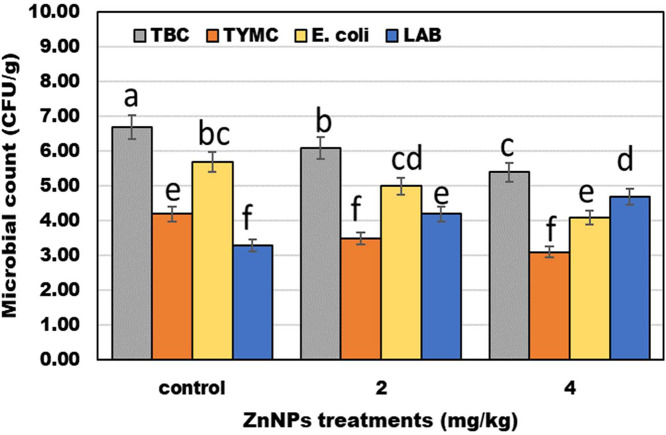
The present investigation aimed to examine the impact of different dietary organic zinc nanoparticle (ZnNP) levels on gut bacteria, meat quality, growth performance, carcass traits, and blood indicators of broilers. A total of 180 unsexed one-wk broiler chicks (Cobb) were allotted to 3 experimental groups and received a basal diet supplemented with 0, 0.2, and 0.4 mg ZnNPs/Kg diet, respectively. The results showed that, after 38 d of age, the supplementary ZnNPs at a level of 0.4 mg/kg raised body weight and weight gain compared to the control and 0.2 mg ZnNPs/kg diet. The addition of ZnNPs improved the daily feed intake. Some of the carcass characteristics in ZnNPs groups excelled that of the control. ZnNPs treatments gave higher dressing % and decreased (P < 0.05) the cholesterol rates, LDL, and uric acid in the blood. In addition, it gave the best concentrations of ALT and AST. The ZnNPs groups exhibited substantially (P < 0.05) improved moisture and fat values in meat samples. The group given ZnNPs at a concentration of 0.4 mg/kg had a substantially (P < 0.05) lower count of TYMC and E. coli. In conclusion, the high level of ZnNPs (0.4 mg/kg) improved the broilers' performance and some of their carcass traits, enhancing their health and meat quality.
本研究旨在探究不同膳食有机锌纳米粒子(ZnNP)水平对肉鸡肠道细菌、肉质、生长性能、胴体特征和血液指标的影响。将 180 只 1 周龄公母不分的肉鸡(科布)随机分为 3 个实验组,分别接受基础日粮添加 0、0.2 和 0.4 mg ZnNPs/kg 日粮的处理。结果表明,在 38 日龄后,与对照组和 0.2 mg ZnNPs/kg 日粮组相比,添加 0.4 mg/kg ZnNPs 提高了体重和体重增重。ZnNPs 的添加提高了日采食量。ZnNPs 组的一些胴体特征优于对照组。ZnNPs 处理提高了(P<0.05)屠宰率和降低了血液中的胆固醇、LDL 和尿酸浓度。此外,它还提高了 ALT 和 AST 的最佳浓度。ZnNPs 组的肉样水分和脂肪值显著提高(P<0.05)。添加 0.4 mg/kg ZnNPs 的组 TYMC 和大肠杆菌数量显著降低(P<0.05)。综上所述,高水平的 ZnNPs(0.4 mg/kg)可改善肉鸡的性能和一些胴体特征,提高其健康和肉质。