García-Paz Flor de María, Del Moral Sandra, Morales-Arrieta Sandra, Ayala Marcela, Treviño-Quintanilla Luis Gerardo, Olvera-Carranza Clarita
Departamento de Ingeniería Celular y Biocatálisis, Instituto de Biotecnología, Universidad Nacional Autónoma de México, Av. Universidad 2001 Col. Chamilpa CP 62210, Cuernavaca, Morelos, México.
Investigador por México-CONAHCyT, Unidad de Investigación y Desarrollo en Alimentos, Tecnológico Nacional de México, Campus Veracruz. MA de Quevedo 2779, Col. Formando Hogar, CP 91960, Veracruz, Veracruz, México.
Mol Biol Rep. 2024 Mar 11;51(1):410. doi: 10.1007/s11033-024-09332-9.
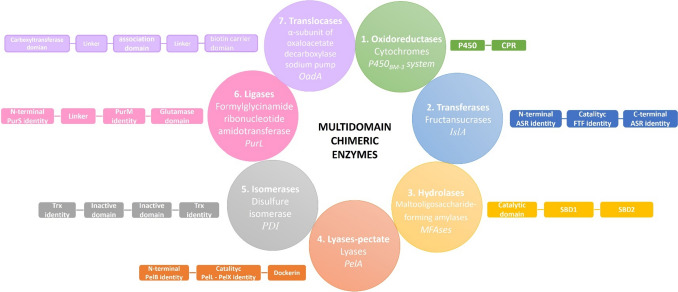
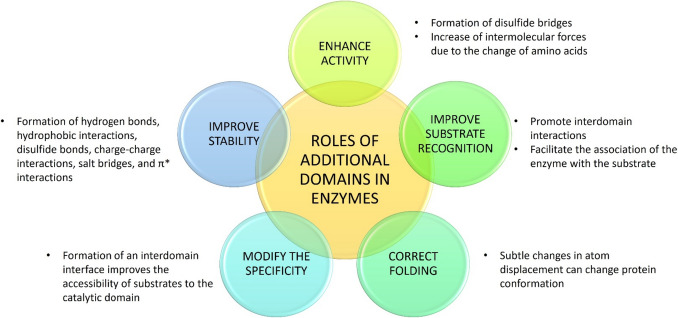
Searching for new and better biocatalysts is an area of study in constant development. In nature, mechanisms generally occurring in evolution, such as genetic duplication, recombination, and natural selection processes, produce various enzymes with different architectures and properties. The recombination of genes that code proteins produces multidomain chimeric enzymes that contain two or more domains that sometimes enhance their catalytic properties. Protein engineering has mimicked this process to enhance catalytic activity and the global stability of enzymes, searching for new and better biocatalysts. Here, we present and discuss examples from both natural and synthetic multidomain chimeric enzymes and how additional domains heighten their stability and catalytic activity. Moreover, we also describe progress in developing new biocatalysts using synthetic fusion enzymes and revise some methodological strategies to improve their biological fitness.
寻找新型且更优的生物催化剂是一个不断发展的研究领域。在自然界中,进化过程中普遍存在的机制,如基因复制、重组和自然选择过程,会产生具有不同结构和特性的各种酶。编码蛋白质的基因重组会产生多结构域嵌合酶,这些酶包含两个或更多结构域,有时会增强它们的催化特性。蛋白质工程模仿了这一过程,以提高酶的催化活性和整体稳定性,从而寻找新型且更优的生物催化剂。在此,我们展示并讨论天然和合成多结构域嵌合酶的实例,以及额外的结构域如何提高它们的稳定性和催化活性。此外,我们还描述了使用合成融合酶开发新型生物催化剂的进展,并修订了一些方法策略以提高它们的生物学适应性。