Prokop Bartosz, Gelens Lendert
Laboratory of Dynamics in Biological Systems, Department of Cellular and Molecular Medicine, KU Leuven, Herestraat 49, 3000 Leuven, Belgium.
iScience. 2024 Feb 23;27(4):109316. doi: 10.1016/j.isci.2024.109316. eCollection 2024 Apr 19.
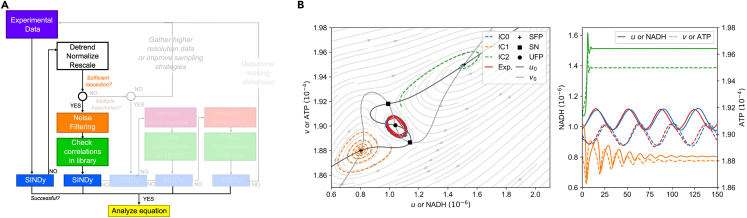
Periodic changes in the concentration or activity of different molecules regulate vital cellular processes such as cell division and circadian rhythms. Developing mathematical models is essential to better understand the mechanisms underlying these oscillations. Recent data-driven methods like SINDy have fundamentally changed model identification, yet their application to experimental biological data remains limited. This study investigates SINDy's constraints by directly applying it to biological oscillatory data. We identify insufficient resolution, noise, dimensionality, and limited prior knowledge as primary limitations. Using various generic oscillator models of different complexity and/or dimensionality, we systematically analyze these factors. We then propose a comprehensive guide for inferring models from biological data, addressing these challenges step by step. Our approach is validated using glycolytic oscillation data from yeast.
不同分子浓度或活性的周期性变化调节着诸如细胞分裂和昼夜节律等重要的细胞过程。建立数学模型对于更好地理解这些振荡背后的机制至关重要。像SINDy这样的最新数据驱动方法从根本上改变了模型识别,但它们在实验生物学数据中的应用仍然有限。本研究通过直接将SINDy应用于生物振荡数据来研究其局限性。我们确定分辨率不足、噪声、维度和先验知识有限是主要限制因素。使用不同复杂度和/或维度的各种通用振荡器模型,我们系统地分析了这些因素。然后,我们提出了一个从生物数据推断模型的综合指南,逐步应对这些挑战。我们的方法通过使用酵母糖酵解振荡数据进行了验证。