Department of Environmental Monitoring and Research, Swedish Museum of Natural History, Stockholm, Sweden.
Department of Mathematics, Stockholm University, Stockholm, Sweden.
Sci Data. 2024 Apr 20;11(1):400. doi: 10.1038/s41597-024-03216-0.
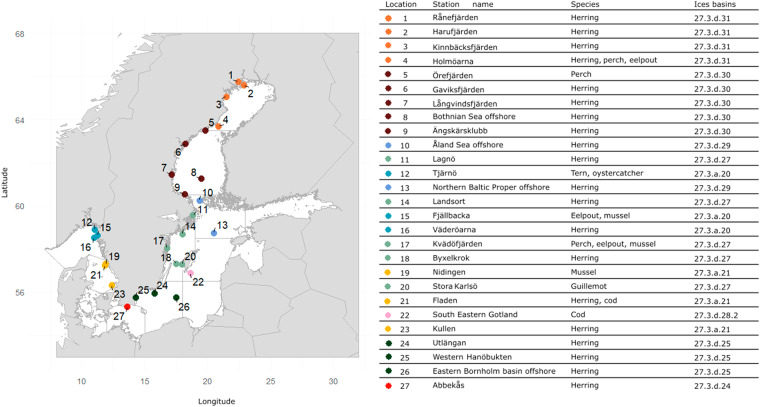
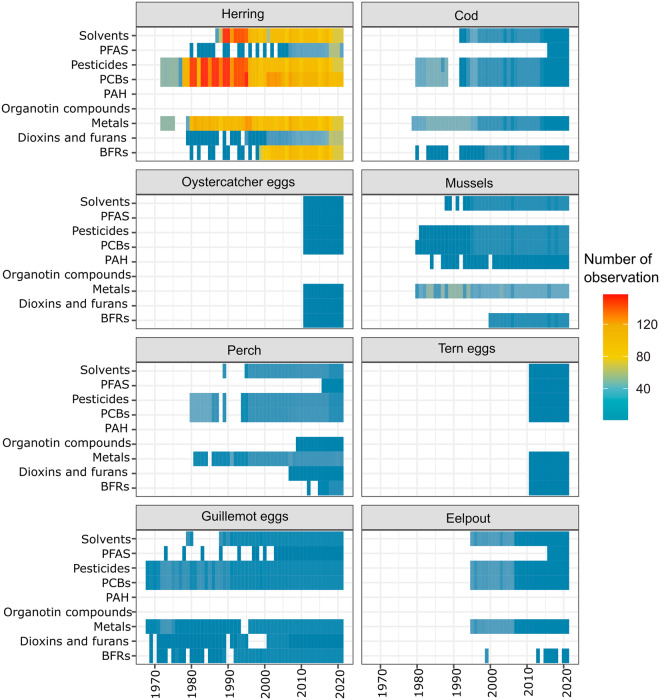
Widespread persistent contaminants are a global environmental problem. In the Baltic Sea, wildlife contamination was first noticed in the 1960s, prompting the Swedish Environmental Protection Agency to establish a comprehensive Swedish National Monitoring Programme for Contaminants in Marine Biota (MCoM) in 1978 run by the Swedish Museum of Natural History. Eight species have been analysed, four fish species (Atlantic herring, Atlantic cod, European perch, viviparous eelpout), one bivalve species (blue mussel), and egg from three bird species (common guillemot, common tern, Eurasian oystercatcher). Here, we present a dataset containing MCoM data from its start until 2021. It includes 36 sets of time-series, each analysed for more than 100 contaminants. The longest time-series is for common guillemot and starts in 1968. We describe the structure of MCoM including historic changes to the number of stations, sample treatment, analytical methods, instruments, and laboratories. The MCoM data is available at the Bolin Centre repository and on GitHub through our R package mcomDb. The latter will be updated yearly with new MCoM records.
广泛存在的持久性污染物是一个全球性的环境问题。在波罗的海中,野生动物污染于 20 世纪 60 年代首次被注意到,促使瑞典环境保护局于 1978 年由瑞典自然历史博物馆设立了一个全面的瑞典国家海洋生物污染物监测计划(MCoM)。已经分析了八种物种,包括四种鱼类(大西洋鲱鱼、大西洋鳕鱼、欧洲鲈鱼、胎生无须鳕)、一种双壳类动物(贻贝)和三种鸟类的卵(普通海鸠、普通燕鸥、欧洲蛎鹬)。在这里,我们提供了一个包含从开始到 2021 年的 MCoM 数据的数据集。它包括 36 组时间序列,每个序列都分析了超过 100 种污染物。最长的时间序列是普通海鸠,始于 1968 年。我们描述了 MCoM 的结构,包括对监测站数量、样品处理、分析方法、仪器和实验室的历史变化。MCoM 数据可在博林中心存储库以及通过我们的 R 包 mcomDb 在 GitHub 上获得。后者将每年更新新的 MCoM 记录。