Ray Ankita, Minh Tran Thu Thi, Santos Natividade Rita Dos, Moreira Rodrigo A, Simpson Joshua D, Mohammed Danahe, Koehler Melanie, L Petitjean Simon J, Zhang Qingrong, Bureau Fabrice, Gillet Laurent, Poma Adolfo B, Alsteens David
Louvain Institute of Biomolecular Science and Technology, Université catholique de Louvain, 1348 Louvain-la-Neuve, Belgium.
Faculty of Materials Science and Technology, University of Science-VNU HCM, 227 Nguyen Van Cu Street, District 5, 700000 Ho Chi Minh City, Vietnam.
ACS Nanosci Au. 2024 Mar 8;4(2):136-145. doi: 10.1021/acsnanoscienceau.3c00060. eCollection 2024 Apr 17.
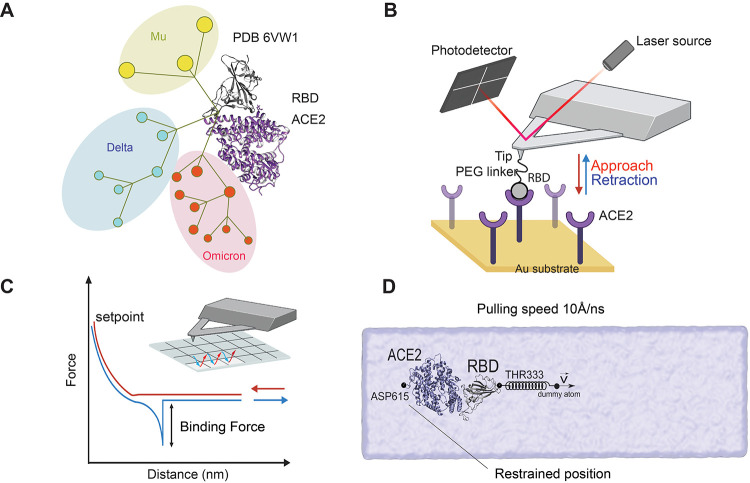
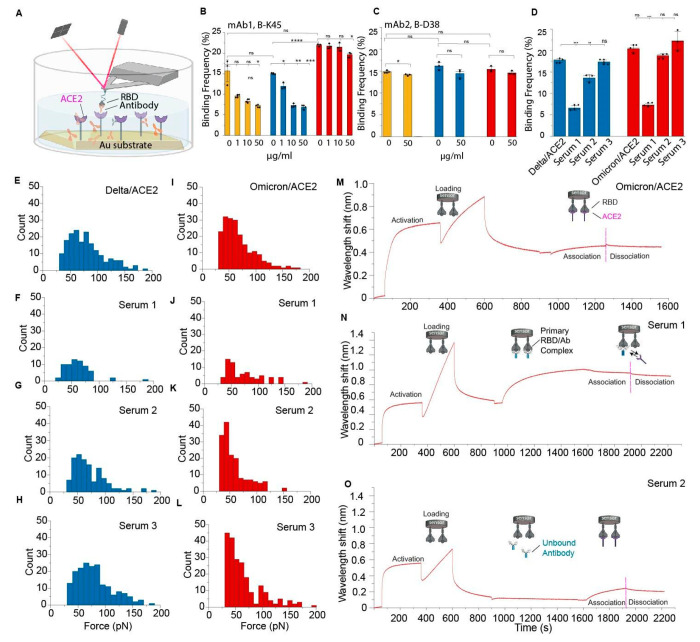
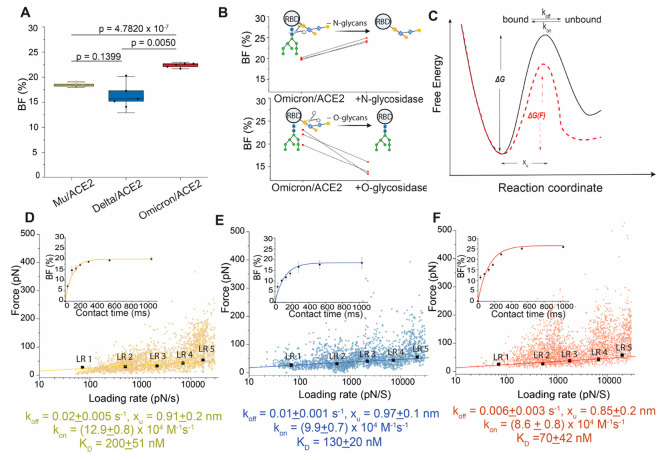
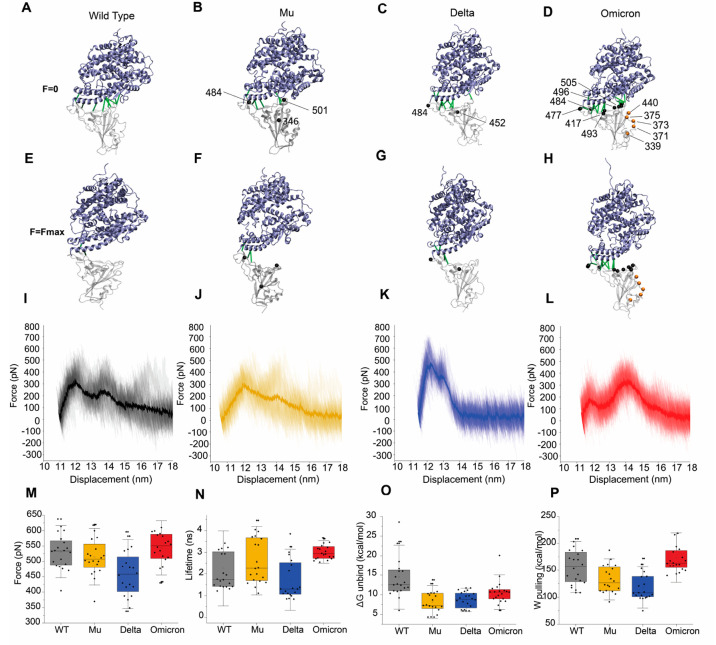
The SARS-CoV-2 pandemic spurred numerous research endeavors to comprehend the virus and mitigate its global severity. Understanding the binding interface between the virus and human receptors is pivotal to these efforts and paramount to curbing infection and transmission. Here we employ atomic force microscopy and steered molecular dynamics simulation to explore SARS-CoV-2 receptor binding domain (RBD) variants and angiotensin-converting enzyme 2 (ACE2), examining the impact of mutations at key residues upon binding affinity. Our results show that the Omicron and Delta variants possess strengthened binding affinity in comparison to the Mu variant. Further, using sera from individuals either vaccinated or with acquired immunity following Delta strain infection, we assess the impact of immunity upon variant RBD/ACE2 complex formation. Single-molecule force spectroscopy analysis suggests that vaccination before infection may provide stronger protection across variants. These results underscore the need to monitor antigenic changes in order to continue developing innovative and effective SARS-CoV-2 abrogation strategies.
严重急性呼吸综合征冠状病毒2(SARS-CoV-2)大流行促使众多研究工作致力于了解该病毒并减轻其在全球范围内的严重程度。了解病毒与人类受体之间的结合界面对于这些努力至关重要,对于遏制感染和传播也至关重要。在此,我们采用原子力显微镜和定向分子动力学模拟来探索SARS-CoV-2受体结合域(RBD)变体和血管紧张素转换酶2(ACE2),研究关键残基处的突变对结合亲和力的影响。我们的结果表明,与缪变体相比,奥密克戎和德尔塔变体具有更强的结合亲和力。此外,我们使用来自接种疫苗或在感染德尔塔毒株后获得免疫力的个体的血清,评估免疫对变体RBD/ACE2复合物形成的影响。单分子力谱分析表明,感染前接种疫苗可能对不同变体提供更强的保护。这些结果强调了监测抗原变化的必要性,以便继续开发创新有效的SARS-CoV-2消除策略。