Park Jaeseoung, Kumar Ashwani, Zhou Yucheng, Oh Sangheon, Kim Jeong-Hoon, Shi Yuhan, Jain Soumil, Hota Gopabandhu, Qiu Erbin, Nagle Amelie L, Schuller Ivan K, Schuman Catherine D, Cauwenberghs Gert, Kuzum Duygu
Department of Electrical and Computer Engineering, University of California San Diego, La Jolla, CA, USA.
Department of Bioengineering, University of California San Diego, La Jolla, CA, USA.
Nat Commun. 2024 Apr 25;15(1):3492. doi: 10.1038/s41467-024-46682-1.
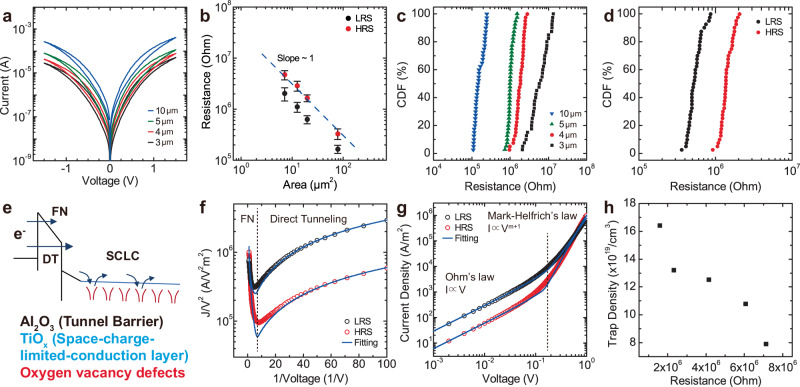
CMOS-RRAM integration holds great promise for low energy and high throughput neuromorphic computing. However, most RRAM technologies relying on filamentary switching suffer from variations and noise, leading to computational accuracy loss, increased energy consumption, and overhead by expensive program and verify schemes. We developed a filament-free, bulk switching RRAM technology to address these challenges. We systematically engineered a trilayer metal-oxide stack and investigated the switching characteristics of RRAM with varying thicknesses and oxygen vacancy distributions to achieve reliable bulk switching without any filament formation. We demonstrated bulk switching at megaohm regime with high current nonlinearity, up to 100 levels without compliance current. We developed a neuromorphic compute-in-memory platform and showcased edge computing by implementing a spiking neural network for an autonomous navigation/racing task. Our work addresses challenges posed by existing RRAM technologies and paves the way for neuromorphic computing at the edge under strict size, weight, and power constraints.
互补金属氧化物半导体电阻式随机存取存储器(CMOS-RRAM)集成在低能耗和高吞吐量神经形态计算方面具有巨大潜力。然而,大多数依赖丝状开关的电阻式随机存取存储器(RRAM)技术都存在变化和噪声问题,导致计算精度损失、能耗增加,以及因昂贵的编程和验证方案而产生开销。我们开发了一种无丝状、体相开关的RRAM技术来应对这些挑战。我们系统地设计了一种三层金属氧化物堆栈,并研究了具有不同厚度和氧空位分布的RRAM的开关特性,以实现可靠的体相开关而不形成任何细丝。我们展示了在兆欧级别的体相开关,具有高电流非线性,无需顺从电流即可达到100个电平。我们开发了一个神经形态内存计算平台,并通过为自主导航/竞赛任务实现一个脉冲神经网络来展示边缘计算。我们解决了现有RRAM技术带来的挑战,并为在严格的尺寸、重量和功率限制下的边缘神经形态计算铺平了道路。