Department of Medicine and Optometry, eHealth Institute, Linnaeus University, Kalmar, Sweden.
Department of Management, School of Business and Economics, Linnaeus University, Kalmar, Sweden.
J Health Organ Manag. 2024 Apr 30;38(9):175-194. doi: 10.1108/JHOM-04-2023-0127.
The purpose of this mixed-methods study was to explore how medical secretaries experience digital transformation in a Swedish healthcare organisation, with a focus on workplace climate and health.
DESIGN/METHODOLOGY/APPROACH: Data were collected using a sequential exploratory mixed-methods design based on grounded theory, with qualitative data collection (a Quality Café and individual interviews) followed by quantitative data collection (a questionnaire).
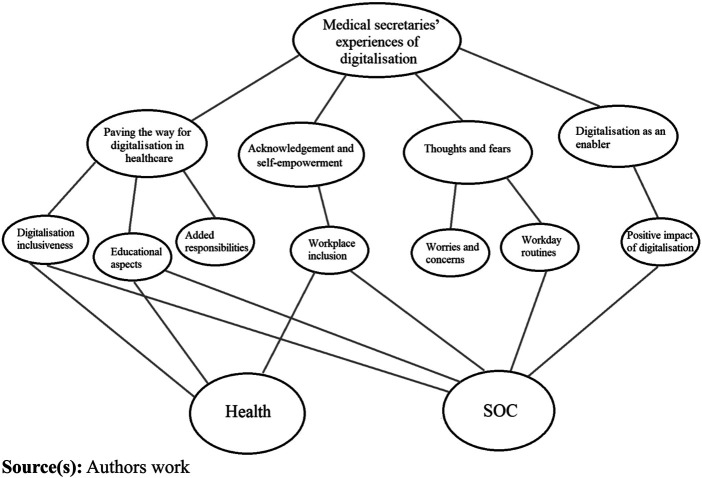
Four categories with seven underlying factors were identified, emphasising the crucial need for effective organisation of digital transformation. This is vital due to the increased knowledge and skills in utilising technology. The evolving roles and responsibilities of medical secretaries in dynamic healthcare settings should be clearly defined and acknowledged, highlighting the importance of professionality. Ensuring proper training for medical secretaries and other occupations in emerging techniques is crucial, emphasising equal value and knowledge across each role. Associations were found between some factors and the health of medical secretaries.
RESEARCH LIMITATIONS/IMPLICATIONS: This study adds to the knowledge on digital transformation in healthcare by examining an important occupation. Most data were collected online, which may be a limitation of this study.
Several aspects of the medical secretaries' experiences were identified. Knowledge of these is valuable for healthcare managers to make digital transformation more effective while avoiding excessive strain on medical secretaries.
ORIGINALITY/VALUE: Medical secretaries are expected to contribute to the digitalisation of healthcare. However, minimal research has been conducted on the role of medical secretaries in workplace digitalisation, focusing on workplace roles and its dynamics.
本混合方法研究旨在探讨瑞典医疗组织中的医疗秘书如何在工作场所环境和健康方面体验数字化转型,重点关注工作场所氛围和健康。
设计/方法/途径:本研究采用基于扎根理论的顺序探索性混合方法设计,收集定性数据(质量咖啡馆和个人访谈),然后收集定量数据(问卷)。
确定了四个类别,包含七个潜在因素,强调了有效组织数字化转型的关键需求。由于利用技术的知识和技能增加,这一点至关重要。在动态医疗环境中,医疗秘书不断变化的角色和职责应明确界定并得到承认,突出专业性的重要性。确保为医疗秘书和其他从事新兴技术的职业提供适当的培训至关重要,强调每个角色的平等价值和知识。发现一些因素与医疗秘书的健康之间存在关联。
研究局限性/影响:本研究通过考察一个重要职业,增加了对医疗保健数字化转型的知识。本研究大多数数据是在线收集的,这可能是该研究的一个局限性。
确定了医疗秘书体验的几个方面。了解这些方面对医疗保健管理人员有价值,可以使数字化转型更加有效,同时避免给医疗秘书带来过度压力。
原创性/价值:医疗秘书被期望为医疗保健的数字化做出贡献。然而,很少有研究关注医疗秘书在工作场所数字化中的角色,重点关注工作场所角色及其动态。