Department of Clinical Neuroscience, Karolinska Institutet, Stockholm, 171 65, Sweden.
Department of Psychology, Stress Research Institute, Stockholm University, Stockholm, 114 19, Sweden.
Transl Psychiatry. 2024 Jun 4;14(1):237. doi: 10.1038/s41398-024-02943-7.
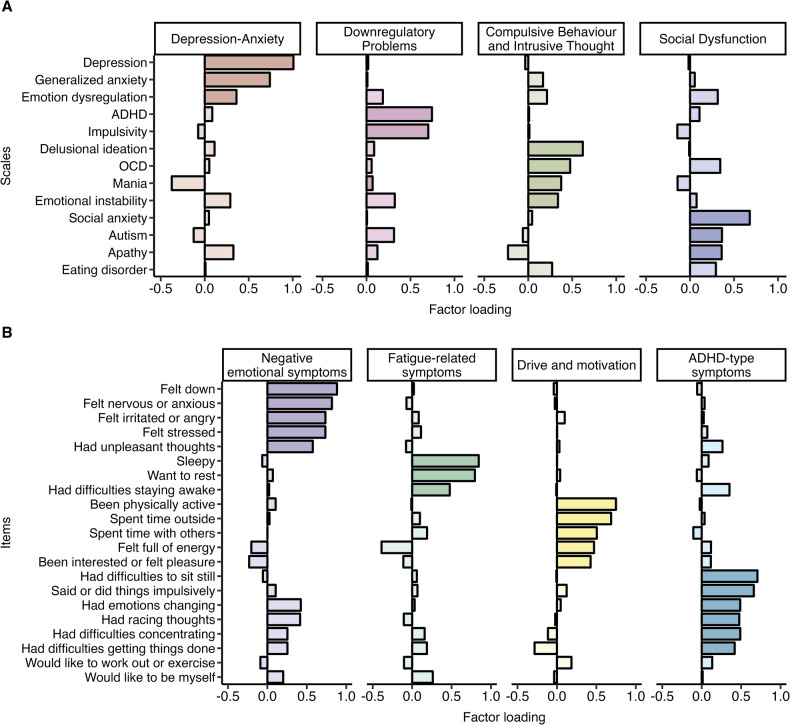
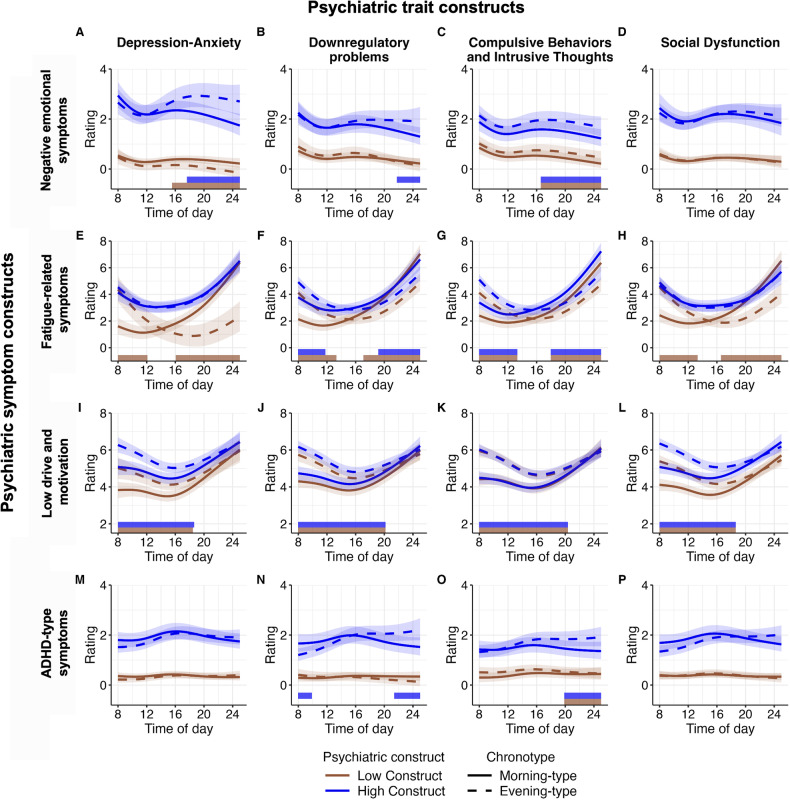
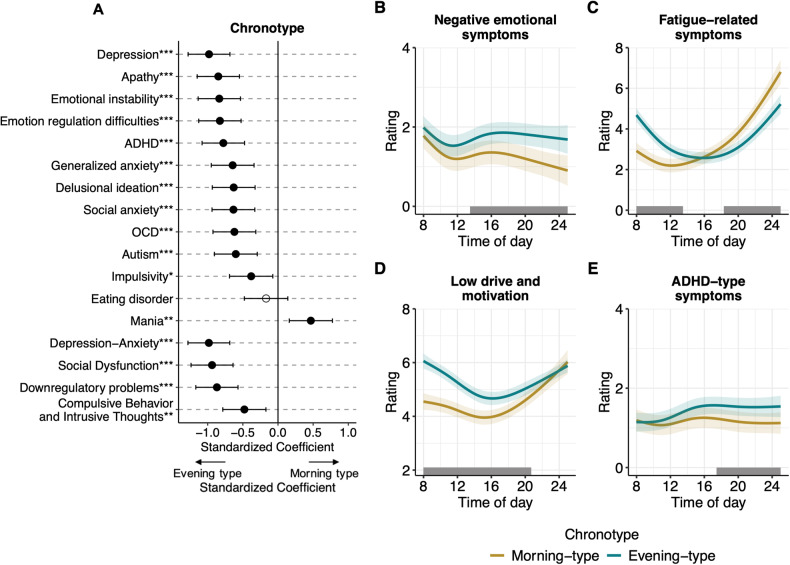
To advance the emergence of circadian-based therapies, this study characterized how psychiatric symptoms fluctuate across the day and vary between individuals. Using a dimensional approach, we determined how chronotype relates to 13 psychiatric traits, and modeled the temporal development of symptoms throughout the day using generalized additive mixed effects models. In this preregistered study, a subclinical sample completed 13 psychiatric trait scales and a chronotype scale at baseline (N = 515, n = 404 women, 109 men, n = 2 non-binary, M age = 32.4 years, range 18-77), followed by 22 psychiatric symptoms and behaviors rated repeatedly between ~08:00-00:00 (n = 410). Key findings are that 11 out of 13 psychiatric traits were associated with being an evening-type, ranging from depression to obsessive comulsive disorder, social anxiety, and delusional ideation, while only mania was associated with being a morning-type. Four distinct psychiatric trait factors were identified, each predicting worse symptom levels throughout the day. Fatigue-related symptoms exhibited strong time-of-day changes with evening-types experiencing worse fatigue in the morning and morning-types in the evening. Evening-types had considerably lower drive and motivation than morning-types from morning to early evening. Evening-types also had more pronounced negative emotional symptoms and ADHD-type symptoms in the evening, particularly among those high in psychiatric trait factors. These findings identified important research targets that hold promise for improving mental health outcomes, such as strategies to boost morning motivation. Furthermore, the results emphasize the relevance of incorporating circadian factors, including chronotype, into translational psychiatric research and interventions.
为了推动基于昼夜节律的疗法的出现,本研究描述了精神症状如何在一天中波动,并在个体之间变化。使用维度方法,我们确定了时型如何与 13 种精神特质相关,并用广义加性混合效应模型来模拟症状在一天中的时间发展。在这项预先注册的研究中,亚临床样本在基线时完成了 13 种精神特质量表和时型量表(N=515,n=404 名女性,109 名男性,n=2 名非二元性别,M 年龄=32.4 岁,范围 18-77),随后在大约 08:00-00:00 之间重复评估了 22 种精神症状和行为(n=410)。主要发现是,13 种精神特质中有 11 种与夜型有关,从抑郁到强迫症、社交焦虑和妄想观念,而只有躁狂与晨型有关。确定了四个不同的精神特质因素,每个因素都预测了全天更严重的症状水平。与疲劳相关的症状表现出强烈的时间变化,夜型在早晨经历更严重的疲劳,晨型在晚上经历更严重的疲劳。从早晨到傍晚,夜型的动力和动机比晨型低得多。夜型在傍晚时也有更明显的负面情绪症状和 ADHD 症状,尤其是在那些具有较高精神特质因素的人中。这些发现确定了一些重要的研究目标,这些目标有望改善心理健康结果,例如提高早晨动力的策略。此外,这些结果强调了将昼夜节律因素(包括时型)纳入转化精神病学研究和干预措施的相关性。