Chen Long, Li Wenzheng, Wang Song, Gu Mengyue, Jiang Feng, Liu Huanzhong, Tang Yi-Lang
Department of Psychiatry, Chaohu Hospital of Anhui Medical University, Hefei, China.
Anhui Clinical Center for Mental and Psychological Diseases, Hefei Fourth People's Hospital, Hefei, China.
Tob Induc Dis. 2024 Jun 13;22. doi: 10.18332/tid/189299. eCollection 2024.
Healthcare workers are integral to public smoking cessation; however, their own smoking behavior can create a significant obstacle to intervening in patients' cessation efforts. Conversely, their success in quitting can enhance their ability to support patients. Research on smoking behavior, particularly smoking cessation among Chinese psychiatric professionals is limited. This study addresses this gap by examining the factors associated with smoking cessation in this population, providing insights for targeted tobacco control policies.
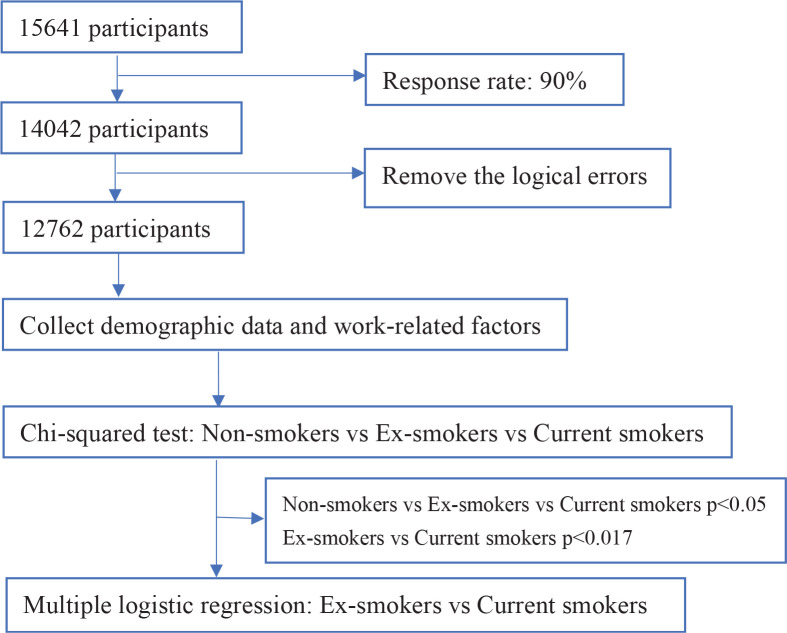
A cross-sectional survey was conducted, targeting psychiatric professionals including psychiatrists and psychiatric nurses, in 41 tertiary psychiatric hospitals in China. From January to March 2021, a WeChat-based questionnaire was distributed to collect demographic, occupational, and health-behaviors (including smoking) data. Statistical analyses, including the chi-squared test and adjusted binary logistic regression analysis, were conducted to identify the factors associated with smoking cessation.
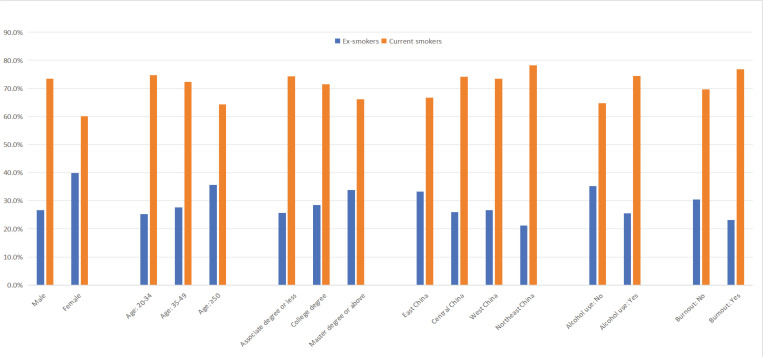
Among the 12762 psychiatric professionals who participated in the survey, 11104 (87.0%) were non-smokers, 1196 (9.4%) were current smokers, and 462 (3.6%) were ex-smokers. Several factors were found to be associated with smoking cessation. Women had a higher prevalence of ex-smokers than men (AOR=1.88; 95% CI: 1.332-2.666, p<0.001). Compared to East China, the prevalence of ex-smokers among participants in Central and Northeast China was lower. Older age (≥50 years), higher level of education (Master's degree or higher), and non-drinkers, showed a higher likelihood of being ex-smokers. Notably, compared to current smokers, ex-smokers reported a lower prevalence of burnout (AOR=0.70; 95% CI: 0.552-0.892, p=0.004).
Smoking cessation interventions or health promotion programs should also focus on gender, age, education level, region, alcohol use, and burnout to effectively address smoking cessation within this specific professional group.
医护人员对于公众戒烟至关重要;然而,他们自身的吸烟行为可能会对干预患者的戒烟努力造成重大障碍。相反,他们成功戒烟可以增强其支持患者的能力。关于吸烟行为的研究,尤其是中国精神科专业人员的戒烟情况,较为有限。本研究通过调查该人群中与戒烟相关的因素来填补这一空白,为有针对性的烟草控制政策提供见解。
在中国41家三级精神病医院对包括精神科医生和精神科护士在内的精神科专业人员进行了横断面调查。2021年1月至3月,通过微信发放问卷以收集人口统计学、职业和健康行为(包括吸烟)数据。进行了包括卡方检验和调整后的二元逻辑回归分析在内的统计分析,以确定与戒烟相关的因素。
在参与调查的12762名精神科专业人员中,11104人(87.0%)不吸烟,1196人(9.4%)为当前吸烟者,462人(3.6%)为既往吸烟者。发现几个因素与戒烟有关。女性既往吸烟者的患病率高于男性(调整后比值比=1.88;95%置信区间:1.332至2.666,p<0.001)。与华东地区相比,中部和东北地区参与者中既往吸烟者的患病率较低。年龄较大(≥50岁)、教育水平较高(硕士学位或更高)以及不饮酒者,成为既往吸烟者的可能性更高。值得注意的是,与当前吸烟者相比,既往吸烟者报告的职业倦怠患病率较低(调整后比值比=0.70;95%置信区间:0.552至0.892,p=0.004)。
戒烟干预措施或健康促进项目也应关注性别、年龄、教育水平、地区、饮酒情况和职业倦怠,以有效解决这一特定专业群体中的戒烟问题。