Institute of Biological Chemistry, Faculty of Chemistry, University of Vienna, Währinger Str. 38, Vienna, 109, Austria.
Vienna Doctoral School in Chemistry (DoSChem), University of Vienna, Währinger Str. 42, Vienna, 1090, Austria.
Adv Sci (Weinh). 2024 Aug;11(30):e2401239. doi: 10.1002/advs.202401239. Epub 2024 Jun 14.
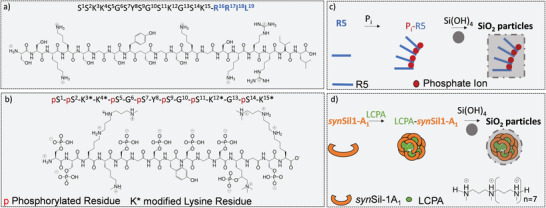
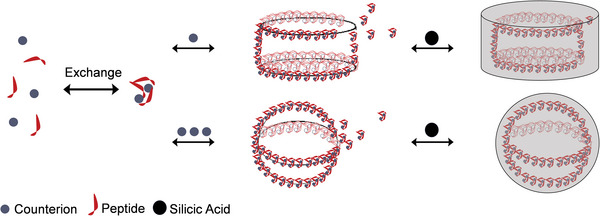
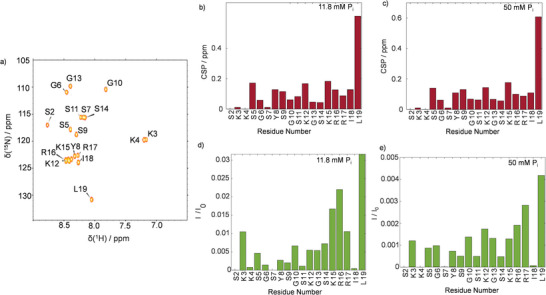
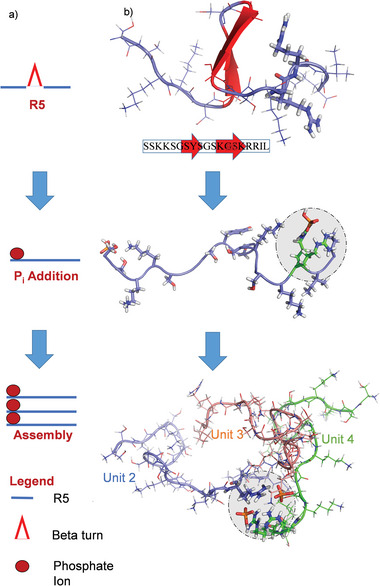
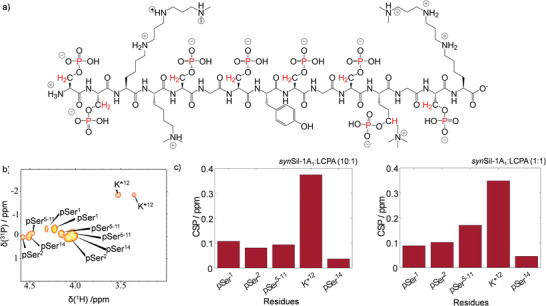
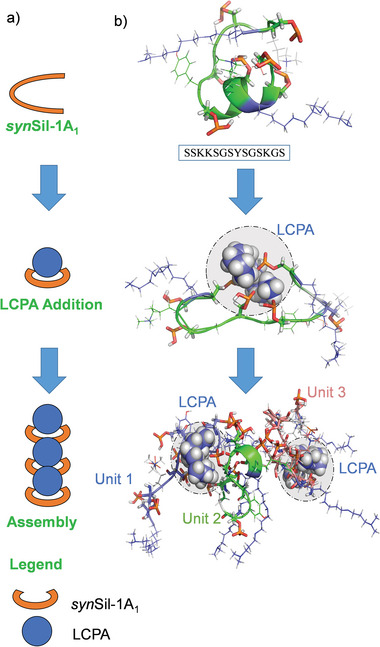
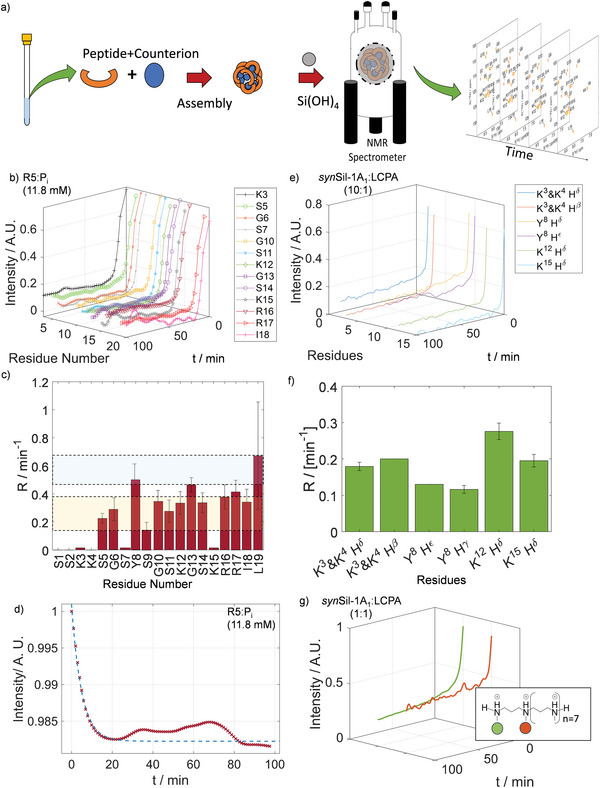
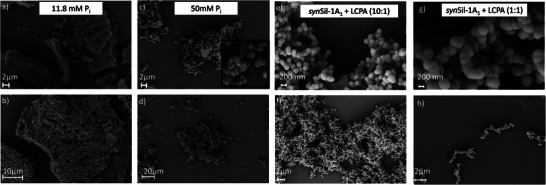
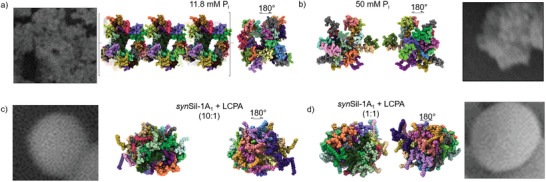
Deciphering nature's remarkable way of encoding functions in its biominerals holds the potential to enable the rational development of nature-inspired materials with tailored properties. However, the complex processes that convert solution-state precursors into solid biomaterials remain largely unknown. In this study, an unconventional approach is presented to characterize these precursors for the diatom-derived peptides R5 and synthetic Silaffin-1A (synSil-1A). These molecules can form defined supramolecular assemblies in solution, which act as templates for solid silica structures. Using a tailored structural biology toolbox, the structure-function relationships of these self-assemblies are unveiled. NMR-derived constraints are employed to enable a recently developed fractal-cluster formalism and then reveal the architecture of the peptide assemblies in atomistic detail. Finally, by monitoring the self-assembly activities during silica formation at simultaneous high temporal and residue resolution using real-time spectroscopy, the mechanism is elucidated underlying template-driven silica formation. Thus, it is demonstrated how to exercise morphology control over bioinorganic solids by manipulating the template architectures. It is found that the morphology of the templates is translated into the shape of bioinorganic particles via a mechanism that includes silica nucleation on the solution-state complexes' surfaces followed by complete surface coating and particle precipitation.
破译自然界在其生物矿化中对功能进行编码的非凡方式,有可能实现具有定制特性的受自然启发的材料的合理开发。然而,将溶液状态前体转化为固体生物材料的复杂过程在很大程度上仍然未知。在这项研究中,提出了一种非常规的方法来对来源于硅藻的肽 R5 和合成的 Silaffin-1A(synSil-1A)的这些前体进行表征。这些分子可以在溶液中形成定义明确的超分子组装体,这些组装体充当固体二氧化硅结构的模板。使用定制的结构生物学工具箱,揭示了这些自组装体的结构-功能关系。利用 NMR 衍生的约束条件,可以使用最近开发的分形簇形式主义,并以原子细节揭示肽组装体的结构。最后,通过使用实时光谱学在同时具有高时间和残基分辨率的情况下监测二氧化硅形成过程中的自组装活性,阐明了模板驱动的二氧化硅形成的机制。因此,展示了如何通过操纵模板结构来对生物无机固体进行形态控制。研究发现,模板的形态通过一种机制转化为生物无机颗粒的形状,该机制包括在溶液态配合物表面上进行二氧化硅成核,然后完全进行表面涂层和颗粒沉淀。