Jannah Mutmainah Wardatul, Handayani Fitri, Lukiswanto Bambang Sektiari, Arif Mohammad Anam Al, Suwarno Suwarno, Purnobasuki Hery, Sugihartuti Rahmi, Utama Suzanita, Darodjah Siti, Lestari Tita Damayanti, Lamid Mirni, Jang Goo, Safitri Erma
Department of Veterinary Medicine, Student of Veterinary Medicine Faculty, Universitas Airlangga, Surabaya, East Java, Indonesia.
Veterinary Clinic Division of Veterinary Medicine Faculty, Universitas Airlangga, Surabaya, East Java, Indonesia.
Vet World. 2024 May;17(5):1044-1051. doi: 10.14202/vetworld.2024.1044-1051. Epub 2024 May 15.
Mycotoxins such as aflatoxin B1 and ochratoxin A (OTA) are secondary metabolites in molds that grow in raw materials or commercial feed. This interaction has a synergistic effect on mortality, body weight, feed intake, embryo abnormalities, egg production, and lymphoid organ atrophy. This study was conducted to determine the effect of a mycotoxin detoxifier on the blood profile of broilers that were given feed contaminated with mycotoxin, such as the number of heterophils, lymphocytes, monocytes, mean corpuscular hemoglobin (MCH), and MCH concentration (MCHC).
A total of 20 day-old chicks (DOC) of Cobb broilers were given four treatments with five replicates. The number of chickens used in this research was determined using statistical calculations, and the data obtained was homogeneous so that the population was represented. Treatments included negative control with basal feed (C-), positive control with mycotoxins contamination (C+), treatment 1: Mycotoxins contamination and mycotoxin detoxification 1.1 g/kg (T1), and treatment 2: Mycotoxins contamination and mycotoxin detoxification 1.6 g/kg (T2). Mycotoxin contamination comprised 0.1 mg/kg aflatoxin B1 and 0.1 mg/kg OTA. The treatment period for chickens was 28 days, from 8 to 35 days. A battery cage was used in this study. Chickens were kept in a closed, ventilated room and the room temperature (27°C) was monitored during the treatment period.
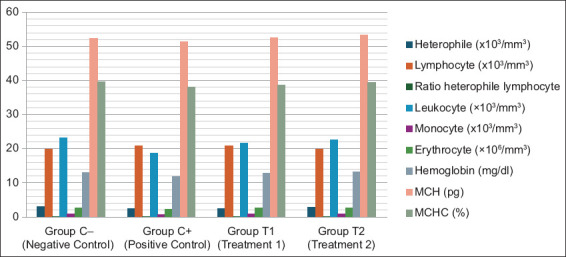
Based on the results of statistical data processing, a significant difference (p < 0.05) was observed between chickens fed mycotoxin-contaminated feed (C+) and chickens not fed mycotoxin-contaminated feed (C-) and chickens given 1.6 g/kg mycotoxin detoxification (T2). Mycotoxin detoxification at a dose of 1.6 g/kg had a significant (p < 0.05) effect on the heterophil, lymphocyte, and heterophil lymphocyte ratio, leukocyte, erythrocyte, and hemoglobin levels of the blood broiler in this experiment. On other parameters such as monocytes, MCH, and MCHC, treatment 2 at dose 1.6 g/kg was the best treatment, although there was no significant effect with C- and T1.
The administration of mycotoxin detoxifiers at a dose of 1.6 g/kg increased the number of heterophils and the ratio of heterophil lymphocytes, leukocytes, erythrocytes, and hemoglobin in broilers fed mycotoxin-contaminated feed.
黄曲霉毒素B1和赭曲霉毒素A(OTA)等霉菌毒素是在原料或商业饲料中生长的霉菌产生的次生代谢产物。这种相互作用对死亡率、体重、采食量、胚胎异常、产蛋量和淋巴器官萎缩具有协同作用。本研究旨在确定霉菌毒素解毒剂对食用受霉菌毒素污染饲料的肉鸡血液指标的影响,如嗜异性粒细胞、淋巴细胞、单核细胞、平均红细胞血红蛋白(MCH)和MCH浓度(MCHC)。
选用20只1日龄的科宝肉鸡雏鸡,进行4种处理,每种处理5个重复。本研究中使用的鸡只数量通过统计计算确定,所获得的数据具有同质性,能够代表总体。处理包括基础饲料阴性对照(C-)、霉菌毒素污染阳性对照(C+)、处理1:霉菌毒素污染及1.1 g/kg霉菌毒素解毒剂(T1)、处理2:霉菌毒素污染及1.6 g/kg霉菌毒素解毒剂(T2)。霉菌毒素污染包括0.1 mg/kg黄曲霉毒素B1和0.1 mg/kg OTA。鸡的处理期为28天,从8日龄至35日龄。本研究使用层叠式鸡笼。鸡饲养在封闭、通风的房间内,处理期间监测室温(27°C)。
基于统计数据处理结果,发现喂食受霉菌毒素污染饲料的鸡(C+)与未喂食受霉菌毒素污染饲料的鸡(C-)以及给予1.6 g/kg霉菌毒素解毒剂的鸡(T2)之间存在显著差异(p < 0.05)。在本实验中,1.6 g/kg剂量的霉菌毒素解毒剂对肉鸡血液中的嗜异性粒细胞、淋巴细胞、嗜异性粒细胞与淋巴细胞比值、白细胞、红细胞和血红蛋白水平具有显著(p < 0.05)影响。在单核细胞、MCH和MCHC等其他参数方面,1.6 g/kg剂量的处理2是最佳处理,尽管与C-和T1相比无显著影响。
给予1.6 g/kg剂量的霉菌毒素解毒剂可增加食用受霉菌毒素污染饲料的肉鸡的嗜异性粒细胞数量、嗜异性粒细胞与淋巴细胞比值、白细胞、红细胞和血红蛋白水平。