
在许多情况下,流动性降低对感染增长的影响是二次方的。
The effect of mobility reductions on infection growth is quadratic in many cases.
机构信息
Technische Universität Berlin, FG Verkehrssystemplanung und Verkehrstelematik, 10623, Berlin, Germany.
Zuse Institute Berlin, 14195, Berlin, Germany.
出版信息
Sci Rep. 2024 Jun 24;14(1):14475. doi: 10.1038/s41598-024-64230-1.
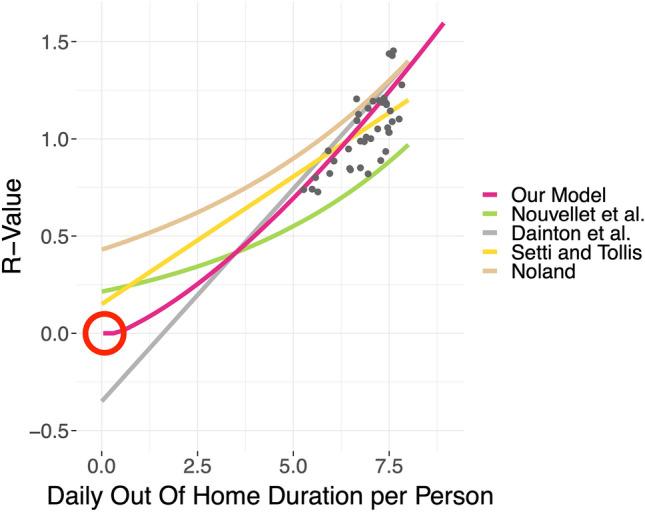
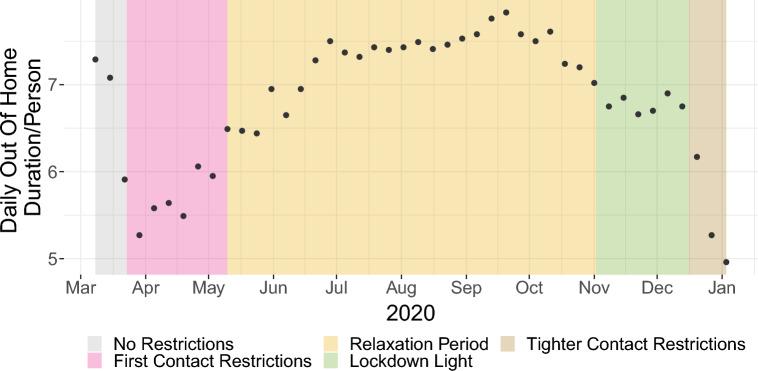
Stay-at-home orders were introduced in many countries during the COVID-19 pandemic, limiting the time people spent outside their home and the attendance of gatherings. In this study, we argue from a theoretical model that in many cases the effect of such stay-at-home orders on incidence growth should be quadratic, and that this statement should also hold beyond COVID-19. That is, a reduction of the out-of-home duration to, say, 70% of its original value should reduce incidence growth and thus the effective R-value to of its original value. We then show that this hypothesis can be substantiated from data acquired during the COVID-19 pandemic by using a multiple regression model to fit a combination of the quadratic out-of-home duration and temperature to the COVID-19 growth multiplier. We finally demonstrate that many other models, when brought to the same scale, give similar reductions of the effective R-value, but that none of these models extend plausibly to an out-of-home duration of zero.
在 COVID-19 大流行期间,许多国家都发布了居家令,限制人们离家在外的时间和聚会的出席人数。在这项研究中,我们从理论模型出发认为,在许多情况下,这种居家令对发病率增长的影响应该是二次方的,而且这种说法应该也适用于 COVID-19 之外的情况。也就是说,将外出时间减少到原来的 70%,应该会降低发病率,从而将有效 R 值降低到原来的 0.49。然后,我们通过使用多元回归模型将二次方的外出时间和温度与 COVID-19 增长率相乘,从 COVID-19 大流行期间获得的数据中证明了这一假设。最后,我们证明了许多其他模型在相同的规模下也会给出类似的有效 R 值降低,但没有一个模型可以合理地扩展到零外出时间。



 Zotero 插件