• 文献检索
  • 文档翻译
  • 深度研究
  • 学术资讯
  • Suppr Zotero 插件Zotero 插件
  • 邀请有礼
  • 套餐&价格
  • 历史记录
应用&插件
Suppr Zotero 插件Zotero 插件浏览器插件Mac 客户端Windows 客户端微信小程序
定价
高级版会员购买积分包购买API积分包
服务
文献检索文档翻译深度研究API 文档MCP 服务
关于我们
关于 Suppr公司介绍联系我们用户协议隐私条款
关注我们

Suppr 超能文献

核心技术专利:CN118964589B侵权必究
粤ICP备2023148730 号-1Suppr @ 2026

文献检索

告别复杂PubMed语法,用中文像聊天一样搜索,搜遍4000万医学文献。AI智能推荐,让科研检索更轻松。

立即免费搜索

文件翻译

保留排版,准确专业,支持PDF/Word/PPT等文件格式,支持 12+语言互译。

免费翻译文档

深度研究

AI帮你快速写综述,25分钟生成高质量综述,智能提取关键信息,辅助科研写作。

立即免费体验

ST-CellSeg:基于多尺度流形学习的成像空间转录组学细胞分割。

ST-CellSeg: Cell segmentation for imaging-based spatial transcriptomics using multi-scale manifold learning.

机构信息

Department of Biochemistry, Schulich School of Medicine & Dentistry, Western University, London, Ontario, Canada.

Department of Computer Science, Western University, London, Ontario, Canada.

出版信息

PLoS Comput Biol. 2024 Jun 27;20(6):e1012254. doi: 10.1371/journal.pcbi.1012254. eCollection 2024 Jun.

DOI:10.1371/journal.pcbi.1012254
PMID:38935799
原文链接:https://pmc.ncbi.nlm.nih.gov/articles/PMC11236102/
Abstract

Spatial transcriptomics has gained popularity over the past decade due to its ability to evaluate transcriptome data while preserving spatial information. Cell segmentation is a crucial step in spatial transcriptomic analysis, as it enables the avoidance of unpredictable tissue disentanglement steps. Although high-quality cell segmentation algorithms can aid in the extraction of valuable data, traditional methods are frequently non-spatial, do not account for spatial information efficiently, and perform poorly when confronted with the problem of spatial transcriptome cell segmentation with varying shapes. In this study, we propose ST-CellSeg, an image-based machine learning method for spatial transcriptomics that uses manifold for cell segmentation and is novel in its consideration of multi-scale information. We first construct a fully connected graph which acts as a spatial transcriptomic manifold. Using multi-scale data, we then determine the low-dimensional spatial probability distribution representation for cell segmentation. Using the adjusted Rand index (ARI), normalized mutual information (NMI), and Silhouette coefficient (SC) as model performance measures, the proposed algorithm significantly outperforms baseline models in selected datasets and is efficient in computational complexity.

摘要

空间转录组学在过去十年中变得流行起来,因为它能够在保留空间信息的同时评估转录组数据。细胞分割是空间转录组分析的关键步骤,因为它可以避免不可预测的组织分离步骤。虽然高质量的细胞分割算法可以帮助提取有价值的数据,但传统方法通常是非空间的,不能有效地利用空间信息,并且在面对具有不同形状的空间转录组细胞分割问题时表现不佳。在这项研究中,我们提出了 ST-CellSeg,这是一种基于图像的机器学习方法,用于空间转录组学,它使用流形进行细胞分割,并考虑了多尺度信息。我们首先构建了一个全连接图,作为空间转录组学的流形。然后,我们使用多尺度数据确定细胞分割的低维空间概率分布表示。使用调整后的兰德指数(ARI)、归一化互信息(NMI)和轮廓系数(SC)作为模型性能指标,所提出的算法在选定的数据集上显著优于基线模型,并且在计算复杂度方面效率很高。
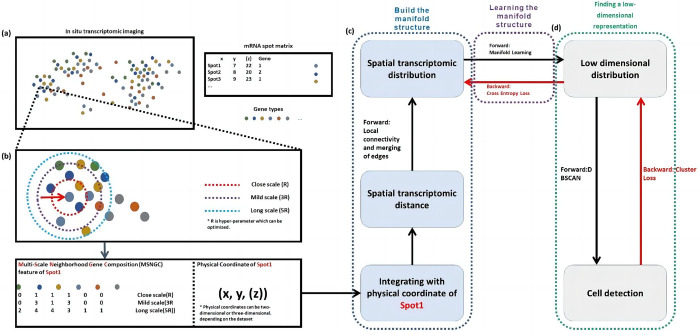
https://cdn.ncbi.nlm.nih.gov/pmc/blobs/3811/11236102/5014dbe80b4a/pcbi.1012254.g003.jpg
https://cdn.ncbi.nlm.nih.gov/pmc/blobs/3811/11236102/c28b85c0da3a/pcbi.1012254.g001.jpg
https://cdn.ncbi.nlm.nih.gov/pmc/blobs/3811/11236102/2952eb20dc66/pcbi.1012254.g002.jpg
https://cdn.ncbi.nlm.nih.gov/pmc/blobs/3811/11236102/5014dbe80b4a/pcbi.1012254.g003.jpg
https://cdn.ncbi.nlm.nih.gov/pmc/blobs/3811/11236102/c28b85c0da3a/pcbi.1012254.g001.jpg
https://cdn.ncbi.nlm.nih.gov/pmc/blobs/3811/11236102/2952eb20dc66/pcbi.1012254.g002.jpg
https://cdn.ncbi.nlm.nih.gov/pmc/blobs/3811/11236102/5014dbe80b4a/pcbi.1012254.g003.jpg

相似文献

1
ST-CellSeg: Cell segmentation for imaging-based spatial transcriptomics using multi-scale manifold learning.ST-CellSeg:基于多尺度流形学习的成像空间转录组学细胞分割。
PLoS Comput Biol. 2024 Jun 27;20(6):e1012254. doi: 10.1371/journal.pcbi.1012254. eCollection 2024 Jun.
2
STGNNks: Identifying cell types in spatial transcriptomics data based on graph neural network, denoising auto-encoder, and k-sums clustering.基于图神经网络、去噪自编码器和 k-sums 聚类的空间转录组学数据中的细胞类型识别。
Comput Biol Med. 2023 Nov;166:107440. doi: 10.1016/j.compbiomed.2023.107440. Epub 2023 Sep 9.
3
Computational solutions for spatial transcriptomics.空间转录组学的计算解决方案。
Comput Struct Biotechnol J. 2022 Sep 1;20:4870-4884. doi: 10.1016/j.csbj.2022.08.043. eCollection 2022.
4
scBOL: a universal cell type identification framework for single-cell and spatial transcriptomics data.scBOL:单细胞和空间转录组学数据的通用细胞类型识别框架。
Brief Bioinform. 2024 Mar 27;25(3). doi: 10.1093/bib/bbae188.
5
FICTURE: scalable segmentation-free analysis of submicron-resolution spatial transcriptomics.示意图:亚微米分辨率空间转录组学的可扩展无分割分析。
Nat Methods. 2024 Oct;21(10):1843-1854. doi: 10.1038/s41592-024-02415-2. Epub 2024 Sep 12.
6
A graph self-supervised residual learning framework for domain identification and data integration of spatial transcriptomics.一种图自监督残差学习框架,用于空间转录组学的领域识别和数据集成。
Commun Biol. 2024 Sep 12;7(1):1123. doi: 10.1038/s42003-024-06814-1.
7
Hexagonal image segmentation on spatially resolved transcriptomics.空间分辨转录组学中的六边形图像分割
Methods. 2023 Dec;220:61-68. doi: 10.1016/j.ymeth.2023.11.002. Epub 2023 Nov 4.
8
An initial game-theoretic assessment of enhanced tissue preparation and imaging protocols for improved deep learning inference of spatial transcriptomics from tissue morphology.从组织形态学上提高空间转录组学深度学习推断的增强组织准备和成像协议的初步博弈论评估。
Brief Bioinform. 2024 Sep 23;25(6). doi: 10.1093/bib/bbae476.
9
A multi-view graph contrastive learning framework for deciphering spatially resolved transcriptomics data.一种用于破译空间分辨转录组学数据的多视图图对比学习框架。
Brief Bioinform. 2024 May 23;25(4). doi: 10.1093/bib/bbae255.
10
ST-SCSR: identifying spatial domains in spatial transcriptomics data via structure correlation and self-representation.ST-SCSR:通过结构相关性和自表示来识别空间转录组学数据中的空间域。
Brief Bioinform. 2024 Jul 25;25(5). doi: 10.1093/bib/bbae437.

引用本文的文献

1
SMORE: spatial motifs reveal patterns in cellular architecture of complex tissues.SMORE:空间基序揭示复杂组织细胞结构中的模式。
Genome Biol. 2025 Jan 3;26(1):3. doi: 10.1186/s13059-024-03467-5.

本文引用的文献

1
Deciphering spatial domains from spatially resolved transcriptomics with an adaptive graph attention auto-encoder.利用自适应图注意自动编码器从空间分辨转录组学中破译空间域。
Nat Commun. 2022 Apr 1;13(1):1739. doi: 10.1038/s41467-022-29439-6.
2
Analysis and Visualization of Spatial Transcriptomic Data.空间转录组数据的分析与可视化
Front Genet. 2022 Jan 27;12:785290. doi: 10.3389/fgene.2021.785290. eCollection 2021.
3
SpaGCN: Integrating gene expression, spatial location and histology to identify spatial domains and spatially variable genes by graph convolutional network.
SpaGCN:通过图卷积网络整合基因表达、空间位置和组织学信息以识别空间域和空间可变基因
Nat Methods. 2021 Nov;18(11):1342-1351. doi: 10.1038/s41592-021-01255-8. Epub 2021 Oct 28.
4
Cell segmentation in imaging-based spatial transcriptomics.基于成像的空间转录组学中的细胞分割
Nat Biotechnol. 2022 Mar;40(3):345-354. doi: 10.1038/s41587-021-01044-w. Epub 2021 Oct 14.
5
ClusterMap for multi-scale clustering analysis of spatial gene expression.空间基因表达的多尺度聚类分析的聚类图。
Nat Commun. 2021 Oct 8;12(1):5909. doi: 10.1038/s41467-021-26044-x.
6
Advances in spatial transcriptomic data analysis.空间转录组数据分析的进展。
Genome Res. 2021 Oct;31(10):1706-1718. doi: 10.1101/gr.275224.121.
7
Cellpose: a generalist algorithm for cellular segmentation.Cellpose:一种通用的细胞分割算法。
Nat Methods. 2021 Jan;18(1):100-106. doi: 10.1038/s41592-020-01018-x. Epub 2020 Dec 14.
8
Single cell transcriptomics comes of age.单细胞转录组学时代的到来。
Nat Commun. 2020 Aug 27;11(1):4307. doi: 10.1038/s41467-020-18158-5.
9
Spatial Transcriptomics and In Situ Sequencing to Study Alzheimer's Disease.空间转录组学和原位测序在阿尔茨海默病研究中的应用。
Cell. 2020 Aug 20;182(4):976-991.e19. doi: 10.1016/j.cell.2020.06.038. Epub 2020 Jul 22.
10
Benchmarking single-cell RNA-sequencing protocols for cell atlas projects.单细胞 RNA 测序技术在细胞图谱项目中的基准测试。
Nat Biotechnol. 2020 Jun;38(6):747-755. doi: 10.1038/s41587-020-0469-4. Epub 2020 Apr 6.