College of Physical Education, Huaqiao University, Quanzhou, Fujian, China.
PLoS One. 2024 Jul 15;19(7):e0299135. doi: 10.1371/journal.pone.0299135. eCollection 2024.
Meta-analysis was conducted to examine the effect of supplemental curcumin intake on skeletal muscle injury status and to propose an optimal intervention program.
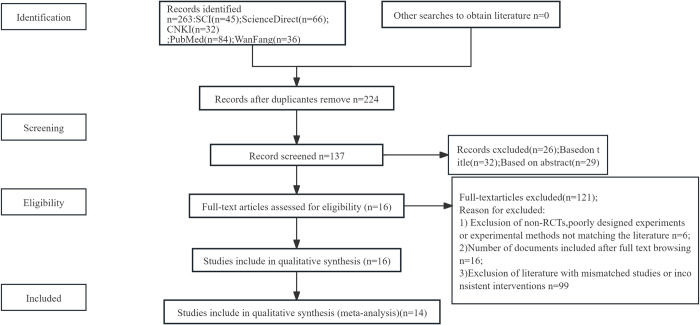
In accordance with the procedures specified in the PRISMA statement for systematic reviews and meta-analyses of randomized controlled trials, the Review Manager 5.3 was used to analyze the results of creatine kinase (CK), muscle soreness, interleukin-6 (IL-6), and range of motion (ROM) as outcome indicators in the 349 subjects included in the 14 articles.
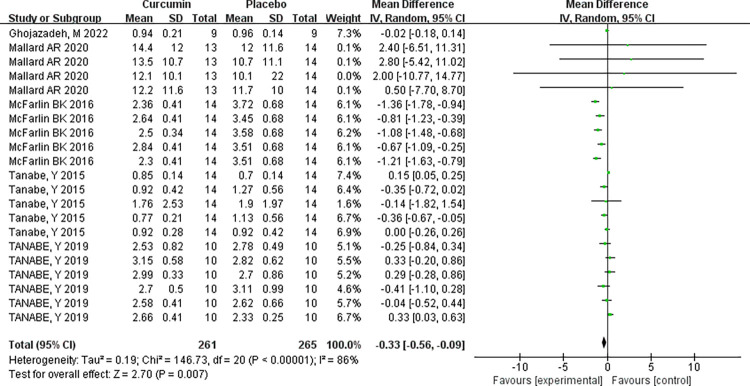
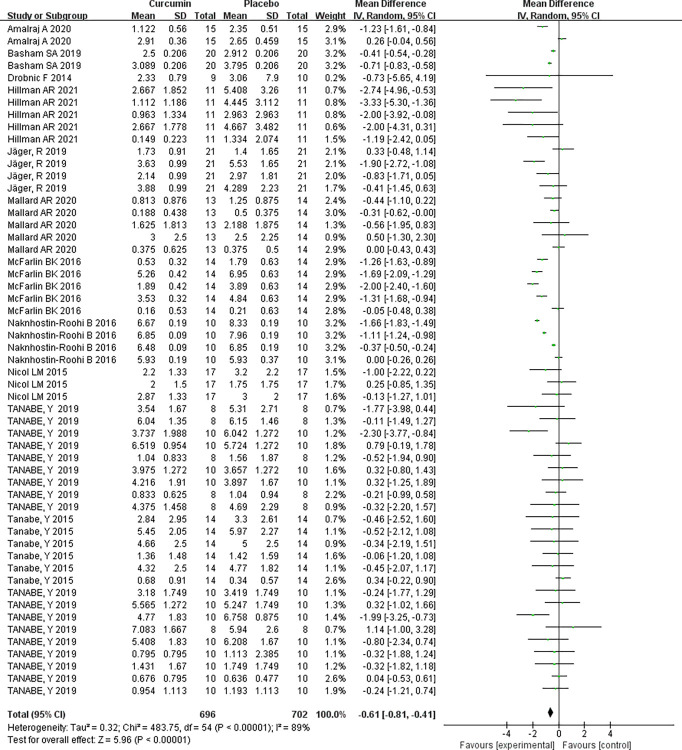
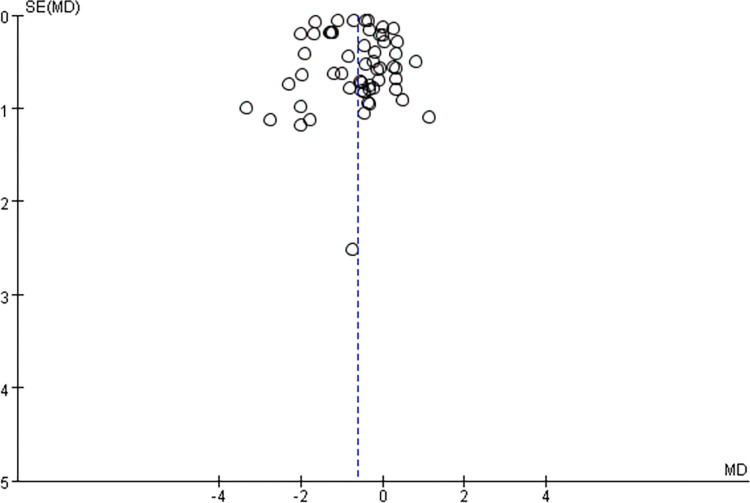
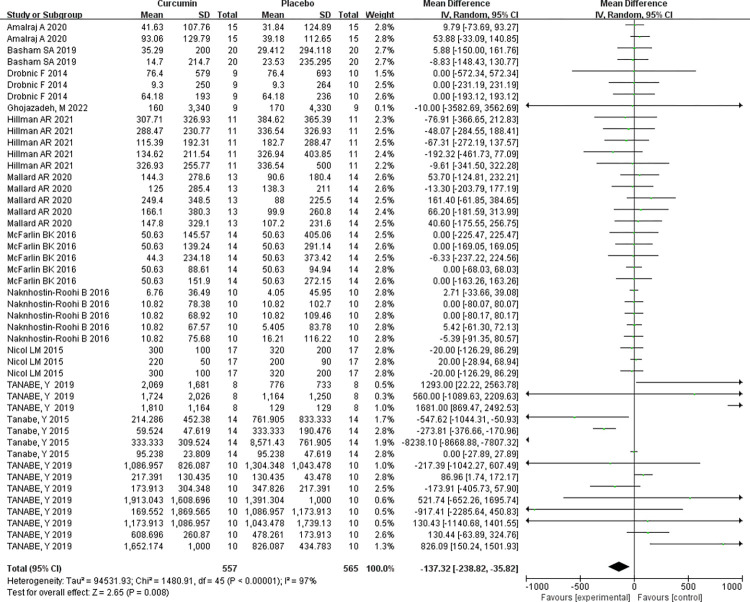
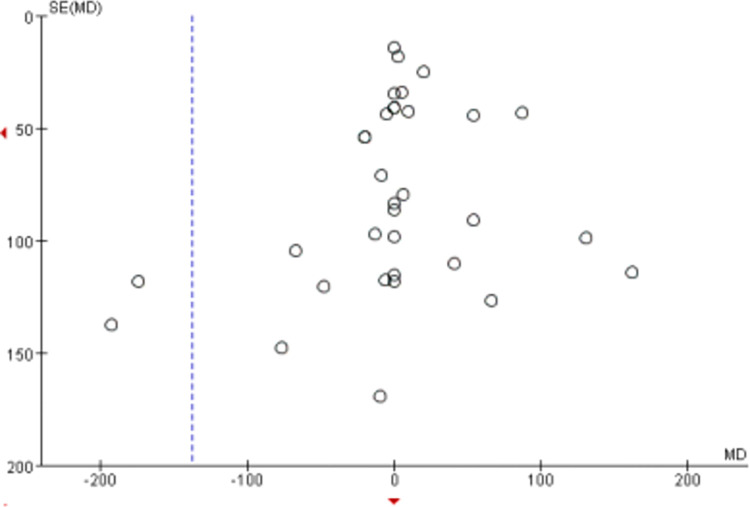
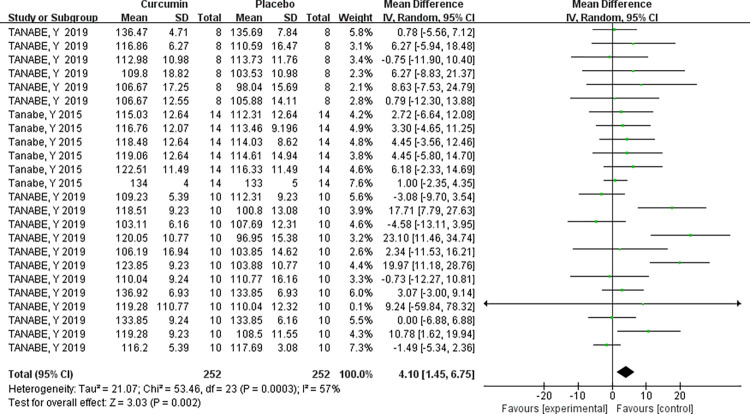
The effect size of curcumin supplementation on muscle soreness, mean difference (MD) = -0.61; the relationship between curcumin supplementation and muscle soreness for time of measurement (I2 = 83.6%)、the relationship between curcumin supplementation and muscle soreness for period of intervention (I2 = 26.2%)、the relationship between whether one had been trained (I2 = 0%) and supplementation dose (I2 = 0%) were not heterogeneous for the relationship between curcumin supplementation and muscle soreness; The effect size on CK, MD = -137.32; the relationship between curcumin supplementation and CK (I2 = 79.7%)、intervention period (I2 = 91.9%)、whether or not trained (I2 = 90.7%)、and no heterogeneity in the relationship between curcumin supplementation and CK for the time of measurement (I2 = 0%); The effect size MD = 4.10 for the effect on ROM; The effect size for IL-6 was MD = -0.33.
This meta-analysis highlights that curcumin supplementation significantly mitigates skeletal muscle damage, with notable improvements in CK levels, muscle soreness, IL-6 levels, and ROM. The results highlight the importance of curcumin dosage and timing, revealing that prolonged supplementation yields the best results, especially for untrained individuals or those less exposed to muscle-damaging exercise. For muscle soreness and ROM enhancement, a pre-emptive, low-dose regimen is beneficial, while immediate post-exercise supplementation is most effective at reducing CK and IL-6 levels.
系统评价荟萃分析旨在探讨补充姜黄素对骨骼肌损伤状态的影响,并提出最佳的干预方案。
根据系统评价和随机对照试验荟萃分析 PRISMA 声明的程序,使用 Review Manager 5.3 分析纳入的 14 项研究中的 349 名受试者的肌酸激酶(CK)、肌肉酸痛、白细胞介素-6(IL-6)和活动范围(ROM)等结果指标。
姜黄素补充对肌肉酸痛的效应量,均数差(MD)=-0.61;姜黄素补充与肌肉酸痛的测量时间(I2=83.6%)、干预时间(I2=26.2%)、是否训练(I2=0%)和补充剂量(I2=0%)之间的关系无统计学异质性;姜黄素补充对 CK 的效应量,MD=-137.32;姜黄素补充与 CK 的关系(I2=79.7%)、干预时间(I2=91.9%)、是否训练(I2=90.7%)和测量时间的关系无统计学异质性(I2=0%);对 ROM 的效应量 MD=4.10;对 IL-6 的效应量 MD=-0.33。
本荟萃分析强调了姜黄素补充可显著减轻骨骼肌损伤,显著降低 CK 水平、肌肉酸痛、IL-6 水平和 ROM。结果强调了姜黄素剂量和时间的重要性,表明延长补充时间可获得最佳效果,特别是对未经训练或较少接触肌肉损伤运动的个体。对于肌肉酸痛和 ROM 的增强,预补充低剂量方案有益,而运动后即刻补充对降低 CK 和 IL-6 水平最有效。