From the University of Iowa College of Nursing, Iowa City, IA.
Yale School of Medicine, New Haven, CT.
Menopause. 2024 Sep 1;31(9):756-763. doi: 10.1097/GME.0000000000002396. Epub 2024 Jul 29.
The purpose of this qualitative study was to explore the symptom experience and coping strategies for managing joint pain during the menopause transition in urban Latina women.
We conducted focus groups with 13 English-speaking peri and early postmenopausal Latinas living in Upper Manhattan in New York City in 2014. Eligible participants were self-identified Latinas aged 45 to 60 years with new onset or worsening joint pain and spontaneous amenorrhea, recruited through flyers and snowball sampling. Focus group interviews conducted in English were audiotaped, transcribed, and analyzed by a bilingual research team, using NVivo software (QSR International) to organize and code themes.
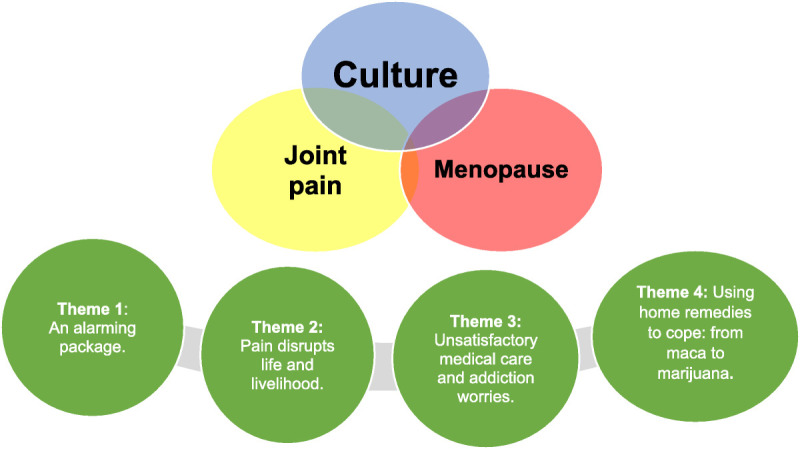
On average, participants were aged 51.7 ± 4.8 years and overweight (body mass index of 29.3 ± 6.7 kg/m 2 ); 10 (76.9%) were Puerto Rican, and the last menstrual period was 1 month to 5 years ago. The following four themes emerged: 1) menopause and joint pain are an alarming package; 2) pain disrupts life and livelihood; 3) medical management is unsatisfactory and raises worries about addiction; and 4) home remedies for coping with pain-from maca to marijuana. Despite access to a world-class medical facility in their neighborhood, women seeking pain relief preferred to self-manage joint pain with exercise, over-the-counter products, and other culturally valued home remedies. Many suffered through it.
For midlife Latinas, joint pain symptoms may emerge or worsen unexpectedly as part of the menopause transition and carry distressing consequences for daily activities and quality of life. There is a need to develop more culturally specific approaches for menopause-related pain management in this underserved population.
本定性研究旨在探索城市拉丁裔女性绝经过渡期关节疼痛的症状体验和应对策略。
我们于 2014 年在纽约市曼哈顿上城进行了焦点小组访谈,参与者为 13 名英语流利的绝经前期和早期的拉丁裔女性,年龄 45 至 60 岁,有新发或加重的关节疼痛和自发性闭经,通过传单和滚雪球抽样招募。用英语进行的焦点小组访谈被录音、转录,并由双语研究团队使用 NVivo 软件(QSR International)进行分析,以组织和编码主题。
参与者的平均年龄为 51.7 ± 4.8 岁,超重(体重指数 29.3 ± 6.7 kg/m 2 );10 人(76.9%)为波多黎各人,末次月经为 1 个月至 5 年前。出现了以下四个主题:1)绝经和关节疼痛是一个令人震惊的组合;2)疼痛扰乱了生活和生计;3)医疗管理不尽如人意,并引起了对成瘾的担忧;4)应对疼痛的家庭疗法——从玛卡到大麻。尽管附近有一家世界级的医疗设施,但寻求缓解疼痛的女性更愿意通过锻炼、非处方产品和其他受文化重视的家庭疗法来自我管理关节疼痛。许多人都在忍受痛苦。
对于中年拉丁裔女性来说,关节疼痛症状可能会在绝经过渡期意外出现或恶化,并对日常活动和生活质量产生令人痛苦的后果。在这个服务不足的人群中,需要开发更具文化特异性的绝经相关疼痛管理方法。