Wu Zhenjie, Wang Zheng, Moschovas Marcio Covas, Bertolo Riccardo, Campi Riccardo, Rivas Juan Gómez, Wei Yong, Xia Dan, Xu Bin, Zhu Qingyi, Teoh Jeremy Yuen-Chun, Gandaglia Giorgio, Amparore Daniele, Porpiglia Francesco, Patel Vipul, Wang Linhui
Department of Urology, Changhai Hospital, Naval Medical University, Shanghai, China.
European Association of Urology Young Academic Urologists, Arnhem, The Netherlands.
Eur Urol Open Sci. 2024 Jul 17;67:26-37. doi: 10.1016/j.euros.2024.07.107. eCollection 2024 Sep.
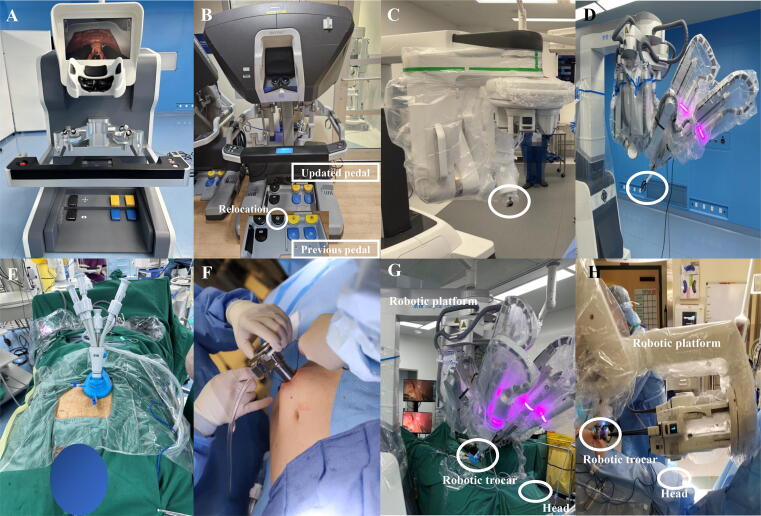
The purpose-built SHURUI single-port (SP) robotic platform has recently been introduced for several procedures in urology, general surgery, and gynecology. However, comparative evidence on its performance in relation to earlier models such as the da Vinci SP is lacking. Our aim was to compare the step-by-step techniques and 1-yr outcomes for radical prostatectomy (RP) between the SHURUI SP and da Vinci SP robots.
Data were retrieved from two prospectively maintained databases. The SHURUI SP robot was used to perform RP in 34 patients in China (September 2021 to August 2022); the da Vinci SP robot was used to perform 100 consecutive RP cases in the USA (June 2019 to October 2020). A comparative analysis was conducted before and after 1:1 propensity score matching for age, body mass index, American Urological Association symptom score, prostate size, prostate-specific antigen (PSA) levels, biopsy grade group, and D'Amico risk group. Intraoperative performance and short-term oncological and continence outcomes were compared between the groups. Biochemical recurrence was defined as two consecutive postoperative PSA levels >0.2 ng/ml. Continence was defined as full recovery of urinary control without the use of pads. The Kaplan-Meier method was used to estimate continence recovery curves, and a log-rank test for trend was used to detect ordered differences in continence recovery between the SHURUI SP and da Vinci SP groups after surgery.
For the matched SHURUI and da Vinci groups, median age (69 vs 69 yr), median PSA (8.4 vs 7.1 ng/ml), and the proportion of patients with low-risk (33.3% vs 29.6%), intermediate-risk (66.7% vs 63%), and high-risk disease (0% vs 7.4%) were comparable (all > 0.05). All surgeries were successfully accomplished without conversion. A higher percentage of cases in the SHURUI group involved extraperitoneal access (81.5% vs 0%; < 0.001) and a pure SP approach (25.9% vs 0%; = 0.01), while a higher percentage of cases in the da Vinci group had nerve-sparing surgery. The median total operative (215 vs 110 min; < 0.001) and median console time (162 vs 75 min; < 0.001) were significantly longer in the SHURUI group. No intraoperative or major postoperative complications were observed in either group. Rates of positive surgical margins (18.5% vs 14.8%; = 1.0) and extraprostatic extension (14.8% vs 29.6%; = 0.19) were similar. At median follow-up of 13.5 versus 15.9 mo, none of the patients had experienced biochemical recurrence. At 1 yr after surgery, the continence rate was 96.3% in both groups.
Despite differences in driving mechanisms between the two SP robotic systems, RP can be performed safely and effectively with the SHURUI RP robot during the initial learning phase, with similar short-term oncological and continence outcomes to those with the da Vinci SP robot.
We compared two surgical robots (SHURUI SP and da Vinci SP) used to perform robotic surgery to remove the prostate through a single keyhole incision instead of multiple incisions. Our results show comparable technology and similar surgical and short-term cancer control outcomes for the two robots.
专门设计的舒瑞单孔(SP)机器人平台最近已被应用于泌尿外科、普通外科和妇科的多种手术。然而,缺乏关于其与早期型号(如达芬奇SP)相比性能的比较证据。我们的目的是比较舒瑞SP机器人和达芬奇SP机器人在根治性前列腺切除术(RP)中的分步技术和1年结果。
数据来自两个前瞻性维护的数据库。在中国,使用舒瑞SP机器人为34例患者实施RP(2021年9月至2022年8月);在美国,使用达芬奇SP机器人连续为100例患者实施RP(2019年6月至2020年10月)。在对年龄、体重指数、美国泌尿外科协会症状评分、前列腺大小、前列腺特异性抗原(PSA)水平、活检分级组和达米科风险组进行1:1倾向评分匹配前后进行比较分析。比较两组的术中表现以及短期肿瘤学和控尿结果。生化复发定义为术后连续两次PSA水平>0.2 ng/ml。控尿定义为无需使用尿垫即可完全恢复排尿控制。采用Kaplan-Meier方法估计控尿恢复曲线,并使用趋势对数秩检验检测舒瑞SP组和达芬奇SP组术后控尿恢复的有序差异。
对于匹配的舒瑞组和达芬奇组,中位年龄(69岁对69岁)、中位PSA(8.4 ng/ml对7.1 ng/ml)以及低风险(33.3%对29.6%)、中风险(66.7%对63%)和高风险疾病患者的比例(0%对7.4%)具有可比性(均P>0.05)。所有手术均成功完成,无需中转。舒瑞组中更高比例的病例采用腹膜外入路(81.5%对0%;P<0.001)和单纯单孔入路(25.9%对0%;P=0.01),而达芬奇组中更高比例的病例进行了保留神经手术。舒瑞组的中位总手术时间(215分钟对110分钟;P<0.001)和中位控制台时间(162分钟对75分钟;P<0.001)明显更长。两组均未观察到术中或重大术后并发症。手术切缘阳性率(18.5%对14.8%;P=1.0)和前列腺外侵犯率(14.8%对29.6%;P=0.19)相似。中位随访时间分别为13.5个月和15.个月,所有患者均未发生生化复发。术后1年,两组的控尿率均为96.3%。
尽管两种单孔机器人系统的驱动机制存在差异,但在初始学习阶段,使用舒瑞RP机器人可以安全有效地实施RP,其短期肿瘤学和控尿结果与达芬奇SP机器人相似。
我们比较了两种用于通过单个小孔切口而非多个切口进行机器人手术切除前列腺的手术机器人(舒瑞SP和达芬奇SP)。我们的结果显示,这两种机器人技术相当,手术和短期癌症控制结果相似。