School of Computer Science, Hunan First Normal University, Changsha, 410205, China.
Department of Dermatology, Shenzhen People's Hospital (The Second Clinical Medical College, Jinan University; The First Affiliated Hospital, Southern University of Science and Technology), Shenzhen, 518020, Guangdong, China.
Sci Rep. 2024 Aug 26;14(1):19781. doi: 10.1038/s41598-024-70231-x.
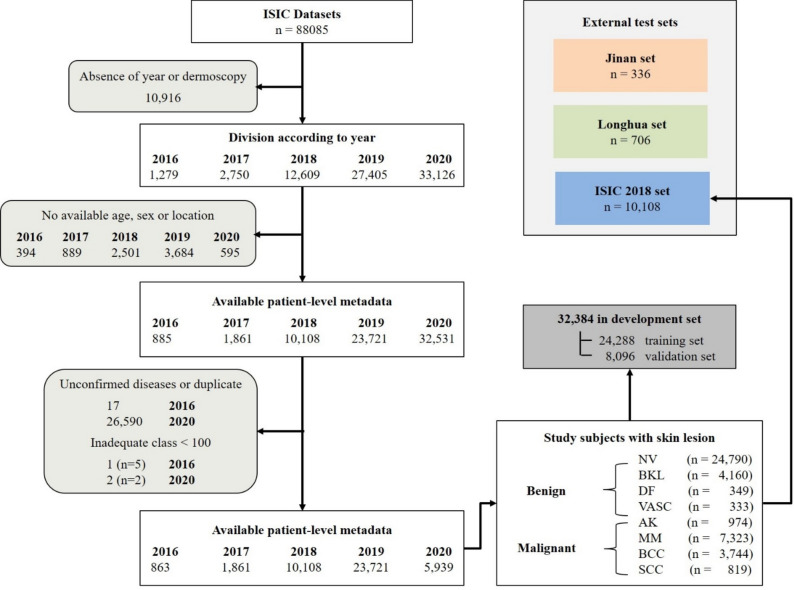
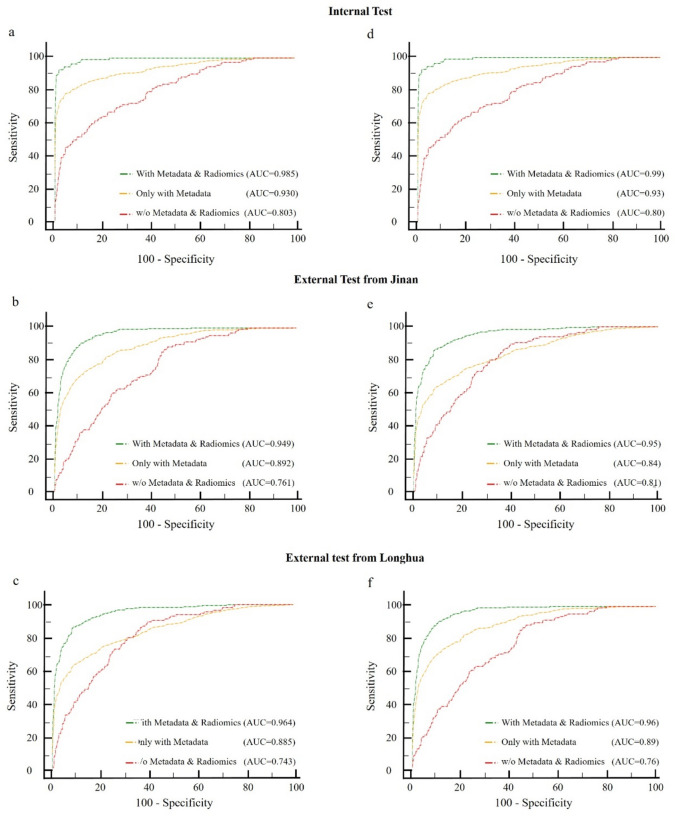
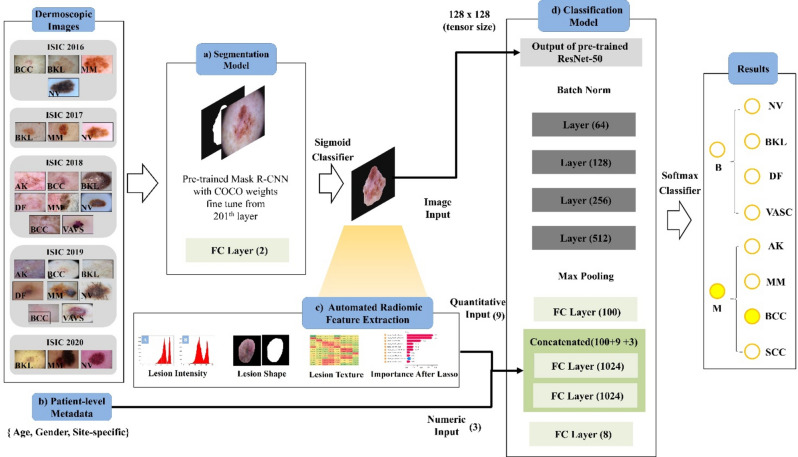
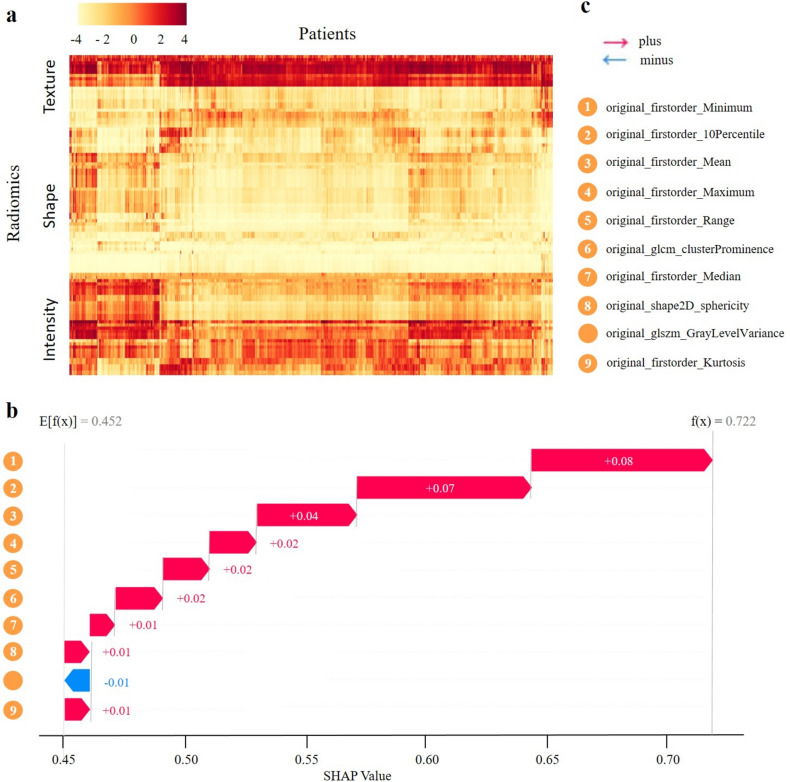
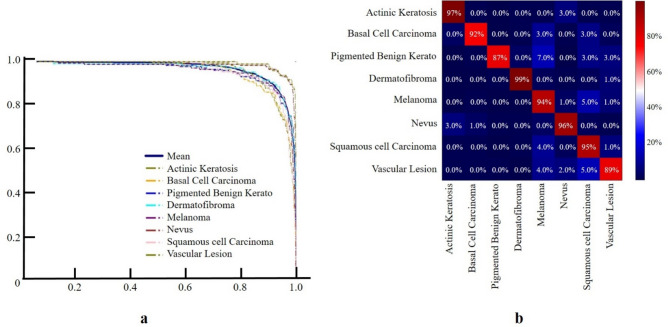
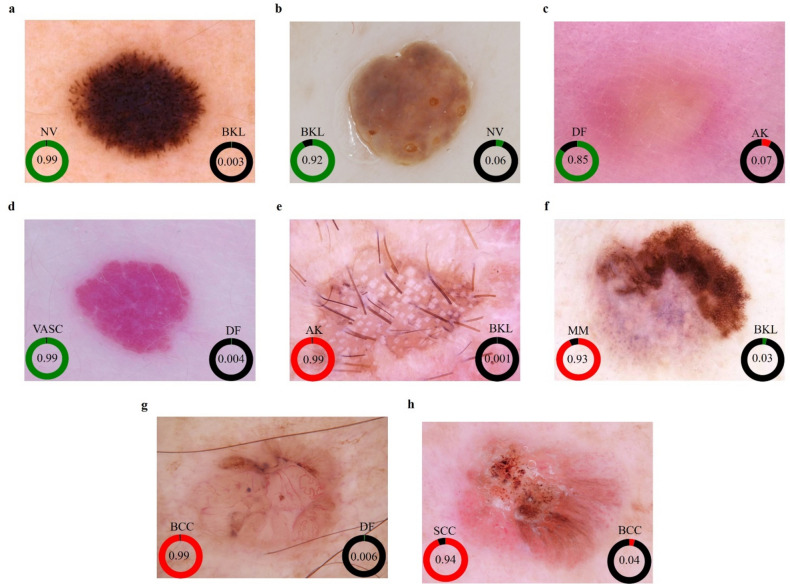
This study aims to explore the efficacy of a hybrid deep learning and radiomics approach, supplemented with patient metadata, in the noninvasive dermoscopic imaging-based diagnosis of skin lesions. We analyzed dermoscopic images from the International Skin Imaging Collaboration (ISIC) dataset, spanning 2016-2020, encompassing a variety of skin lesions. Our approach integrates deep learning with a comprehensive radiomics analysis, utilizing a vast array of quantitative image features to precisely quantify skin lesion patterns. The dataset includes cases of three, four, and eight different skin lesion types. Our methodology was benchmarked against seven classification methods from the ISIC 2020 challenge and prior research using a binary decision framework. The proposed hybrid model demonstrated superior performance in distinguishing benign from malignant lesions, achieving area under the receiver operating characteristic curve (AUROC) scores of 99%, 95%, and 96%, and multiclass decoding AUROCs of 98.5%, 94.9%, and 96.4%, with sensitivities of 97.6%, 93.9%, and 96.0% and specificities of 98.4%, 96.7%, and 96.9% in the internal ISIC 2018 challenge, as well as in the external Jinan and Longhua datasets, respectively. Our findings suggest that the integration of radiomics and deep learning, utilizing dermoscopic images, effectively captures the heterogeneity and pattern expression of skin lesions.
本研究旨在探索一种结合深度学习和放射组学方法的功效,辅以患者元数据,用于非侵入性皮肤镜成像的皮肤病变诊断。我们分析了来自国际皮肤影像协作组织(ISIC)数据集的皮肤镜图像,涵盖了 2016 年至 2020 年的各种皮肤病变。我们的方法结合了深度学习和全面的放射组学分析,利用大量的定量图像特征来精确量化皮肤病变模式。该数据集包括三种、四种和八种不同皮肤病变类型的病例。我们的方法学使用二元决策框架,与 ISIC 2020 挑战赛和先前研究中的七种分类方法进行了基准测试。所提出的混合模型在区分良性和恶性病变方面表现出卓越的性能,在内部 ISIC 2018 挑战赛中,其区分良恶性病变的接收器操作特征曲线下面积(AUROC)评分分别为 99%、95%和 96%,多类解码 AUROC 评分为 98.5%、94.9%和 96.4%,灵敏度分别为 97.6%、93.9%和 96.0%,特异性分别为 98.4%、96.7%和 96.9%,同时在外部济南和龙华数据集也取得了较好的效果。我们的研究结果表明,结合放射组学和深度学习,利用皮肤镜图像,可以有效地捕捉皮肤病变的异质性和模式表达。