Li Dongyang, Lian Qing, Du Tao, Ma Ruijie, Liu Heng, Liang Qiong, Han Yu, Mi Guojun, Peng Ouwen, Zhang Guihua, Peng Wenbo, Xu Baomin, Lu Xinhui, Liu Kuan, Yin Jun, Ren Zhiwei, Li Gang, Cheng Chun
Department of Materials Science and Engineering, Southern University of Science and Technology, 518055, Shenzhen, Guangdong Province, China.
Department of Electrical and Electronic Engineering, Research Institute for Smart Energy (RISE), Photonic Research Institute (PRI), The Hong Kong Polytechnic University, Hung Hom, 999077, Kowloon, Hong Kong, China.
Nat Commun. 2024 Sep 1;15(1):7605. doi: 10.1038/s41467-024-51760-5.
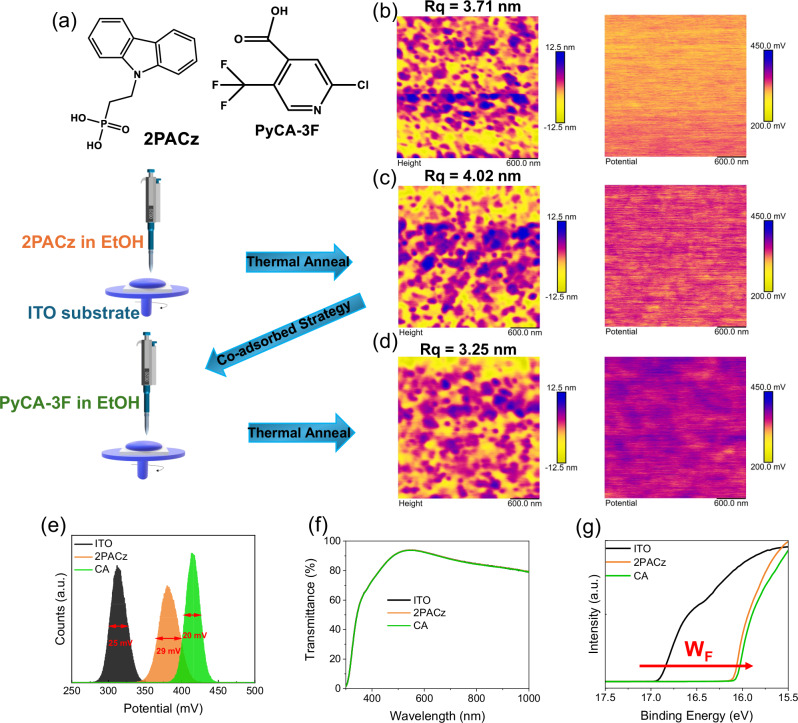
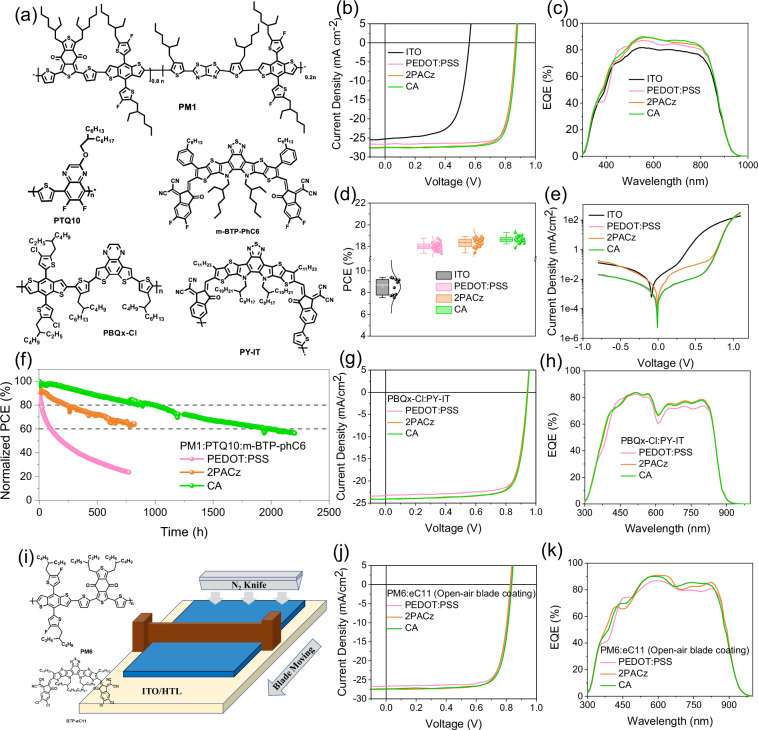
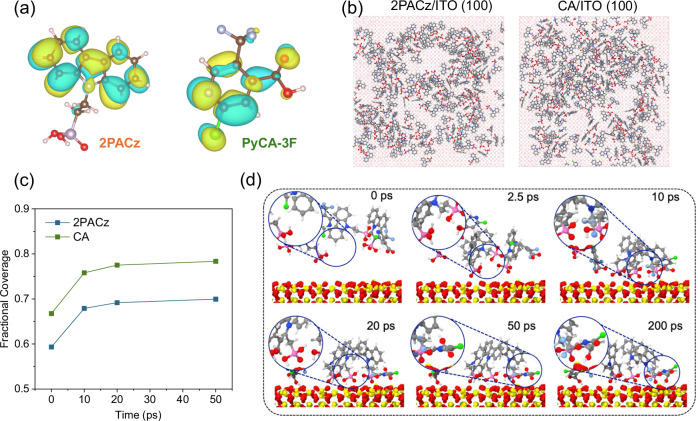
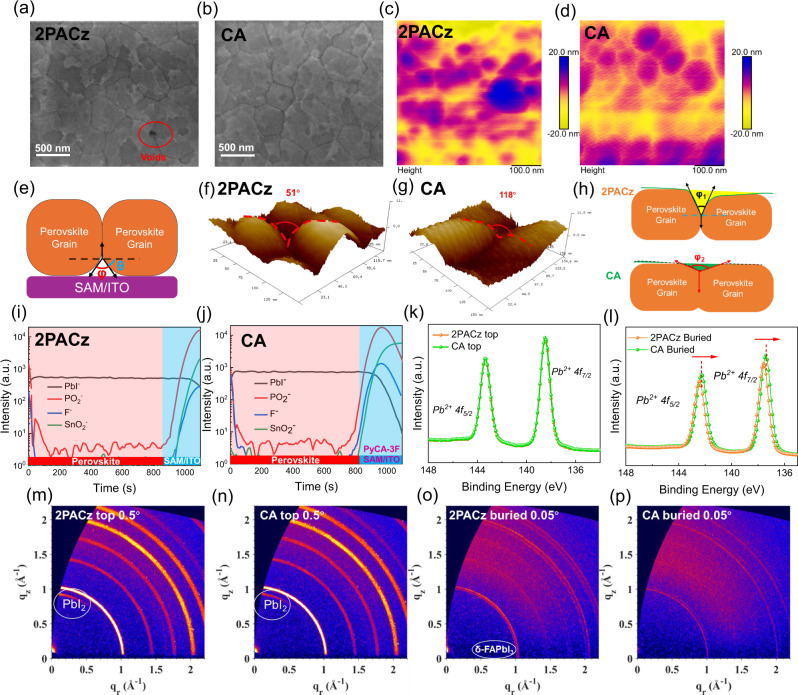
Self-assembled monolayers (SAMs) have become pivotal in achieving high-performance perovskite solar cells (PSCs) and organic solar cells (OSCs) by significantly minimizing interfacial energy losses. In this study, we propose a co-adsorb (CA) strategy employing a novel small molecule, 2-chloro-5-(trifluoromethyl)isonicotinic acid (PyCA-3F), introducing at the buried interface between 2PACz and the perovskite/organic layers. This approach effectively diminishes 2PACz's aggregation, enhancing surface smoothness and increasing work function for the modified SAM layer, thereby providing a flattened buried interface with a favorable heterointerface for perovskite. The resultant improvements in crystallinity, minimized trap states, and augmented hole extraction and transfer capabilities have propelled power conversion efficiencies (PCEs) beyond 25% in PSCs with a p-i-n structure (certified at 24.68%). OSCs employing the CA strategy achieve remarkable PCEs of 19.51% based on PM1:PTQ10:m-BTP-PhC6 photoactive system. Notably, universal improvements have also been achieved for the other two popular OSC systems. After a 1000-hour maximal power point tracking, the encapsulated PSCs and OSCs retain approximately 90% and 80% of their initial PCEs, respectively. This work introduces a facile, rational, and effective method to enhance the performance of SAMs, realizing efficiency breakthroughs in both PSCs and OSCs with a favorable p-i-n device structure, along with improved operational stability.
自组装单分子层(SAMs)通过显著降低界面能量损失,在实现高性能钙钛矿太阳能电池(PSCs)和有机太阳能电池(OSCs)方面发挥了关键作用。在本研究中,我们提出了一种共吸附(CA)策略,采用一种新型小分子2-氯-5-(三氟甲基)异烟酸(PyCA-3F),将其引入2PACz与钙钛矿/有机层之间的掩埋界面。这种方法有效地减少了2PACz的聚集,提高了表面平整度,并增加了改性SAM层的功函数,从而为钙钛矿提供了一个平整的掩埋界面和良好的异质界面。由此带来的结晶度提高、陷阱态最小化以及空穴提取和转移能力增强,推动了具有p-i-n结构的PSCs的功率转换效率(PCEs)超过25%(经认证为24.68%)。采用CA策略的OSCs基于PM1:PTQ10:m-BTP-PhC6光活性体系实现了19.51%的显著PCEs。值得注意的是,其他两种流行的OSC体系也实现了普遍的性能提升。经过1000小时的最大功率点跟踪后,封装的PSCs和OSCs分别保留了其初始PCEs的约90%和80%。这项工作引入了一种简便、合理且有效的方法来提高SAMs的性能,在具有良好p-i-n器件结构的PSCs和OSCs中实现了效率突破,并提高了操作稳定性。