Liang Wei, Wang Xiang, Cheng Shishi, Jiao Jiao, Zhu Xiangui, Duan Yanping
School of Physical Education, Shenzhen University, Shenzhen, China.
Department of Sport, Physical Education and Health, Hong Kong Baptist University, Hong Kong, China.
Sports Med Open. 2024 Sep 12;10(1):98. doi: 10.1186/s40798-024-00767-9.
As a novel and time-efficient exercise form, high-intensity interval training (HIIT) has shown great potential in improving health-related physical fitness among diverse populations. However, empirical evidence on its efficacy among the elderly has not been well summarized. This systematic review and meta-analysis aimed to determine the effect of HIIT interventions on the parameters related to physical fitness and health of older adults, including resting heart rate (HR), systolic blood pressure (SBP), diastolic blood pressure (DBP), cardiorespiratory fitness (CRF), body mass index (BMI), body fat percent (BF%), waist circumference (WC), muscular endurance (ME), muscular strength (MS), muscular power (MP), balance and flexibility, compared to non-exercise and other-exercise (e.g., moderate-intensity continuous training, resistance training) conditions.
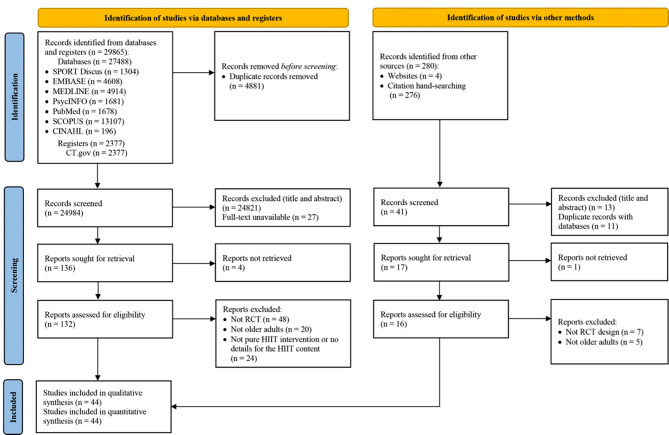
Literature published from January 2000 to May 2023 was collected through extensive searches across eight databases and relevant review papers. Randomized controlled trials (RCTs) featuring a minimum 2-week exercise intervention for older adults (≥ 60 years) were included. The pooled effect size of Hedges'g was estimated using random-effects models in R. Meta-regression was performed for both categorical (health status, duration of training programme, and frequency) and continuous moderators (mean age, male rate, and attrition rate).
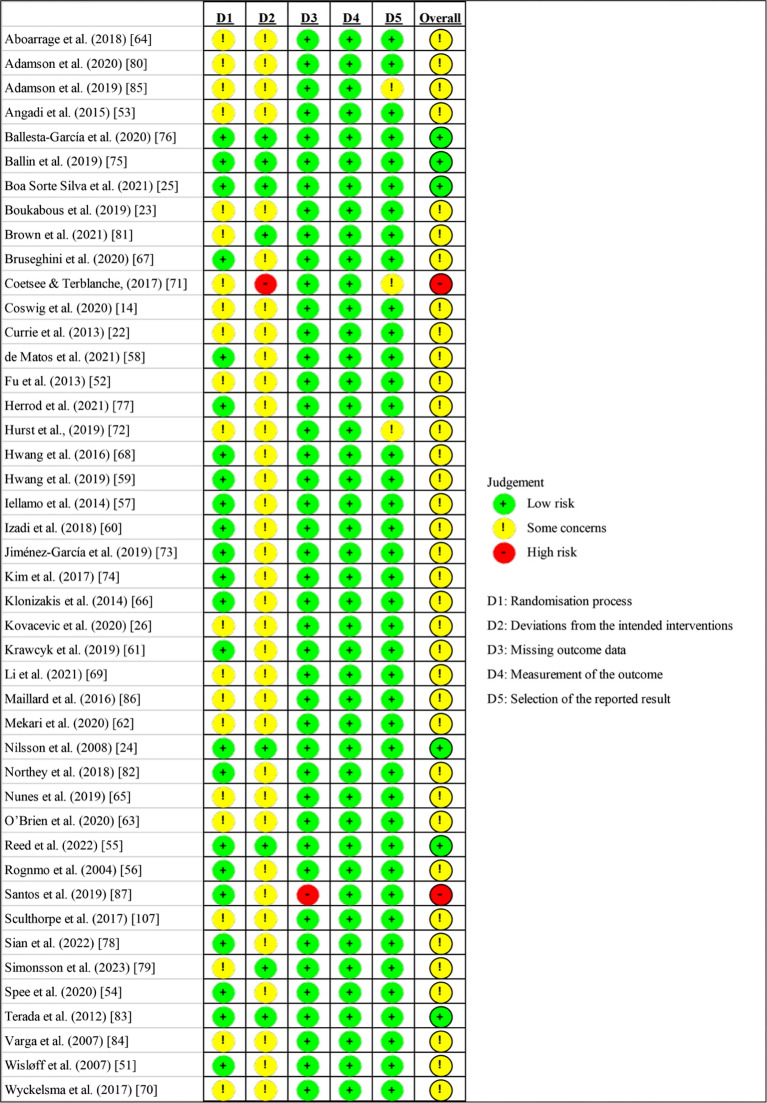
Forty-four eligible RCTs with 1863 participants (52.1% female; 60.5-81.2 years) were included in the quantitative analysis. Compared to non-exercise condition, HIIT significantly improved resting HR (g = -0.36, 95%CI = [-0.67, -0.05], P = 0.032), SBP (g = -0.29, 95%CI = [-0.54, -0.03], P = 0.008), CRF (g = 0.77, 95%CI = [0.51, 1.04], P < 0.001), BF% (g = -0.26, 95%CI = [-0.41, -0.11], P = 0.006), MS (g = 0.47, 95%CI = [0.23, 0.71], P = 0.004), ME (g = 0.65, 95%CI = [0.10, 1.19], P = 0.036), and balance (e.g., timed-up-and-go) (g = -0.79, 95%CI = [-1.19, -0.40], P = 0.035). Compared to other-exercise condition, HIIT significantly improved resting HR (g = -0.11, 95%CI = [-0.21, -0.01], P = 0.029), SBP (g = -0.14, 95%CI = [-0.28, -0.01], P = 0.038), and CRF (g = 0.23, 95%CI = [0.07, 0.38], P = 0.008). No significant difference was found between HIIT and non-exercise condition for DBP, BMI and WC, as well as between HIIT and other-exercise condition for DBP, BMI, BF%, WC, ME, and balance (all P > 0.05). Meta-regression indicated that mean age moderated the HIIT effect on resting HR (b = -0.02, P = 0.014; HIIT vs. other-exercise condition) and SBP (b = 0.03, P = 0.048; HIIT vs. non-exercise), and attrition rate moderated the effect on CRF (b = 0.03, P = 0.007; HIIT vs. non-exercise).
This study supports the efficacy of HIIT in improving resting HR, SBP, CRF, BF%, MS, ME and balance among older adults. More empirical evidence is needed to determine the efficacy of HIIT for MP and flexibility in this population.
PROSPERO CRD42022316246.
作为一种新颖且省时的运动形式,高强度间歇训练(HIIT)在改善不同人群与健康相关的身体素质方面展现出了巨大潜力。然而,关于其在老年人中的功效的实证证据尚未得到充分总结。本系统评价和荟萃分析旨在确定与非运动和其他运动(如中等强度持续训练、阻力训练)条件相比,HIIT干预对老年人身体素质和健康相关参数的影响,这些参数包括静息心率(HR)、收缩压(SBP)、舒张压(DBP)、心肺适能(CRF)、体重指数(BMI)、体脂百分比(BF%)、腰围(WC)、肌肉耐力(ME)、肌肉力量(MS)、肌肉功率(MP)、平衡和柔韧性。
通过对八个数据库和相关综述论文进行广泛检索,收集了2000年1月至2023年5月发表的文献。纳入了针对老年人(≥60岁)进行至少为期2周运动干预的随机对照试验(RCT)。使用R语言中的随机效应模型估计Hedges'g的合并效应量。对分类变量(健康状况、训练计划持续时间和频率)和连续调节变量(平均年龄、男性比例和失访率)进行荟萃回归分析。
定量分析纳入了44项符合条件的RCT,共1863名参与者(女性占52.1%;年龄60.5 - 81.2岁)。与非运动条件相比,HIIT显著改善了静息心率(g = -0.36,95%CI = [-0.67, -0.05],P = 0.032)、收缩压(g = -0.29,95%CI = [-0.54, -0.03],P = 0.008)、心肺适能(g = 0.77,95%CI = [0.51, 1.04],P < 0.001)、体脂百分比(g = -0.26,95%CI = [-0.41, -0.11],P = 0.006)、肌肉力量(g = 0.47,95%CI = [0.23, 0.71],P = 0.004)、肌肉耐力(g = 0.65,95%CI = [0.10, 1.19],P = 0.036)以及平衡能力(如计时起立行走)(g = -0.79,95%CI = [-1.19, -0.40],P = 0.035)。与其他运动条件相比,HIIT显著改善了静息心率(g = -0.11,95%CI = [-0.21, -0.01],P = 0.029)、收缩压(g = -0.14,95%CI = [-0.28, -0.01],P = 0.038)和心肺适能(g = 0.23,95%CI = [0.07, 0.38],P = 0.008)。在舒张压、BMI和腰围方面,HIIT与非运动条件之间以及在舒张压、BMI、体脂百分比、腰围、肌肉耐力和平衡能力方面,HIIT与其他运动条件之间均未发现显著差异(所有P > 0.05)。荟萃回归分析表明,平均年龄调节了HIIT对静息心率的影响(b = -0.