Department of Preventive Medicine, Shantou University Medical College, Shantou, China.
National Key Laboratory of Intelligent Tracking and Forecasting for Infectious Diseases, National Institute for Communicable Disease Control and Prevention, Chinese Center for Disease Control and Prevention, Beijing, China.
Nat Commun. 2024 Sep 14;15(1):8060. doi: 10.1038/s41467-024-52460-w.
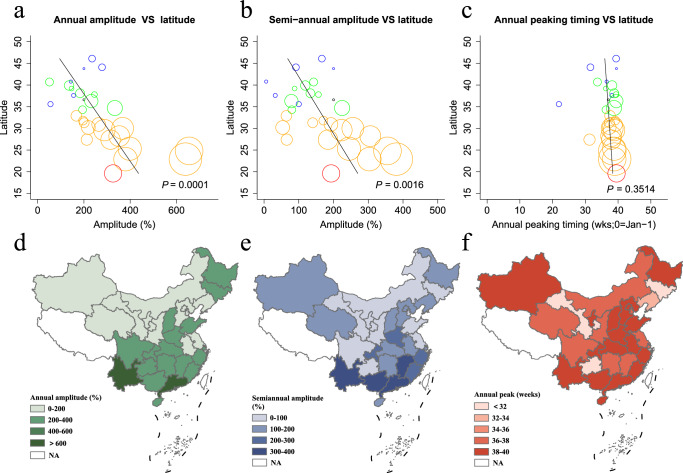
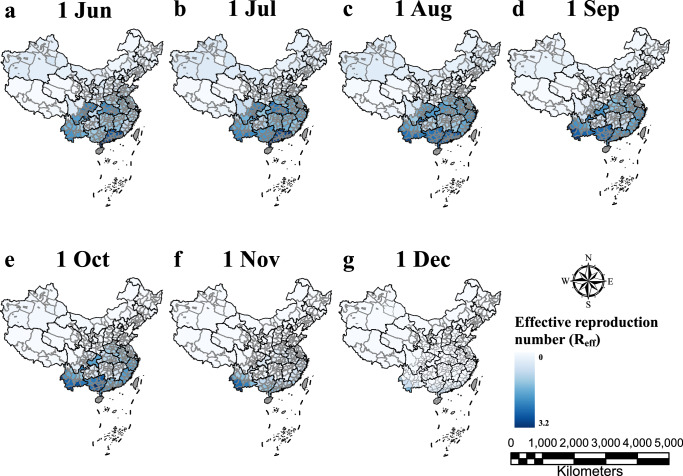
China has experienced successive waves of dengue epidemics over the past decade. Nationwide data on 95,339 dengue cases, 89 surveillance sites for mosquito density and population mobility between 337 cities during 2013-20 were extracted. Weekly dengue time series including time trends and harmonic terms were fitted using seasonal regression models, and the amplitude and peak timing of the annual and semiannual cycles were estimated. A data-driven model-inference approach was used to simulate the epidemic at city-scale and estimate time-evolving epidemiological parameters. We found that the geographical distribution of dengue cases was expanding, and the main imported areas as well as external sources of imported cases changed. Dengue cases were predominantly concentrated in southern China and it exhibited an annual peak of activity, typically peaking in September. The annual amplitude of dengue epidemic varied with latitude (F = 19.62, P = 0.0001), mainly characterizing by large in southern cities and small in northern cities. The effective reproduction number R across cities is commonly greater than 1 in several specific months from July to November, further confirming the seasonal fluctuations and spatial heterogeneity of dengue epidemics. The results of this national study help to better informing interventions for future dengue epidemics in China.
中国在过去十年中经历了连续几波登革热疫情。提取了 2013-20 年期间全国 95339 例登革热病例、89 个蚊虫密度监测点和 337 个城市间人口流动的全国数据。使用季节性回归模型拟合了包括时间趋势和调和项在内的每周登革热时间序列,并估计了年度和半年度周期的幅度和峰值时间。采用数据驱动的模型推断方法模拟了市级流行情况,并估计了时变的流行病学参数。我们发现,登革热病例的地理分布正在扩大,主要输入地区和输入病例的外部来源也发生了变化。登革热病例主要集中在中国南方,呈年度高峰活动,通常在 9 月达到高峰。登革热流行的年度幅度随纬度而变化(F=19.62,P=0.0001),主要表现为南部城市较大,北部城市较小。全市范围内的有效繁殖数 R 在 7 月至 11 月的几个特定月份通常大于 1,进一步证实了登革热疫情的季节性波动和空间异质性。这项全国性研究的结果有助于更好地为中国未来的登革热疫情提供干预措施。