
SEEG4D:一种用于立体脑电图数据4D可视化的工具。
SEEG4D: a tool for 4D visualization of stereoelectroencephalography data.
作者信息
Evans James L, Bramlet Matthew T, Davey Connor, Bethke Eliot, Anderson Aaron T, Huesmann Graham, Varatharajah Yogatheesan, Maldonado Andres, Amos Jennifer R, Sutton Bradley P
机构信息
Department of Bioengineering, University of Illinois Urbana-Champaign, Urbana, IL, United States.
Beckman Institute for Advanced Science and Technology, University of Illinois Urbana-Champaign, Urbana, IL, United States.
出版信息
Front Neuroinform. 2024 Sep 3;18:1465231. doi: 10.3389/fninf.2024.1465231. eCollection 2024.
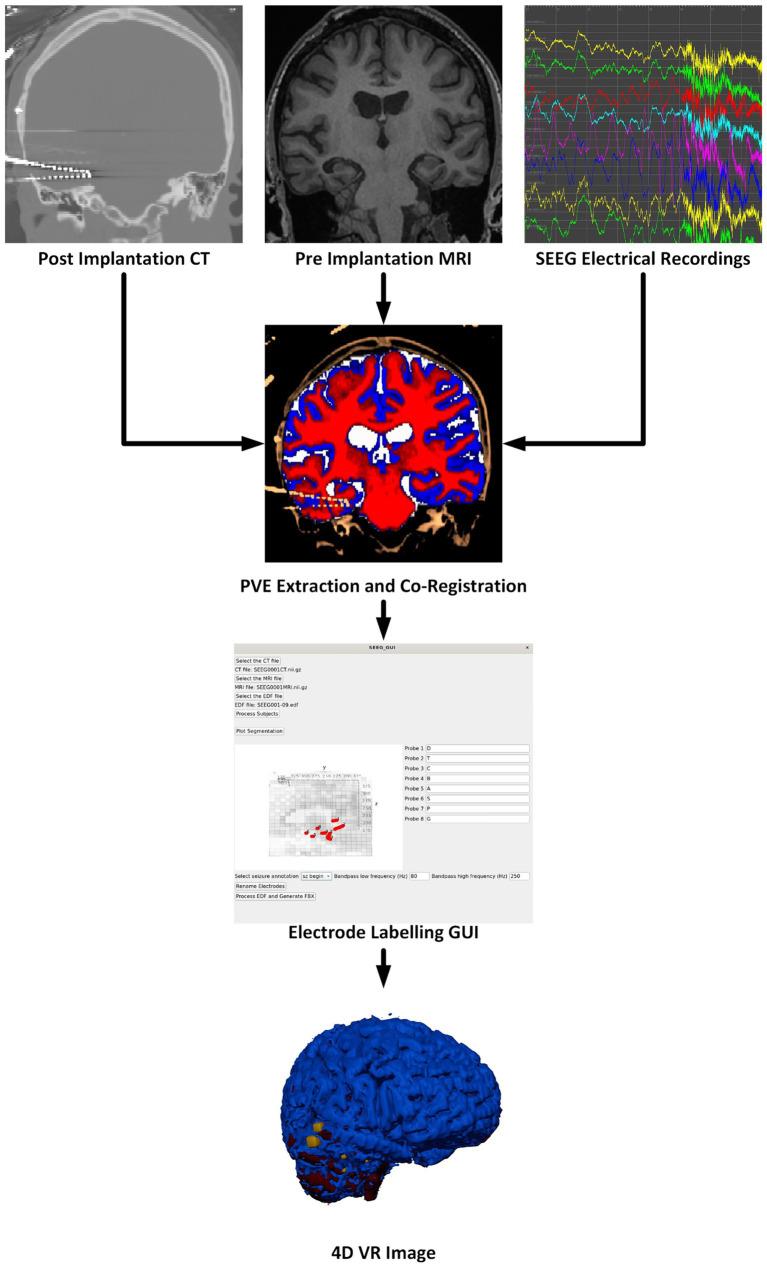
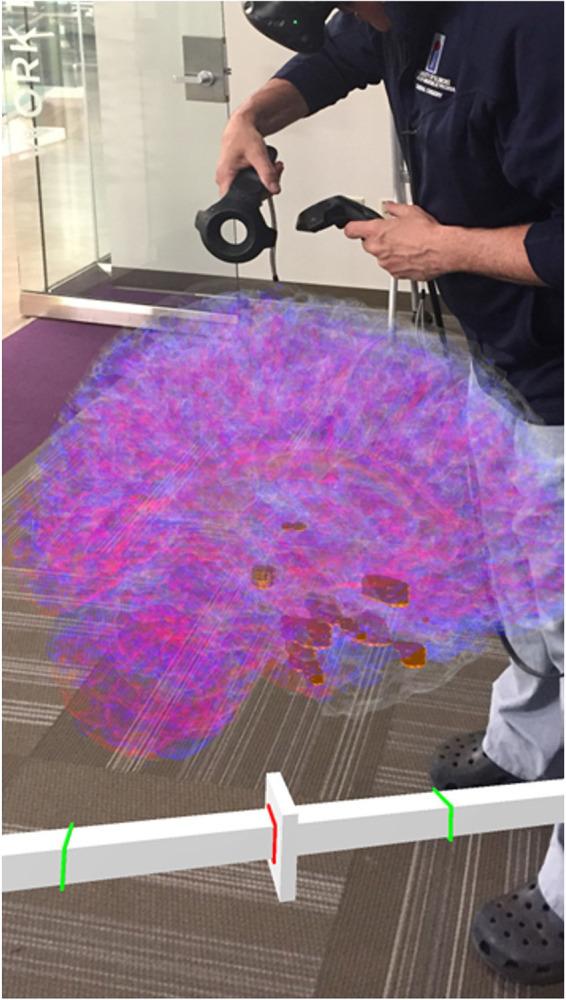
Epilepsy is a prevalent and serious neurological condition which impacts millions of people worldwide. Stereoelectroencephalography (sEEG) is used in cases of drug resistant epilepsy to aid in surgical resection planning due to its high spatial resolution and ability to visualize seizure onset zones. For accurate localization of the seizure focus, sEEG studies combine pre-implantation magnetic resonance imaging, post-implant computed tomography to visualize electrodes, and temporally recorded sEEG electrophysiological data. Many tools exist to assist in merging multimodal spatial information; however, few allow for an integrated spatiotemporal view of the electrical activity. In the current work, we present SEEG4D, an automated tool to merge spatial and temporal data into a complete, four-dimensional virtual reality (VR) object with temporal electrophysiology that enables the simultaneous viewing of anatomy and seizure activity for seizure localization and presurgical planning. We developed an automated, containerized pipeline to segment tissues and electrode contacts. Contacts are aligned with electrical activity and then animated based on relative power. SEEG4D generates models which can be loaded into VR platforms for viewing and planning with the surgical team. Automated contact segmentation locations are within 1 mm of trained raters and models generated show signal propagation along electrodes. Critically, spatial-temporal information communicated through our models in a VR space have potential to enhance sEEG pre-surgical planning.
癫痫是一种普遍且严重的神经系统疾病,影响着全球数百万人。立体脑电图(sEEG)因其高空间分辨率和可视化癫痫发作起始区的能力,被用于耐药性癫痫病例,以辅助手术切除规划。为了精确确定癫痫病灶的位置,sEEG研究结合了植入前磁共振成像、植入后计算机断层扫描以可视化电极,以及随时间记录的sEEG电生理数据。有许多工具可协助合并多模态空间信息;然而,很少有工具能提供电活动的综合时空视图。在当前的工作中,我们展示了SEEG4D,这是一种自动化工具,可将空间和时间数据合并为一个完整的四维虚拟现实(VR)对象,并带有时间电生理信息,从而能够同时查看解剖结构和癫痫活动,以进行癫痫定位和术前规划。我们开发了一个自动化的、容器化的管道来分割组织和电极触点。触点与电活动对齐,然后根据相对功率进行动画处理。SEEG4D生成的模型可加载到VR平台中,供手术团队进行查看和规划。自动触点分割位置与经过训练的评估者的分割位置相差在1毫米以内,生成的模型显示了信号沿电极的传播。至关重要的是,通过我们在VR空间中的模型传达的时空信息有可能增强sEEG术前规划。

 Zotero 插件