Department of General Surgery, Faculty of Medicine, Yuzuncu Yıl University, Van, Turkey.
Department of General Surgery, Faculty of Medicine, Gaziantep University, Gaziantep, Turkey.
Sci Rep. 2024 Sep 18;14(1):21766. doi: 10.1038/s41598-024-72344-9.
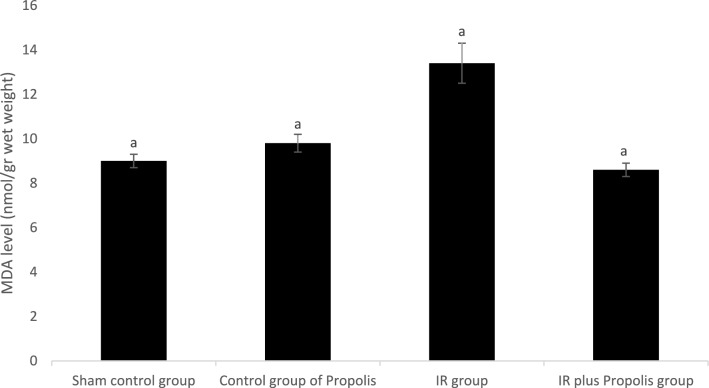
Stresses caused by ionizing radiation can also damage tissues and organs through the circulatory system. In this study, we aimed to determine the radioprotective effect of propolis, a natural and powerful antioxidant product, against oxidative liver damage caused by cranial irradiation. Thirty-two male albino Sprague-Dawley rats, divided into four groups, were designed as sham group, irradiation (IR) group, propolis plus IR, control group of propolis. Biochemical parameters were measured in liver tissue of rats. While Total enzymatic superoxide scavenging activity (TSSA) and non-enzymatic superoxide scavenging activity (NSSA), glutathione peroxidase (GSH-Px) activities of all groups were statistically significantly higher than rats receiving only-irradiation, Glutathione-S-transferase (GST) activity in the IR group was significantly lower than in the sham control group and IR + propolis group. Superoxide dismutase (SOD) activity in the IR group was found to be significantly higher than both the sham control group and the propolis control group, but lower than the IR + propolis group. Malondialdehyde level and xanthine oxidase activity were higher in the IR group than in the other groups. Compared to the sham control group, in the group treated with propolis, a significant elevation in antioxidant parameters, specifically TSSA, NSSA, SOD, and GST activities, was noted, with corresponding increases of 32.3%, 23.2%, 47.6%, and 22.6%, respectively. Our findings show that propolis can be a radioprotective agent against ionized radiation damage by increasing antioxidant activity and reducing oxidant stress in liver tissue.
电离辐射引起的应激也可以通过循环系统损伤组织和器官。在这项研究中,我们旨在确定蜂胶作为一种天然且强大的抗氧化产品对颅脑照射引起的氧化性肝损伤的辐射防护作用。将 32 只雄性白化 Sprague-Dawley 大鼠分为 4 组,分别为假手术组、照射组(IR)、蜂胶加 IR 组、蜂胶对照组。测量大鼠肝组织的生化参数。与仅接受照射的大鼠相比,所有组的总酶超氧化物清除活性(TSSA)和非酶超氧化物清除活性(NSSA)、谷胱甘肽过氧化物酶(GSH-Px)活性均统计学显著升高,IR 组的谷胱甘肽-S-转移酶(GST)活性显著低于假手术对照组和 IR+蜂胶组。IR 组的超氧化物歧化酶(SOD)活性明显高于假手术对照组和蜂胶对照组,但低于 IR+蜂胶组。与其他组相比,IR 组的丙二醛水平和黄嘌呤氧化酶活性更高。与假手术对照组相比,用蜂胶处理的组中的抗氧化参数,特别是 TSSA、NSSA、SOD 和 GST 活性显著升高,分别增加了 32.3%、23.2%、47.6%和 22.6%。我们的研究结果表明,蜂胶可以通过增加抗氧化活性和减少肝组织中的氧化应激来作为一种电离辐射损伤的辐射防护剂。