Department of Periodontics, School and Hospital of Stomatology, Liaoning Provincial Key Laboratory of Oral Disease, China Medical University, Heping District, Nanjing North Street No.117, Shenyang, 110002, China.
Department of Oral mucosiology, School and Hospital of Stomatology, Liaoning Provincial Key Laboratory of Oral Disease, China Medical University, Heping District, Nanjing North Street No.117, Shenyang, 110002, China.
Lipids Health Dis. 2024 Sep 28;23(1):321. doi: 10.1186/s12944-024-02312-9.
Periodontitis, a persistent inflammatory condition, significantly impairs individuals' overall quality of life. Lymphocyte-to-high-density lipoprotein cholesterol ratio (LHR), monocyte-to-high-density lipoprotein cholesterol ratio (MHR), neutrophil-to-high-density lipoprotein cholesterol ratio (NHR), and platelet-to-high-density lipoprotein cholesterol ratio (PHR) are new convenient and economical biomarkers. However, whether the above high-density lipoprotein-related inflammatory biomarkers are associated with periodontitis has rarely been investigated. Therefore, the research endeavor focused on uncovering potential relationships.
The research encompassed a diverse and extensive sample, comprising 9,470 participants, selected from the National Health and Nutrition Examination Survey spanning the years 2009 to 2014. The association between high-density lipoprotein-related inflammatory biomarkers and periodontitis was explored utilizing a multivariable logistic regression model with weighted analysis. Additionally, the study employed smoothed curve fitting to explore potential nonlinear relationships. Further stratified analyses and interaction tests were performed.
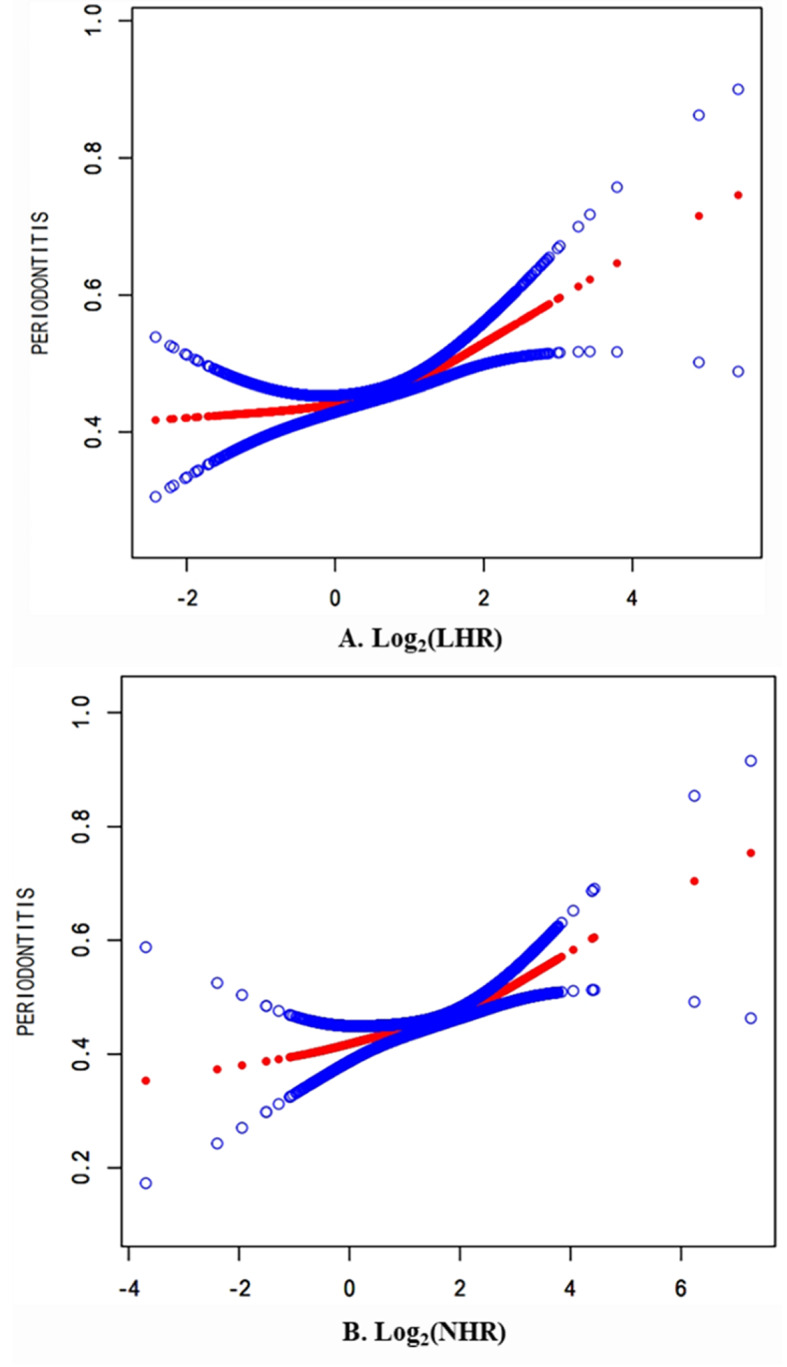
This study indicated no apparent association between MHR and PHR with periodontitis, whereas LHR and NHR demonstrated a statistically significant positive relationship with the prevalence of periodontitis. In the fully adjusted model, participants belonging to the highest tertile of both LHR and NHR showed a notably higher likelihood of having periodontitis compared to those in the lowest tertile (LHR: OR = 1.22, 95% CI: 1.06, 1.39; NHR: OR = 1.27, 95% CI: 1.09, 1.49). Furthermore, smooth curve fitting was employed to investigate the potential nonlinear relationship between LHR, NHR, and periodontitis. The results indicated that there was a significant increase in the occurrence of periodontitis when Log (LHR) exceeded 1.01 and Log(NHR) surpassed 2.16 (Log(LHR): OR = 1.42; 95% CI: 1.19, 1.69; Log(NHR): OR = 1.40; 95% CI: 1.15, 1.71). The subgroup analysis revealed that the associations between periodontitis and either LHR or NHR, separately, were more pronounced among individuals under the age of 50 and those without hypertension.
This cross-sectional study revealed a positive relationship between LHR、NHR and periodontitis, particularly when these indicators exceeded their thresholds. LHR and NHR may serve as potential inflammatory markers for identifying periodontitis, thereby facilitating early warning for both patients and dentists, and enabling early intervention in the oral environment. Besides, extensive prospective cohort investigations are essential to confirm and solidify this observation.
牙周炎是一种持续存在的炎症性疾病,会显著降低个体的整体生活质量。淋巴细胞与高密度脂蛋白胆固醇比值(LHR)、单核细胞与高密度脂蛋白胆固醇比值(MHR)、中性粒细胞与高密度脂蛋白胆固醇比值(NHR)和血小板与高密度脂蛋白胆固醇比值(PHR)是新的方便且经济的生物标志物。然而,这些与高密度脂蛋白相关的炎症生物标志物与牙周炎之间的关系很少被研究。因此,本研究旨在探讨潜在的相关性。
该研究纳入了来自 2009 年至 2014 年全国健康与营养调查的 9470 名参与者,这是一个多样化和广泛的样本。采用加权多变量 logistic 回归模型进行分析,探讨与牙周炎相关的高密度脂蛋白相关炎症生物标志物。此外,还采用平滑曲线拟合来探讨潜在的非线性关系,并进行了分层分析和交互作用检验。
本研究表明,MHR 和 PHR 与牙周炎之间无明显关联,而 LHR 和 NHR 与牙周炎的患病率呈显著正相关。在完全调整的模型中,与最低三分位组相比,LHR 和 NHR 最高三分位组的参与者发生牙周炎的可能性明显更高(LHR:OR=1.22,95%CI:1.06,1.39;NHR:OR=1.27,95%CI:1.09,1.49)。此外,还采用平滑曲线拟合来探讨 LHR、NHR 与牙周炎之间的潜在非线性关系。结果表明,当 Log(LHR)超过 1.01 且 Log(NHR)超过 2.16 时,牙周炎的发生率显著增加(Log(LHR):OR=1.42;95%CI:1.19,1.69;Log(NHR):OR=1.40;95%CI:1.15,1.71)。亚组分析显示,LHR 或 NHR 与牙周炎之间的关联在年龄<50 岁和无高血压的个体中更为显著。
本横断面研究表明,LHR、NHR 与牙周炎之间存在正相关关系,尤其是当这些指标超过其阈值时。LHR 和 NHR 可能是识别牙周炎的潜在炎症标志物,有助于为患者和牙医提供早期预警,并在口腔环境中进行早期干预。此外,还需要进行广泛的前瞻性队列研究来证实和巩固这一观察结果。