Department of Anesthesiology, Amsterdam UMC, location Academic Medical Centre, University of Amsterdam, Meibergdreef 9, PO Box 22660, Amsterdam, 1105 AZ, The Netherlands.
Department of Intensive Care, Amsterdam UMC, location Academic Medical Centre, University of Amsterdam, Meibergdreef 9, PO Box 22660, Amsterdam, 1105 AZ, The Netherlands.
Sci Rep. 2024 Oct 4;14(1):23125. doi: 10.1038/s41598-024-73291-1.
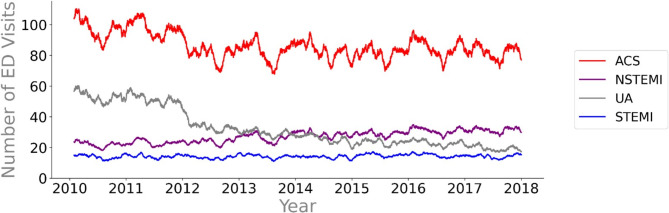
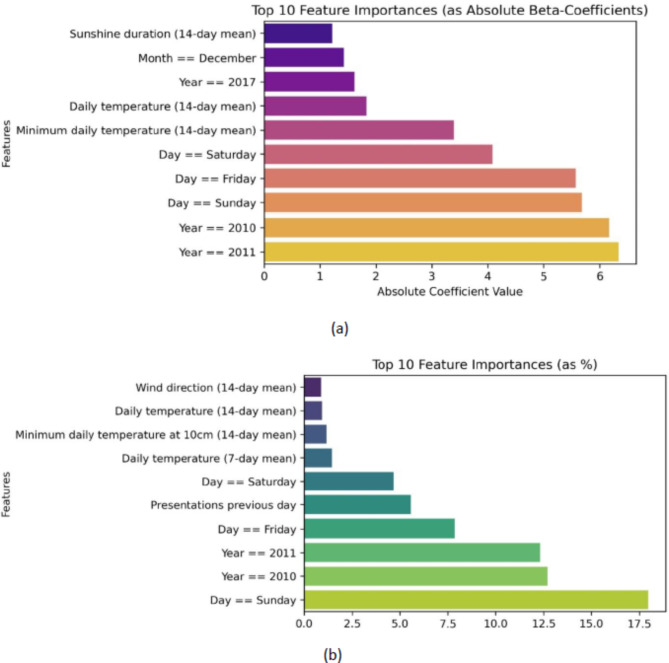
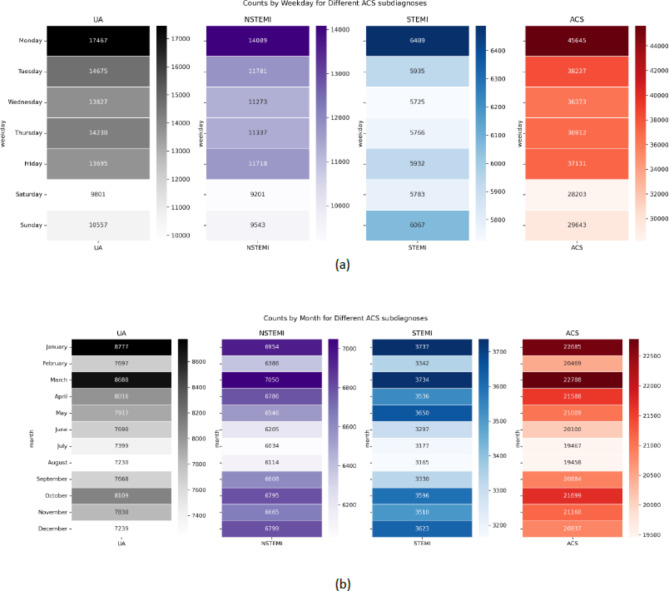
The relationship between weather and acute coronary syndrome (ACS) incidence has been the subject of considerable research, with varying conclusions. Harnessing machine learning techniques, our study explores the relationship between meteorological factors and ACS presentations in the emergency department (ED), offering insights into seasonal variations and inter-day fluctuations to optimize patient care and resource allocation. A retrospective cohort analysis was conducted, encompassing ACS presentations to Dutch EDs from 2010 to 2017. Temporal patterns were analyzed using heat-maps and time series plots. Multivariable linear regression (MLR) and Random Forest (RF) regression models were employed to forecast daily ACS presentations with prediction horizons of one, three, seven, and thirty days. Model performance was assessed using the coefficient of determination (R²), Mean Absolute Error (MAE), and Mean Absolute Percentage Error (MAPE). The study included 214,953 ACS presentations, predominantly unstable angina (UA) (94,272; 44%), non-ST-elevated myocardial infarction (NSTEMI) (78,963; 37%), and ST-elevated myocardial infarction (STEMI) (41,718; 19%). A decline in daily ACS admissions over time was observed, with notable inter-day (estimated median difference: 41 (95%CI = 37-43, p = < 0.001) and seasonal variations (estimated median difference: 9 (95%CI 6-12, p = < 0.001). Both MLR and RF models demonstrated similar predictive capabilities, with MLR slightly outperforming RF. The models showed moderate explanatory power for ACS incidence (adjusted R² = 0.66; MAE (MAPE): 7.8 (11%)), with varying performance across subdiagnoses. Prediction of UA incidence resulted in the best-explained variability (adjusted R² = 0.80; MAE (MAPE): 5.3 (19.1%)), followed by NSTEMI and STEMI diagnoses. All models maintained consistent performance over extended prediction horizons. Our findings indicate that ACS presentation exhibits distinctive seasonal changes and inter-day differences, with marked reductions in incidence during the summer months and a distinct peak prevalence on Mondays. The predictive performance of our model was moderate. Nonetheless, we obtained good explanatory power for UA presentations. Our model emerges as a potentially valuable supplementary tool to enhance ED resource allocation or future predictive models predicting ACS incidence in the ED.
天气与急性冠状动脉综合征(ACS)发病率之间的关系一直是相当多研究的主题,但研究结论不一。本研究利用机器学习技术,探讨气象因素与急诊科(ED)ACS 表现之间的关系,深入了解季节性变化和日间波动,以优化患者护理和资源分配。我们进行了一项回顾性队列分析,纳入了 2010 年至 2017 年荷兰 ED 就诊的 ACS 患者。使用热图和时间序列图分析时间模式。采用多元线性回归(MLR)和随机森林(RF)回归模型预测未来一天至三十天的每日 ACS 发作。使用决定系数(R²)、平均绝对误差(MAE)和平均绝对百分比误差(MAPE)评估模型性能。该研究纳入了 214953 例 ACS 患者,主要为不稳定型心绞痛(UA)(94272 例;44%)、非 ST 段抬高型心肌梗死(NSTEMI)(78963 例;37%)和 ST 段抬高型心肌梗死(STEMI)(41718 例;19%)。研究发现,ACS 入院人数随时间呈下降趋势,且日间(估计中位数差异:41(95%CI=37-43,p<0.001)和季节性变化(估计中位数差异:9(95%CI=6-12,p<0.001)显著。MLR 和 RF 模型均表现出相似的预测能力,MLR 略优于 RF。模型对 ACS 发生率的解释能力中等(调整 R²=0.66;MAE(MAPE):7.8(11%)),不同亚诊断的表现存在差异。UA 发生率预测的变异性解释最好(调整 R²=0.80;MAE(MAPE):5.3(19.1%)),其次是 NSTEMI 和 STEMI 诊断。所有模型在延长的预测时间内均保持一致的性能。本研究结果表明,ACS 表现具有明显的季节性变化和日间差异,夏季发病率明显下降,周一发病率明显升高。我们模型的预测性能为中等。然而,对于 UA 表现,我们获得了较好的解释能力。我们的模型可以作为一种有潜力的辅助工具,增强 ED 资源分配,或用于预测 ED 中 ACS 发生率的未来预测模型。