Physical Therapy Department, Federal University of São Carlos, São Carlos, SP, Brazil.
Department of Kinesiology, University of Windsor, Windsor, ON, Canada.
BMC Public Health. 2024 Oct 10;24(1):2767. doi: 10.1186/s12889-024-20233-1.
At the beginning of the COVID-19 pandemic, some workers had the opportunity to work from home, while others remained in on-site work. The aim of the present study was to compare the psychosocial work aspects, work ability, mental health conditions and SARS-CoV-2 infection rates of Brazilian workers in remote and on-site work through a longitudinal study with quarterly follow-up assessments over a 12-month period.
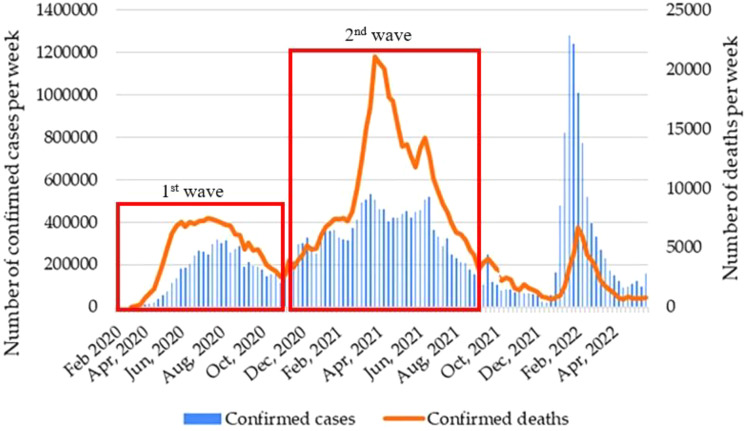
A convenience sample of 1,211 workers from different economic sectors participated in the study, 897 of whom (74.1%) worked from home and 314 (25.9%) remained in on-site work. Psychosocial work aspects were assessed using the Copenhagen Psychosocial Questionnaire (COPSOQ). Work ability was assessed using the Work Ability Index (WAI) and the Work Ability Score (WAS). Mental health conditions and SARS-CoV-2 infection rate were recorded based on self-reported medical diagnoses. Online questionnaires were answered from June 2020 to September 2021, involving two waves of the COVID-19 pandemic. The groups were compared using chi-square tests, t-tests, and two-way ANOVA.
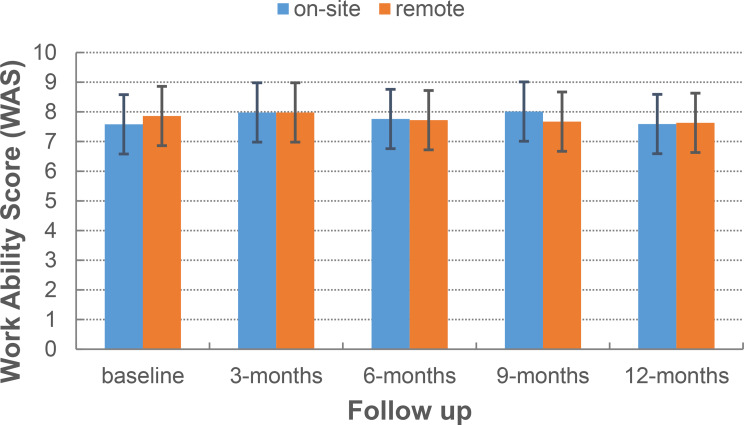
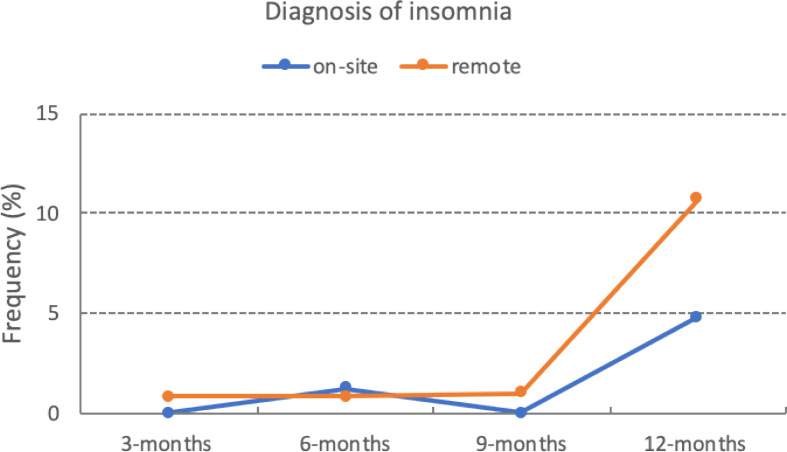
In the first wave of the pandemic, remote workers reported more quantitative demands and work-family conflicts, whereas on-site workers reported more emotional demands, low development of new skills, low commitment, low predictability, low recognition, and low satisfaction. They also reported greater occurrences of unwanted sexual attention, threats of violence, and physical violence. In the second wave, the remote group continued to report high work-family conflicts, whereas the on-site group reported - in addition to the results of the 1st wave - low influence at work, low quality of leadership, and burnout. No significant difference was found between groups with regards to the WAI in either wave. A significant difference was found for the WAS between the 3rd and 12th months (P < 0.01) in both groups. No significant differences were found between groups for the prevalence of anxiety, depression, burnout/stress, insomnia, panic syndrome, and eating disorders, except for the prevalence of insomnia at the 12-month follow-up, with higher rates in the remote group (P = 0.03). SARS-CoV-2 infection was significantly lower in the remote group (11.3%) compared to the on- site (16.9%) group (P < 0.01).
Psychosocial work aspects differed between remote and on-site workers. Work ability and mental health conditions were similar between groups. Remote work might have played a role in limiting the spread of the virus in Brazil had it been more widely available.
在 COVID-19 大流行开始时,一些工人有机会在家工作,而另一些工人则留在现场工作。本研究的目的是通过一项为期 12 个月的纵向研究,每季度进行一次随访评估,比较巴西远程和现场工作的工人的社会心理工作方面、工作能力、心理健康状况和 SARS-CoV-2 感染率。
从不同经济部门中方便抽取了 1211 名工人参加了这项研究,其中 897 名(74.1%)在家工作,314 名(25.9%)留在现场工作。使用哥本哈根心理社会问卷(COPSOQ)评估社会心理工作方面。使用工作能力指数(WAI)和工作能力得分(WAS)评估工作能力。根据自我报告的医疗诊断记录心理健康状况和 SARS-CoV-2 感染率。从 2020 年 6 月到 2021 年 9 月在线回答问卷,涉及 COVID-19 大流行的两个波次。使用卡方检验、t 检验和双向方差分析比较两组。
在大流行的第一波中,远程工作者报告了更多的定量需求和工作与家庭冲突,而现场工作者报告了更多的情绪需求、新技能发展低、承诺低、可预测性低、认可低和满意度低。他们还报告了更多的不必要的性关注、暴力威胁和身体暴力。在第二波中,远程组继续报告高工作与家庭冲突,而现场组除了第一波的结果外,还报告了工作影响力低、领导质量低和倦怠。在两个波次中,远程组和现场组的 WAI 均无显著差异。在 3 个月和 12 个月(P<0.01)时,两组的 WAS 有显著差异。两组的焦虑、抑郁、倦怠/压力、失眠、恐慌综合征和饮食失调的患病率无显著差异,但在 12 个月的随访中,远程组的失眠患病率较高(P=0.03)。SARS-CoV-2 感染在远程组(11.3%)明显低于现场组(16.9%)(P<0.01)。
远程和现场工作者的社会心理工作方面存在差异。工作能力和心理健康状况在两组之间相似。如果远程工作更为普遍,它可能在限制巴西病毒传播方面发挥了作用。