Khokhlov Ivan, Legashev Leonid, Bolodurina Irina, Shukhman Alexander, Shoshin Daniil, Kolesnik Svetlana
Research Institute of Digital Intelligent Technologies, Orenburg State University, Pobedy Pr. 13, Orenburg 460018, Russia.
Federal Research Centre of Biological Systems and Agrotechnologies of the Russian Academy of Sciences, Orenburg 460000, Russia.
Toxics. 2024 Oct 15;12(10):750. doi: 10.3390/toxics12100750.
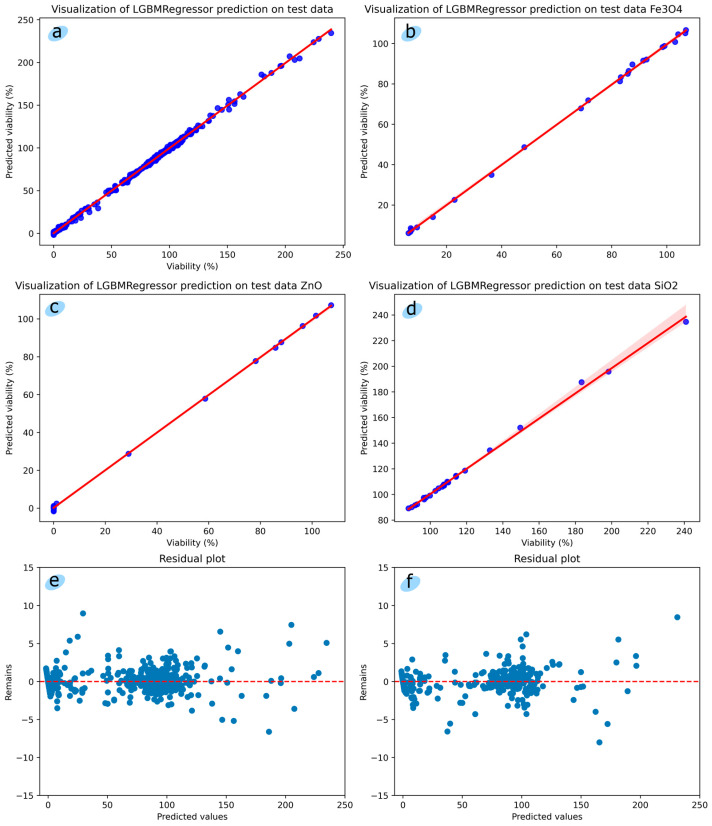
Predicting the toxicity of nanoparticles plays an important role in biomedical nanotechnologies, in particular in the creation of new drugs. Safety analysis of nanoparticles can identify potentially harmful effects on living organisms and the environment. Advanced machine learning models are used to predict the toxicity of nanoparticles in a nutrient solution. In this article, we performed a comparative analysis of the current state of research in the field of nanoparticle toxicity analysis using machine learning methods; we trained a regression model for predicting the quantitative toxicity of nanoparticles depending on their concentration in the nutrient solution at a fixed point in time with the achieved metrics values of MSE = 2.19 and RMSE = 1.48; we trained a multi-class classification model for predicting the toxicity class of nanoparticles depending on their concentration in the nutrient solution at a fixed point in time with the achieved metrics values of Accuracy = 0.9756, Recall = 0.9623, F1-Score = 0.9640, and Log Loss = 0.1855. As a result of the analysis, we concluded the good predictive ability of the trained models. The optimal dosages for the nanoparticles under study were determined as follows: ZnO = 9.5 × 10 mg/mL; FeO = 0.1 mg/mL; SiO = 1 mg/mL. The most significant features of predictive models are the diameter of the nanoparticle and the nanoparticle concentration in the nutrient solution.
预测纳米颗粒的毒性在生物医学纳米技术中起着重要作用,特别是在新药研发方面。纳米颗粒的安全性分析能够识别其对生物体和环境可能产生的有害影响。先进的机器学习模型被用于预测纳米颗粒在营养液中的毒性。在本文中,我们使用机器学习方法对纳米颗粒毒性分析领域的当前研究状况进行了比较分析;我们训练了一个回归模型,用于根据纳米颗粒在固定时间点营养液中的浓度预测其定量毒性,所取得的均方误差(MSE)值为2.19,均方根误差(RMSE)值为1.48;我们还训练了一个多类分类模型,用于根据纳米颗粒在固定时间点营养液中的浓度预测其毒性类别,所取得的准确率(Accuracy)值为0.9756,召回率(Recall)值为0.9623,F1分数(F1-Score)值为0.9640,对数损失(Log Loss)值为0.1855。分析结果表明,训练后的模型具有良好的预测能力。所研究的纳米颗粒的最佳剂量确定如下:氧化锌(ZnO)= 9.5×10毫克/毫升;氧化亚铁(FeO)= 0.1毫克/毫升;二氧化硅(SiO)= 1毫克/毫升。预测模型最显著的特征是纳米颗粒的直径和营养液中纳米颗粒的浓度。