
胸腺瘤组织病理学分类中的弱监督学习:一种可解释的方法。
Weakly supervised learning in thymoma histopathology classification: an interpretable approach.
作者信息
Wang Chunbao, Du Xianglong, Yan Xiaoyu, Teng Xiali, Wang Xiaolin, Yang Zhe, Chang Hongyun, Fan Yangyang, Ran Caihong, Lian Jie, Li Chen, Li Hansheng, Cui Lei, Jiang Yina
机构信息
Department of Pathology, The First Affiliated Hospital of Xi'an Jiaotong University, Xi'an, Shaanxi, China.
School of Computer Science and Technology, Xi'an Jiaotong University, Xi'an, Shaanxi, China.
出版信息
Front Med (Lausanne). 2024 Dec 11;11:1501875. doi: 10.3389/fmed.2024.1501875. eCollection 2024.
INTRODUCTION
Thymoma classification is challenging due to its diverse morphology. Accurate classification is crucial for diagnosis, but current methods often struggle with complex tumor subtypes. This study presents an AI-assisted diagnostic model that combines weakly supervised learning with a divide-and-conquer multi-instance learning (MIL) approach to improve classification accuracy and interpretability.
METHODS
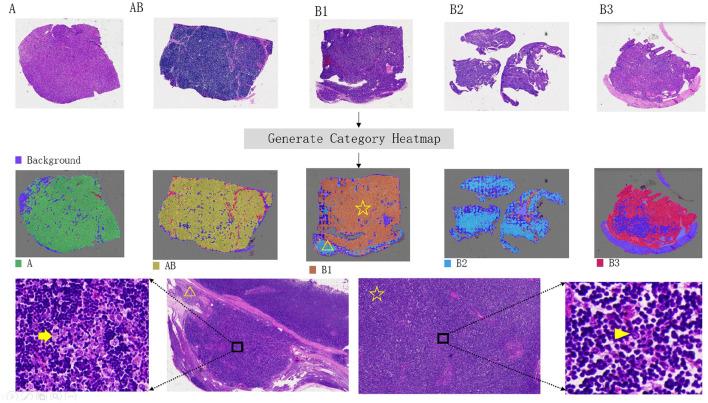
We applied the model to 222 thymoma slides, simplifying the five-class classification into binary and ternary steps. The model features an attention-based mechanism that generates heatmaps, enabling visual interpretation of decisions. These heatmaps align with clinically validated morphological differences between thymoma subtypes. Additionally, we embedded domain-specific pathological knowledge into the interpretability framework.
RESULTS
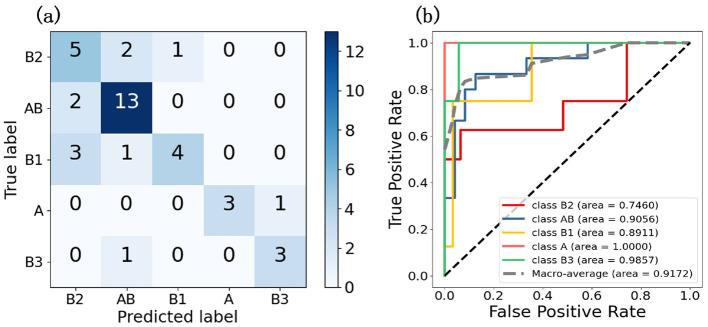
The model achieved a classification AUC of 0.9172. The generated heatmaps accurately reflected the morphological distinctions among thymoma subtypes, as confirmed by pathologists. The model's transparency allows pathologists to visually verify AI decisions, enhancing diagnostic reliability.
DISCUSSION
This model offers a significant advancement in thymoma classification, combining high accuracy with interpretability. By integrating weakly supervised learning, MIL, and attention mechanisms, it provides an interpretable AI framework that is applicable in clinical settings. The model reduces the diagnostic burden on pathologists and has the potential to improve patient outcomes by making AI tools more transparent and clinically relevant.
引言
胸腺瘤的分类具有挑战性,因为其形态多样。准确分类对诊断至关重要,但目前的方法在处理复杂肿瘤亚型时往往存在困难。本研究提出了一种人工智能辅助诊断模型,该模型将弱监督学习与分治多实例学习(MIL)方法相结合,以提高分类准确性和可解释性。
方法
我们将该模型应用于222张胸腺瘤切片,将五类分类简化为二元和三元步骤。该模型具有基于注意力的机制,可生成热图,从而能够对决策进行可视化解释。这些热图与胸腺瘤亚型之间经过临床验证的形态学差异一致。此外,我们将特定领域的病理知识嵌入到可解释性框架中。
结果
该模型的分类AUC达到0.9172。病理学家证实,生成的热图准确反映了胸腺瘤亚型之间的形态学差异。该模型的透明度使病理学家能够直观地验证人工智能的决策,提高了诊断可靠性。
讨论
该模型在胸腺瘤分类方面取得了重大进展,将高准确性与可解释性相结合。通过整合弱监督学习、MIL和注意力机制,它提供了一个适用于临床环境的可解释人工智能框架。该模型减轻了病理学家的诊断负担,并且通过使人工智能工具更透明且与临床相关,有可能改善患者的治疗结果。


 Zotero 插件